
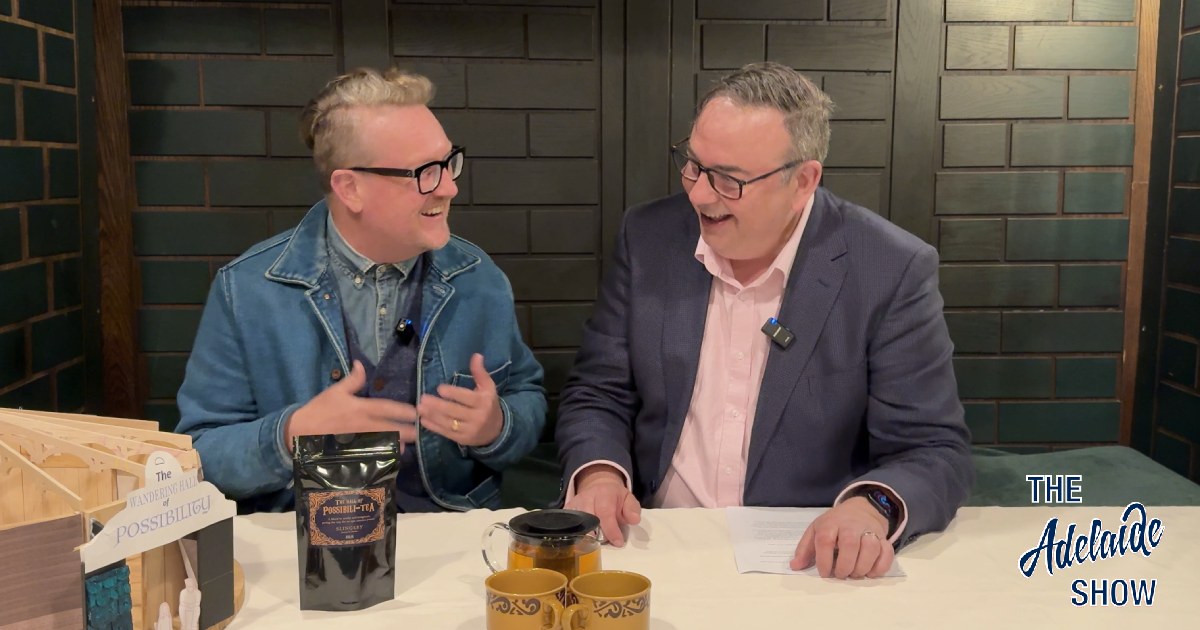
Andy Packer, artistic director and CEO of Slingsby Theatre, joins us for an expansive conversation about the company’s 20-year journey creating original, beautiful theatre that never softens darkness for young audiences, the ambitious three-show triptych closing their chapter at the 2026 Adelaide Festival, and the philosophy behind work that treats audiences with radical respect.
When a South Australian theatre company that began with The Tragical Life of Cheese Boy – performed more than 800 times worldwide – prepares to take its final bow, it doesn’t fade quietly. Instead, Slingsby is staging its most expensive and ambitious production yet: A Concise Compendium of Wonder, a triptych of three interconnected shows housed in a custom-built structure in the Botanic Gardens during the Adelaide Festival.In this episode, we settle into Slingsby’s Hall of Possibility in Parkside with artistic director and CEO Andy Packer for a wide-ranging conversation that explores the company’s distinctive aesthetic, their commitment to treating young audiences with intellectual honesty, and why nostalgia creates the perfect emotional space for processing difficult truths.
In the South Australian Drink Of The Week, we taste the company’s signature Hall of Possibility Tea – a bespoke blend featuring licorice root, organic lavender, red rose petals, spearmint and peppermint that Andy describes as both “invigorating and calming.
“The musical pilgrimage features the Slingsby Ensemble performing “Song for the Adolescent Seal” from their 2018 Adelaide Cabaret Festival show Songs for Those Who’ve Come Across the Seas – a piece Andy realised he’d forgotten to mention during our conversation, despite being extremely proud of it.
You can navigate episodes using chapter markers in your podcast app. Not a fan of one segment? You can click next to jump to the next chapter in the show. We’re here to serve!
The Adelaide Show Podcast: Awarded Silver for Best Interview Podcast in Australia at the 2021 Australian Podcast Awards and named as Finalist for Best News and Current Affairs Podcast in the 2018 Australian Podcast Awards.
And please consider becoming part of our podcast by joining our Inner Circle. It’s an email list. Join it and you might get an email on a Sunday or Monday seeking question ideas, guest ideas and requests for other bits of feedback about YOUR podcast, The Adelaide Show. Email us directly and we’ll add you to the list: podcast@theadelaideshow.com.au
If you enjoy the show, please leave us a 5-star review in iTunes or other podcast sites, or buy some great merch from our Red Bubble store – The Adelaide Show Shop. We’d greatly appreciate it.
And please talk about us and share our episodes on social media, it really helps build our community. Oh, and here’s our index of all episode in one concise
page.
Running Sheet: A Slingsby Life Of Wonder With Andy Packer
00:00:00 Intro
Introduction
00:03:12 SA Drink Of The Week
The SA Drink Of The Week this week is Brewed by Belinda Hall of Possibilitea.
Belinda Hill of Brewed by Belinda created this bespoke blend specifically for Slingsby, capturing both the company’s aesthetic and the practical needs of artists in creative process. The brief: create something both invigorating and calming.
The blend looks almost theatrical. Organic lavender, red rose petals, organic blue cornflower petals creating visual layers in the pot. Licorice root provides the grounding bass note, with spearmint and peppermint lifting everything. There’s aniseed hiding in there too.
Andy explains the tea’s role in Slingsby’s creative practice. During those inevitable moments developing new work when “you get very lost,” the tea provides structured pause. “People go off and do different things and I’ll have a cup of tea and I might go outside for a little while. Usually you find the solution.”
What’s crucial is that Hall of Possibility Tea won’t get bitter or overly steeped. “There’s no black tea leaf or anything like that. It just gets better.” Andy keeps a flask throughout rehearsal days, taking sips during fifteen-minute breaks.
As we taste, the experience unfolds in layers. Initially, the mint notes dominate. Then the aniseed emerges from backstage, as Andy puts it, “ready for you, it knew you were coming, it was just waiting in the wings.”
By the end of our tasting, all the subtle players have made their entrance. No single flavour dominates. They’re holding hands across the palate like a well-mannered audience at a Slingsby show.
Slingsby has been gifting this tea to presenting partners around the world since 2019. After performances overseas, small tins of Hall of Possibility Tea remain behind, tangible tokens of the connections Slingsby creates between communities.
00:13:08 Andy Packer
Andy Packer describes A Concise Compendium of Wonder as “the perfect bookend” to Slingsby Theatre Company’s twenty-year journey. We’re sitting in the Hall of Possibility in Parkside, where families have gathered to experience work that never softened darkness for young audiences, never offered easy answers. In a few weeks, after the final curtain falls on this ambitious triptych at the Adelaide Festival, Slingsby will cease creating new work. The company that began with The Tragical Life of Cheeseboy, performed more than 800 times worldwide, closes with its most expensive, most ambitious production yet.
In this interview, you’ll discover:
The origins trace back to amateur theatre at La Mama in the late eighties, where Packer learnt that being involved in every aspect wasn’t just practical necessity but essential training. “You are crafting an experience for an audience, not just there for your ego to be on stage, but actually to prepare the space to welcome people into the church that theater can be.”
The crystallising moment arrived in Montreal in 2005, watching Danish company Group 38 perform The Little Match Girl. Packer sat in the audience afterwards and wept for fifteen minutes, unable to move. That company’s aesthetic showed him precisely what he wanted to create. Slingsby’s first expenditure as a company was flying their entire creative team to Hobart to see Group 38 perform again, establishing that benchmark from day one.
The distinctive Slingsby voice, that curious blend of the new and familiar, serves a specific purpose. “When you create a nostalgic space, it’s like you’ve gone on a holiday back in time,” Packer explains. “You let your guard down and that allows you to attend to the deep concern, the deep anxiety that sits deeper.”
Slingsby productions have never shied from exploring loss, loneliness, domestic violence and grief. “We can’t protect our audience, we can’t protect children. We have to prepare them.” But preparation doesn’t mean pessimism. Every show ends with hope.
The conversation hopscotches through key productions:
- The Tragical Life of Cheese Boy (800+ performances)
- Man Covets Bird (where a boy’s parents no longer recognise him)
- Ode to Nonsense (a full opera celebrating Edward Lear)
- The Young King (Oscar Wilde’s fable about capitalism performed without softening)
- Emil and the Detectives (capturing post-war reconstruction with audiences building cardboard cities)
- The Boy Who Talked to Dogs (an Irish-Australian collaboration about surviving domestic violence)
The final chapter confronts climate reality. Measuring carbon use revealed that flying sets internationally consumed vastly more carbon than shipping by sea or road transport. “We can’t be flying sets around anymore. We wanna make the world a better place, but we wanna do it now in a way that reduces our impact on the climate.”
The solution: A Concise Compendium of Wonder. Three shows, Hansel and Gretel, The Selfish Giant, and The Little Match Girl, performed by one cast on one regeneratively designed wooden building that can be disassembled and reused. The Wandering Hall of Possibility features 17 speakers, 5,500 pixels built into walls, seating that reconfigures for each show, all touring by road only.
The three fairytales trace a journey from medieval times to 3099 on a lunar colony. At the centre of each story sits a tree or forest, moving from living as part of the forest, to fighting for access to a single Moreton Bay fig, to finding the last tree on the moon whilst Earth re-greens in humanity’s absence.
For Adelaide audiences, the Wandering Hall sits on Plane Tree Lawn in the Botanic Gardens. This is both thank you season and goodbye. Audiences can experience one show or commit to the full “sling cycle” across one day.
“I think it is the most important thing happening in the universe right now,” Packer says about the intent behind every Slingsby show. “We want this for the people that have bothered to come and be with us.”
02:07:07 Musical Pilgrimage
In the Musical Pilgrimage, we feature a piece from the Slingsby show that Andy Packer forgot to mention during our conversation, an oversight that left him “racked with angst.”
Songs for Those Who’ve Come Across the Seas premiered at the Adelaide Cabaret Festival in 2018 and was subsequently invited for a three-week season at the New Victory Theater in New York and a festival in Atlanta. COVID prevented those tours. “Sometimes even the big fish get away,” Andy philosophically notes.
The Slingsby Ensemble perform Song for the Adolescent Seal with the distinctive musicality that characterises Quincy Grant’s compositions, spare and emotionally direct. The piece explores the necessary letting go that allows children to grow into their full selves.
There’s additional resonance hearing this now, as Slingsby itself prepares to let go. The song’s metaphor of adolescent seals venturing beyond safe shores speaks to trusting that what you’ve nurtured will survive and flourish independently.
Here’s this week’s preview video
This is the SA Drink Of The Week segment from this week’s episode.
SFX: Throughout the podcast we use free SFX from freesfx.co.uk for the harp, the visa stamp, the silent movie music, the stylus, the radio signal SFX, the wine pouring and cork pulling SFX, and the swooshes around Siri.
An AI generated transcript – there will be errors. Check quotes against the actual audio (if you would like to volunteer as an editor, let Steve know)
425-The Adelaide Show
Steve Davis: [00:00:00] Hello, I’m Steve Davis and welcome to episode 425 of the Adelaide Show Podcast. Also, welcome to 2026. Well, in this year’s Adelaide Festival, a store war company of the South Australian theater scene, Slingsby is staging a curtain call to end all curtain calls. As it bows out of its 20 odd years of producing wondrous theater, it has a triptych of three timely tales all being performed in the company’s custom made wandering hall of possibility.
But of course, when I say South Australian theater scene, I really mean global theater scene because this company co-founded by Andy Packer and Jodie Glass has impressed beyond its weight since day one. Now, do we have rules for how long episodes can run on that late show? Well, no, we don’t, and even if we did, I’d break them for this [00:01:00] because I’m about to sit down with artistic director and CEO Andy Packer and wander through slings bee’s history, starting with the spilling of tea and ending with a song from the sea.
Alright, I’ll also put the links to the Adelaide Festival shows in the show notes, so you’ve got them there. Hopefully you are listening to this in time right now. Let’s get into the spirit. Ready for this chat. We’ll dim the lights. Let a silence fall. Let’s just hold that silence a little longer. We dimly see the silhouette of an actor as quietly taking their position in the dark.
The music starts softly. Audience members lean forward. Lights. Action[00:02:00]
Speaker 3: lady
Theme: in the spirit of Reconciliation. The Adelaide Show Podcast acknowledges the traditional custodians of country throughout South Australia and their connections to land, sea, and community. We pay our respect to their elders past and present and extend that respect to all Aboriginal and Torres Strait Islander peoples today.
A lady, a[00:03:00]
lady
Speaker 3: lady.
Steve Davis: The South Australian drink of the week. This week is a tea and not just any old tea. Andy Packer, um, artistic director and CEO of Slingsby Theater. It’s the hall of possibility.
Andy Packer: It is, yeah. It’s a terrible pun, but that’s okay. Yes. Uh, made to drink in the Hall of Possibility, which is, which is where we’re recording.
That’s right.
Steve Davis: Which is in Parkside. Yeah. It’s where so much of the magic has happened or been dreamt of. Yeah. For Slingsby. Yeah. And we we’re having a whole conversation about that, but who blended this for you?
Andy Packer: So Brewed by Belinda, uh, which, oh, yeah, yeah. She’s in Belinda Hill. Yes, that’s right.
She makes, uh, a whole series of teas, like stage
[00:04:00] fright and blackout and those things as well.
Break the leg opening night, I think. Yeah.
Uh, so anyway, she, it was a beautiful process, uh, to have this created for us. So it was, yeah. And so it’s, it’s the sort of tea that we like to drink while we’re making work or rehearsing. So it’s both invigorating and calming
Steve Davis: that now this, you’ve just, um, uh, foreshadowed a question that we are leading to later in the conversation. Great. ’cause you love that, don’t you? Yeah. You love having things sit together that are polar opposites. That’s, that’s interesting. I think. Hmm. Oh yeah. Don’t worry. Well, that’s, we’re coming back to that for, so you’ve gotta keep listening.
Um, but is there a. Do different personalities have different types of tea leaf into this? Or did Belinda just sit back and get what you wanted to achieve?
Andy Packer: Yeah, we
talked about the, uh, the [00:05:00] company and the aesthetic of the company and the experience we want or our audience to have when they see our work, but also how we, uh, how we work, how we’re collaborative.
And, uh, and there were some, uh, it’s
very pretty as well Yeah. Is the thing. And there’s like licorice in there, which is something I really like. Mm-hmm. Um, I was getting some, an seed notes. Yeah, so
there’s, so there’s licorice root, uh, organic lavender, uh, organic, uh, red rose petals. Mm-hmm. Organic blue corn, flower petals.
Uh, there’s spearmint, uh, peppermint.
Steve Davis: Yeah. So they would be stimulating the lavenders sort of. Uh, the other way licorice is, well, licorice is you just forget everything else that’s going on, don’t you?
Andy Packer: Yeah. And it, uh, it’s very, uh, I find it quite energizing actually. Okay. Yeah. Yep. And, um, yeah, I mean it’s, we’ve, we’ve had this since, [00:06:00] uh, maybe 2019.
Um, and it’s a gift that we take. It’s also perfect to take around the world. Yes. So this is something that we have, uh, taken and left as gifts for presenting partners around the world.
Steve Davis: Have you, I’m
Andy Packer: gonna
Steve Davis: hold it up, um, so the camera can see it, but. Customs. Uh, some countries are a bit iffy about dried green leaf coming into their, I think only
Andy Packer: New Zealand.
Okay.
Steve Davis: But
Andy Packer: really as Australians, you can pretty well get your stuff anywhere. Okay. You know, most of the realtors is more relaxed than Australia. New Zealand is even more vigilant. Right. So if we was
Steve Davis: gathering today to think about an upcoming production Yeah. You would, you have done this and, and had the tea drawing before we settled.
So it’s here.
Andy Packer: Yes. You don’t wanna burn your lips, so, but you do want it to sort of, uh, it is what it is. A tea
that really can’t get too, uh, [00:07:00] steeped. Like, it, it, it just gets nicer and nicer. Oh. So, because there’s no, I think there’s no, you know, it’s all, um, there’s no black tea leaf or anything like that. So it won’t get too tny or bitter?
No, it’s just gets, it just gets better. So sometimes I have a, a, a flask mm-hmm. A tea flask and, uh, that can stay in there all day and I’ll just, you know, we have a little 15 minute breaks and I’ll go and have a top up.
Steve Davis: Alright. Now, I was anticipating us doing this and thinking of this tea, but having, uh, a role, uh, in your company ca can you recall moments where this has been the catalyst or the, the, um, the complimentary partner in brainstorming, but also.
To gather, to let off some steam when something was very heady and people needed to deflate a bit.
Andy Packer: Yeah, I mean, I think when you’re making new work, when you’re making theater right from scratch, which
is what we’ve always
done, uh, there are times [00:08:00] when you get very
lost. There are times when you go and as director, I go, I, I dunno to help this.
I dunno how to help this right now. So sometimes I just take, we take a break, uh, and um, people go off and do different things and I’ll have a cup of tea and I might go outside for a little while, just take a, take a breath. I just little brain break really. And, uh, usually you find the solution. I have another, a Scottish friend who’s a theater director.
His trick is to just start moving tr the chairs around the room. He’ll just start
moving chairs around the room. Yes. And people think he’s doing something, but he’s just giving himself space literally until an idea, until an idea comes of a solution or something to try. ’cause I I,
for me as a director, um, once I have something in front of me, I can edit it.
Steve Davis: Yeah.
Andy Packer: Um, so just, just intuitively. But it’s, if you’ve gone down a path that’s wrong, [00:09:00] uh, you need some catalyst to head in a different path. Some say you need to just take a break. Have a cup of tea.
Steve Davis: Alright. So are, are we ready to pour this now? Or it’s ready? Okay. Please pour away because. One of the rituals, ’cause you’ve been on the Adelaide show before.
You may or may remember, we toast our late patron Queen Adelaide at the beginning of every beautiful episode. So we do that with Hall of Possibility Tea. And Belinda, I’m a sucker for a great pun. Love that. Uh, and I just, I love it. Cheers. Oh, uh, to the queen. To the queen. Here we go. Now this, I’m looking forward to this.
So you just breathe it in. Okay. Yes. It’s just, just That was subtext for shut up sticks. No, no. Be present in a gentle way. Don’t rush into drinking it just, okay. Oh, okay. I’m the, all the minty notes, the mints have floated to the top. You know, when you look at a lake in the morning and there’s that thick layer of fog mm-hmm.
There’s all [00:10:00] the mint notes are hanging there at the moment. For me it’s a minty miasma. It is, it is. That could be another
Andy Packer: and, okay. Hmm. It’s subtle, but the
Steve Davis: longer it sits there, yes. What happened was it wandered in quite, uh, modestly, but then a bit like your productions, you’ve sat there and you haven’t noticed something, and then you just notice it.
The Anna seed notes came from backstage Forward.
Andy Packer: Yeah. Though it was ready for you. Yeah. It knew you were, it knew you were coming, that it was
Steve Davis: just waiting in the wings. The other things. The lavender I haven’t picked up yet. I imagine everything plays a part at some point. And I feel like this is quite a small
Andy Packer: little pot I’ve put in
here.
Mm-hmm. Uh, I think maybe I could have used a bit more, but also, as I say, the longer it sits there, so, we’ll, we’ll come back to this later on maybe. Yeah. Yeah, we will. And um, and it [00:11:00] will be, the flavors will have opened up more.
Steve Davis: Yes. ’cause at the moment, see, I’m a coffee drinker typically, but I always open up when there’s a tea person who wants to share a tea.
I could drink this, I could
Andy Packer: drink this all day long. Yes, yes. But this is hydrating you as well. Of course. So that’s also good.
But now I find it, I feel, I find it just really opens me up. And that, and that’s when you’re making theater, uh, you have to feel brave and safe and open. Mm. Um, so this is a, a nice reminder.
Steve Davis: Some guests, I think of the espresso cups I have, they’re like guests. They’re lovely when they come, but you then want them to leave. Mm. That you don’t have to drop hints with this. I’m, I’m happy this is a guest that you’d be sad when they do leave. Nice tea. Leave
Andy Packer: tea leave and they leave.
Steve Davis: Wow.
Andy Packer: Well, leaving is always a possibility.
Steve Davis: [00:12:00] On that note, I hardly recommend this. Do you think Belinda will keep making this tea after slings beers?
Andy Packer: I don’t know. That’s an, that’s a very interesting question. We’re just about to, um, get, get Belinda to make a whole whole lot more Okay.
Steve Davis: For us. Yes. Beautiful. So all that’s left for me to say in this essay drink of the week is that really we we’re trying the possibility, but seriously I’ve heard about Brooded by Belinda Tea before.
Mm. I’m so glad I’ve had a chance to try and, uh, I think we’ll just say Tease by Brewed by Belinda Arc. The South Australian drinks. Yeah. Of the week. Brilliant. Very nice. Yeah, it’s good, isn’t it? Yeah. Alright, one more sip. In fact, maybe a nap as well. Yes.
Andy Packer: A little lie down. I do my no. On the daybed, we’re in the Young King’s chamber, so if Oscar Wilde would be so proud, he’d be very happy.
Steve Davis: Beautiful.[00:13:00]
Theme: Alex Fran here. If you’re listening to Steve Davis’s Adelaide Show podcast and you’re out shooting film, remember to take the lens cap off, particularly if you’re shooting range finder cameras. Happy shooting.
Steve Davis: Hey, Andy Packer. Describes a concise compendium of wonder as the perfect bookend to Slingsby Theater company’s 20 year journey. And we’re sitting here at the moment in the Hall of Possibility in Parkside, where families have gathered to experience work that never softened darkness for young audiences.
Never offered easy answers. Shortly after the final curtain falls on this ambitious triptych at the Adelaide Festival, Slingsby ceased creating new work. The [00:14:00] company that began with the Tragic Life of Cheese Boy performed more than 800 times worldwide, closes with its most expensive and most ambitious production yet.
Andy Packer, welcome officially now to the Adelaide Show. Thank you, Steve. It’s great to be with you. Ah, and as artistic director and CEO of Slingsby Yeah. Gonna come to those two hats. Yeah, for sure. Our big hats to wear. But first, this concise compendium, uh, of wonder, a massive triptych. Now, just in case anyone’s unsure, that’s typically a three part piece of art.
Yeah. Uh, and so you’ve got three standalone productions that are all woven together. It’s going to be housed in a custom-built structure in the Botanic Gardens. Most companies. When they’re winding down, they scrape and scratch together their remaining resources. You’ve gone the opposite direction. This is [00:15:00] ambitious.
This is an expensive production. It’s either wildly irresponsible or it’s the perfect artistic statement. Where would you peg it on that?
Andy Packer: I, I, I think it is. Uh, you know, we decided to wind up the company, uh, with plenty of time left and knowing the resources that we had and knowing the resources that, uh, we would still receive, uh, from government over the next couple of years.
And it was a project that we had planned for several years and there was a shift in, in, uh, we, we didn’t receive a, a lot of federal funding that we were hoping that we would receive. And so instead of abandoning the project, we said we should do that project. We really believe in that project, not just artistically, but also what it offers the world as a possible other model for international touring companies.
Um, [00:16:00] and for its, uh, its gentle approach to climate and to country. So we really believed in it. So we just went, well, we should do it. And if, if that’s the end of the company, what a wonderful way to go out and we really hope that it will tour. Um, you know, I, I, I feel confident that it will, but uh, this during Adelaide Festival will be our final thank you season to Adelaide Audiences and, and people because of, its the nature of a triptych.
People can, if they’re not sure, come and see one show and when they love that they can book to see another show and then another one. Or if they’re, if they love our work, they can come on an epic journey with us across one day and see all three shows over a sort of [00:17:00] six and a half hour period. And, uh, have that incredible festival, durational theater experience.
But as a family. Wow. Is this your inner VA now wanting to do the ring cycle? Yes. We call it a sling cycle. Oh, I love that. It is indeed. You know, I think like when I first saw, when I saw the Adelaide ring cycle, um, yeah, I, I just really loved that. See something go away, see something that builds on the thing you saw previously.
So I, and the idea of having meal breaks and, you know, I, I don’t see why families, um, shouldn’t have, have that experience. It is, it is a very different kind of arts viewing experience to, um, let it take over a whole day. We’ve
Steve Davis: got a lot more to unpack from that production, which we’re coming back [00:18:00] to.
Andy Packer: Yeah.
Steve Davis: I wanna just reverse Yeah. And go back to when I first met you at La Mama Theater many, many years ago. This is the late eighties, early nineties, that sort of era. It’s amateur theater. Everyone does everything. Acting, directing. I mean, you, you were directing, I wasn’t directing, building sets, getting tickets, cleaning, doing the whole bit, running the bar.
Oh, yes. I forgot about that. Yes. Doing dishes. I remember doing dishes in the background. Um, what were you learning in that experience that became essential to building Slingsby?
Andy Packer: Uh, I th I, I think that, um. Having an opportunity to be involved in every aspect, uh, was actually really, really important, I think.
Um, and, and because you know, what you are doing in amateur theater and that, uh, being involved in, in everything is your, uh, you are crafting an experience for an [00:19:00] audience and not just, uh, there for your ego to be on stage, but actually to prepare the space to, uh, welcome people into the church that theater can be.
Um, so I think that, you know, I was also very fortunate that I, I had, uh, a period of time where I was a production manager for co opera touring opera company where I was operating lights as well. And so, so, so, so, um, so I think that totality of the experience is what I still really love. It’s what I love about Slingsby.
Obviously we have professionals that are invol, you know, leading all of the aspects of the company, but I, I get to be a little bit involved in everything, which I really love. Um, and I, and I think the other thing I learned through La Mama was we were doing some fairly avant-garde stuff, you know, [00:20:00] and, and.
Uh, and just finding that there is an audience out there for everything, you know, and, and even the more sort of on the edge, you know, like Absurdist Egyptian theater by Chu Ka Hakim f of a cockroach. Yeah. The tree climber. The tree, yes. Yeah. I was, I remember as a, as an actor, I was tethered to, to a post in the middle of the stage by an umbilical cord of bungee for the entire show.
And the, but the, the, the, the more distinct the work was, the more the audiences that came deeply loved it.
Steve Davis: I, that’s a really good point about, there’s no way a commercial theater producer would say, you’re not doing would, you would do that because who’s gonna come? But we always found an audience. There was another aspect, there was the trust of the, the relationships, actors and [00:21:00] everyone involved had with their friends, family extended that drew them in.
That’s something that I don’t think is often acknowledged within theater, that those familial connections. Yeah,
Andy Packer: no, I think that’s, that’s, that’s, you know, super important for theater companies. And I think more and more so for professional theater companies as well. It’s the community that you build around a company, which are the people that.
That are working for the company, um, are making the work, but also yes, their extended families and what their extended families feel about the, the quality or the value of the work. ’cause that affects how they all feel about it as well. And, and the energy that those people have to come to work and, and, and make the work.
Uh, but also our audience who are also increasingly our donors and supporters. Um, ’cause ’cause the, the, [00:22:00] you know, the theater game is, there’s a financial aspect to it, but there’s also, um, uh, uh, uh, a kind of a feeling of the energy of the audience behind you. Um, uh, a spirit of trust and encouragement from the audience that makes you more bold and encourages you to take greater risks and to trust yourself.
Um, and so that is, that is very important as well. So this really is a community and that, that goes to the, to the educators, the teachers as well, who we have a very large, um, audience of, of teachers, you know, who are fantastic and who often are buying, you know, 90 tickets at a time. So, so, so it’s just as important from, um, from a faith in the work.
And, um, trust in the work as it is from a financial
Steve Davis: perspective. There’s something counterintuitive about what you just said about some of your [00:23:00] audience then become donors and that emboldens you to try new things. Because I, my first reaction was no, he who pays the piper calls the tune. It could go the other way, but, but it’s the people you’re attracting, isn’t it, in the first place?
Andy Packer: Yeah. That they, uh, I mean we’ve, we’ve found since really we had donors, you know, quite early on in the company, but very small amounts of money and we were not really, um, we weren’t asking people for money ’cause we were supported, you know, for a young company quite well, both federally and at a state level.
So we didn’t feel, we felt a bit weird to ask for Yes. People to donate money. Yeah. Uh, but from 2016 onwards, which is when we lost our federal multi-year funding, uh, we learnt, we learnt that it was okay to ask. And, uh, and we found some audience members who stepped forward, who were more generous than we ever could [00:24:00] have imagined.
Wow. And, uh, there were, there were some individuals that we knew and some individuals that would just new as audience members. Um, and, and it was a sense of, well, I didn’t even know whether you liked the work. You know, and, and then you, you realize, oh, well. They just want us to continue to exist because they love what we do and they love the approach that we have.
And of course, every show is different and people will always have their favorite show, but we continue to take risks and we continue to be true to ourselves. Uh, and so those donors continue to want to support us. Wow. Did you lose any? Uh, we, we have had donors. I wouldn’t say we’ve lost donors, but we have donors who move on to support other things.
Okay. Yeah. Uh, and, and ’cause there’s been various times in the company [00:25:00] where we’ve really needed financial investment. Um, and some people, you know, came and were really there for us at that point in time. And now there are other organizations that are really in strife. Uh, or, or those donors, their children are at a different stage or, yeah, so, so it, we, we haven’t, we haven’t lost any of those donors, um, as part members of our community.
Um, but we have a, we have also found, I was gonna say attracted, but that sounds like it’s an active kind of thing that we’re trying to attract in a false way. I, I mean, we’ve, we’ve found new donors who have fallen in love with the work and. When we’ve asked, have stepped in and, and I mean, you know, quite significant amounts of money and, um, and that just always kind of blows me away.
Um, but I don’t, I, we have a good relationship with those [00:26:00] individuals and they have different access to what we do because of that relationship. So they see works in, in quite early stage developments. They, they know where we’re heading and what we’re doing and, um, and yeah, it, it, it is a very warm sense of encouragement from them to keep doing what
Steve Davis: we are doing.
Yeah. Well, they’re part of something bigger than themselves too. Correct. And what a, how, what a great feeling that would be to, to watch what you’ve been able to nurture through your resources Yes. For other people and other things to bloom, which then has its knock on effect with audiences and who knows which children have come to see the shows that are now branching and a little bit emboldened.
Andy Packer: Yeah, that’s right. And, and you, and the other part of it is that those donors like to be part of a community collectively supporting something. So it’s not them individually, but they really are like our [00:27:00] commissioning circle that that group of seven donors, they, uh, there’s strength in that. That, that group, um, yeah.
And, and, and it is, it’s children seeing the work, but they as adults are deeply moved by the work as well. So
Steve Davis: that’s, um, that’s why they support it. Before I move on to my next question, at the beginning of this episode, we tasted your hall of possibility, and I just have to do a footnote. Mm. Because we got the little bit of the, the mint to start with.
The, an seed came from behind the licorice, and now those other flavors have come together and it’s like a little bed of very gentle ants are across my tongue. Nice. Doing fairy claps. Very nice. Yes. That’s the, they’re all there. Blue corn flower and the Yes. Red rose, petal lave, all that sort of stuff. Yeah.
Nothing dominant. They’re very polite. They’re doing little, yeah. They’re holding hands and Yeah. Like a, like a [00:28:00] nice audience. Mm. At one of your productions slings be, can you remember, was there a moment when the idea crystallized or was it more organic?
Andy Packer: Yeah, it, it was an organic thing. I mean, it sort of was a 10 year.
Evolving idea. Um, I was very fortunate in that I studied under the, the leadership of Frank Ford at Adelaide University. And so that course was amazing and a lot of, you know, real, um, the performing arts leaders in South Australia were in that course, you know, across a 10 year period. But I was very fortunate to be, you know, in a cohort of amazing artists.
Um, so anyway, I, I came out of that and I, as I was saying, I was, I worked for Cooper and I was touring, um, you know, fairly large sets into regional communities, but I was also part of a, a children’s theater company called [00:29:00] Ricochet, where we would myself, um, Emily Branford and Gary George, we would go and perform in schools under the basketball backboard with, we would just, you know, load stuff out of Gary’s station wagon.
So, so these two things were happening at the same time. And I started to have a dream of having a company that performed to children and families that had bigger sets, you know, lights. The full theater experience that could get to regional audiences. So that’s, that sort of was, was where the, the, the thinking was.
And then I was fortunate that I, I got again, some support from Frank Ford. I got to go to Montreal to the AEs Festival in 2005, I wanna say. Um, and I saw a Danish company called Group 38, and just seeing that company’s work crystallized, that’s the sort of work I, I want to do. [00:30:00] And I, I sat in the audience at the end of that show, and I wept for about 15 minutes.
I couldn’t move, you know? Amazing. And then, and then I finally got out of the theater and I stood on a bridge and wept for another 15 minutes was, you know, that’s the, that’s what art can do for you. So, so anyway, then, then, then I came home and, and bought a ticket to Denmark and saw more Danish work and saw more group 38 work.
But that, that really crystallized for me, not that I wanted to copy that company’s work, but that there was an aesthetic, there was an intent, there was a seriousness, uh, and a generosity that I, I really wanted to, uh, carve out for ourselves, um, to, to do that. And ama and amazingly, like, so this took a while to, to kinda get the resources, but then.
Uh, the, and sorry, were they
Steve Davis: youth theater focused?
Andy Packer: Yeah, they, they, they performed for children and adults. Um, and they, they will perform in [00:31:00] a high school gym in Denmark with the audience sitting on tables, stacked up with chairs on table. And it’s terrifying, you know, because Danish high Danish gyms have, have a black, a blackout, you know, we don’t have that in Australia ’cause we’ve got skylights, but, um, and they’ll also perform in the barkin and they’ll perform.
I, I was fortunate enough to be the artistic director of the 2011 Come Out festival and I brought them out to Adelaide with one of their shows. But, and, and also the very first thing that we did as a, as a company, Slingsby. So we had commissioned, uh, Finnegan to write the Tragical Life of Cheese Boy. And he was living in Tasmania at the time and Group 38.
We were in the 10 days on the Island Festival. So we flew our creative team. This was the first thing we did as a company. The first bit of money we did, we got, we we flew. So Sophie Hyde and Steven Shehan and, um, Jeff Coum and Quincy Grant, [00:32:00] uh, Nick O’Connor I think as well. We all flew down to Hobart, picked up Finnegan, and drove to Launceston and saw.
Group 38, saw the Little Match Girl, which was the show that I had seen in Montreal. And um, uh, and then met with the company afterwards, had went to the pub and had a, had had a, a meal with them. And so that was it. That was the first thing to go to our, our team of artists. That’s the benchmark. That’s, that’s what we’re aiming for.
And, and in hindsight, I, I thought it was a good idea at the time, but I think it’s probably the best, best thing you can do is bring together a team of people. ’cause then we had a shared vision, like a shared, yeah. Understanding of what we
Steve Davis: wanted to offer the world. Well, Stephen Covey and the seven habits of hard affected people said, you begin with the end in mind.
Yeah. So you had pegged a standard. It’s interesting ’cause I was gonna [00:33:00] ask, um, what put the icing on the cake of the, of the motivation? Because sometimes it’s seeing lack, so lack in a sector or a genre, and you go, I need to feel that. But the alternative, which I think is closer to yours, is you saw possibility.
You, you saw, wow, we, we’ve been pitching the ceiling here, there is no ceiling. Yes, that’s right. And then I love also the fact that in that high school gym, you were already thinking, how can we make this more wow and immersive for kids, but so we can also take it to the regions. I think you’ve just destroyed the next 30 minutes of my questions, because that is core DNA of Slingsby.
Andy Packer: Yeah, yeah, it, that’s right. Uh, stories of loss and hope and aesthetic worlds like cohesive Worlds. So the first show, the Tragic Life of Cheese [00:34:00] Boy was designed to, uh, travel in an inflatable tent so that we could go to regional audiences, and that tent arrived and it was an error, but it was not made with, um, fire retardant material.
Oh. Despite endless confirmations that that’s what the material was, that it was being made out of. So, so anyway, that, that, that happened. And then I think two days later, our, uh, youngest son Clem was born. And so we had to, uh, we had to cancel our first regional, our first tour because of that, um, ’cause of that building.
So, but anyway, that, that was the goal was to create a blackout and an enclosed space, which was a world unto itself, um, that we could invite audiences into. And so that’s, [00:35:00] that’s, that’s really where the company started. And then, and then in the end, cheese Boy had a very simple drape. That was like walking into a traveling magic Latin show, uh, tent of from the 1890s.
But it was, and so audiences would enter into that tent and which really we’re now just going full circle. Oh you are. And
Steve Davis: we are coming back to that.
Andy Packer: Yeah.
Steve Davis: Alright. I know that I’m saying that a lot. That’s okay. I trust you because I do need to go a bit deeper into the Slingsby DNA now. Yeah. ’cause I’ll tell you this, I could be bound and gagged and dropped in a theater and when they take the blindfold off me and I can hear, I would know if I was seeing a Slingsby show and I realized that that might come across as a compliment as well as an insult as well.
I’d say I’m very conscious of that. Yeah. Um, I want to know this impression that you’ve made on me and other audience members. It’s not just staging and [00:36:00] direction. Uh, I think it’s also the stories that are chosen, the methodology of delivering those stories, which could include activities, audiences do before and after.
Yeah. The spaces you’ve chosen, all the ACC more that go on with that. So before I take you through some of the specifics of Slings Bee’s mission and manifestos off the cuff, is there one dominant constant that connects all the pieces in your body of work?
Andy Packer: I think obviously the artists, the team of artists, um, so, you know, Quincy Grant’s music is, you know, the, the work wouldn’t be what it is without that music, Quincy’s music. I think Wendy Todd’s aesthetic as well, um, that sort of, she just completely [00:37:00] understood the, the world worn kind of nostalgic feeling that I I, that I was interested in.
Um, and then Jeff, uh, COUM and then into Chris Petre. So, so light being a character in the work as, as well, and that there off at times. Yeah. Or which is all part of it. That’s right, that’s right. Yeah. Um, it’s, it’s like, uh, we talk about composed silence, you know, so, so at top mostly you’ll never have silence in a, in a slingsby show, there’ll be music there, but sometimes we’ll choose to have composed silence and in the same way that we’ll choose to have, you know, lit darkness in a way.
So it’s very glen gold. So those, they’re the thing, they’re the things, but I, I think, or I hope that the, that the, that the most, the other element is. The [00:38:00] preparedness of the company and the performers that we are there ready for the audience. Mm-hmm. We are, we are ready to greet you and receive you, and we are there for you.
You are not there for us,
Steve Davis: which is service and hospitality and generosity, isn’t it?
Andy Packer: Yeah. And it’s, and it’s, um, it’s that people, one of the things that people really need is to be seen people, people want to be seen and acknowledged that they exist. I know this sounds very simple, but it’s, it’s really powerful. So that’s why, you know, most of our work, um, has been for quite a small audience of 120 to 140.
Um, it’s the right number of people that you can all see each other. [00:39:00] And the, quite often the audience are, um, performers themselves in some way. They or they are part of the community. They are part of the story. They, you know, the, the story invites them right into the world rather than looking through a, you know, presen arch picture frame, sitting outside the world looking at it.
Mm-hmm. Um, in our work. Uh, the proscenium is behind you as an audience member.
Steve Davis: You are right in the world. And as recently as late last year, seeing one of your shows, I can attest you’re sitting there in the round and there is this anticipation and you can see everyone. You, you are not anonymous. No,
Andy Packer: no.
You,
Steve Davis: you are not anonymous. And you are most welcome. Yeah. But you are also not, um, self-consciously out front either. You Yeah. I know there’s a line that’s in some of your, your writing that you want every, all the [00:40:00] audiences to become a sisterhood and brotherhood. Yeah. And you get that even whether it’s with capital S and capital B or whether it’s just lowercase.
There is that togetherness that’s there. It’s su it’s subtle as well as sometimes very sharp.
Andy Packer: Yeah. And it’s, it’s because theater is a ritual.
Steve Davis: It is,
Andy Packer: isn’t it? It is ritual and I, and so I think, um, that care for the audience. And, you know, this takes a while with each show for, for the, for the right version of that to evolve.
And I’ve become hesitant to kind of impose things, but to let it, to let it unfold and go, ah, this is the right way to do this. And, and so we’ve, we’ve been fortunate with, with the way we’ve sort of structured the company and the way that we invest in new work is we always have long developments and we have long premier seasons and, and recently long preview seasons so that we get [00:41:00] to really learn from the audience who are our final collaborator.
Wow.
Steve Davis: Let’s just go through, ’cause I don’t wanna skip over the nuance in the Slingsby method, uh, for wonder, a term I just made up. Yeah. Uh, in your mission statement, one of them is this, to lovingly craft original, beautiful, complex life-affirming, heartfelt and richly rewarding theater for adults and young people.
I wanna start with that lovingly craft, because as an audience member and sometimes reviewer, it was obvious that these works have that love and care. It is not like, um, you can put on say the importance of being earnest and be detailed about it, but it’s different to lovingly craft it. It, something else happens.
How, how do you name or define that for it? How do we understand what that means? Well,
Andy Packer: well, it comes back to the, the idea of community. [00:42:00] And that’s the community of people making the work. So we are, it’s a very collaborative process. Um, we are, we are making it together. Uh, my job is to sort of lead that process in some respects, but really it is the, it’s the combined work of everybody.
So on the path, less traveled on the, on the path. Less traveled. That’s right. So, and we are like, when we, when we, when we do that process, which we call Path Less traveled, you know, that’s us really digging into a story and going, what’s the most interesting theatrical way to tell this story that puts the audience at the center of the story.
So, so I, I would say that and that, that the community of artists that make it is what makes it lovingly crafted. And I would say that they end dao the story and the characters and the props [00:43:00] and the world, um, with energy and with intent. And we, and we kind of say, you know, uh, when the audience enter. This is ambitious, right?
Mm-hmm. This is the way, this is the way I, I say this has to be the most important thing happening in the universe right now. Like, it’s that. Yeah. You know, it, it has to be, I’m sorry, I get moved, but that’s the, that’s the, that’s my barometer. That’s my tool as an artist. But it is, it’s that ambitious. It’s, and we don’t always achieve that, obviously, but it’s that intent.
It’s the, it’s the, i, we want this for the people that have bothered to come and be with us. We wanna make this important.
Steve Davis: Wow. Um, [00:44:00] coming of age, wisdom, getting of wisdom stories. This is also from your mission statement. Mm-hmm. And so what attracts you to these stories? Why? And, and I, I get is that because of the youth focus? That’s when it is looms large in our lives.
Andy Packer: I think we are cons as humans. We are constantly evolving or, or we should be.
Yes. And so these moments, uh, yes, they’re powerful in young people’s lives, uh, but I think they’re powerful in. Uh, adults and parents lives as well because parents are going through a coming of age, a getting of wisdom. That’s true. Yeah. And, and, and as you get closer to the end of your life, I think you’re getting a new kind of, getting [00:45:00] of wisdom.
Um, so, and, and quite often what happens in these stories, and I think this is a, this is a fairytale thing, but I think it’s, it’s probably quite true in almost all of, um, slingsby stories. The, the plays that people have written for us, um, and, and that we’ve, that we’ve performed, you know, is that a person, the character is lost and they go on a journey and it’s the people they meet and the places they experience that actually doesn’t give them anything.
It just unlocks something that was in them from the, from the start, you know? And so
Steve Davis: that’s, uh, that’s a great message. I, I just wanna ground that. Um, last night at the time of recording my young daughter who’s on her PPLs, so you’re not allowed to have any electrical devices with you was going to a friend’s [00:46:00] house and got lost.
Yeah. And thinking she pulled into a service station and. The man helped her. She asked for help. Now this is that fairytale mythical thing happening, and we are here. Oh, everyone’s scary. This man. Now I’m tearing up. Yeah. He went out of his way. Not only that, he then rang me to see if she was okay.
Beautiful. Well, that is the
Andy Packer: world actually. That is the world. That is the world. The world is a wonderful place, and it’s full of people that just wanna help each other. I mean, and that is, that is a mill. And the detectives right there, that story, you know? But it, it is. Um, so, so this is why, you know, I think some theater companies that make work for children play a, uh, a game where they have, you know, uh, hat and two rings a foot in both [00:47:00] two feet and something.
They have metaphors mixed. Exactly. Yeah. They will do something. They’ll tell a story at one level for the children, and then they have some other kind of adult humor or something else going on for the adults. And I say none of it. Like, no, I, I think that the work has to be open enough and truthful enough that the audience member, each audience member, attaches themselves to the story.
Wherever they need to attach themselves to it at that moment in their lives. And that’s, that’s what fairytale is. Yeah. That’s what, you know, they, they, their meaning is slippery, but it means something, uh, it can mean something very powerful at the right moment for,
Steve Davis: for, for the right person. Uh, there’s only one exception where I think having those double meanings works.
And that’s the, Adam wears a Batman series from the sixties and seventies. Yes. I think they get a free pass.
Andy Packer: Yes. Well, they, and they were not trying to do anything quite so they were not trying [00:48:00] to true, do so, so complex. That’s right. Okay. Yeah. Um,
Steve Davis: I, there’s a couple more things from your mission statement that I need to talk about.
Stories that celebrate the beauty of humanity’s journey, life, death, hope, and our desires to live rich and meaningful lives. Now, I don’t think we talk about this much publicly in this society. And I will say our TV screens, if you are on a streaming, they’re saturated with people getting murdered all the time and then the police procedural to follow them up.
And we don’t think twice about it. Police are alcoholics and Yeah, that’s right. But they get there kind of in the end. Yeah. Despite themselves, uh, aside Mr. Magoo, without the, the humor. Um, but I know that we lost a child then we had two lovely daughters, and I say for about 18 months after their, the last one was born.
I couldn’t watch any of those shows where people get incidentally shot or killed without [00:49:00] thinking of their. Backstory that this was a human I’m, ’cause I was really tender and raw. Yeah. In, I know what went for that human to be alive. Mike Meyers, actually, I think Geniusly touched on that in Austin Powers where there were a henchman was killed and then we flashed the family waiting for their dad to come home.
Yeah. Beautiful. Um, so tell, tell me, it’s a tough challenge to bring this because we don’t have a lot of practiced experience at the social level of getting into depth, but do you think there’s a hunger for it and people know they’re stepping in and there’s gonna be permission to do, to, to, to embrace these dark shadows and, and light shadows of life?
Andy Packer: Yeah, I think, I mean, I think that, you know, your experience is a very common experience, you know, and there is loss, uh, you know, it’s, it’s, [00:50:00] it’s, it’s an experience I’ve had as well of losing, of losing someone. And, um, and you, this is, uh, we are losing people all the time, you know, and we, we don’t, we just don’t talk about it.
But, uh, so if you can go and see a piece of theater for an hour that’s in a safe, welcoming environment where, uh, it’s aesthetically rich, the music is beautiful and. Um, and you can be, you feel safe in there. And the story is dealing with ambiguity perhaps, but is really, is really letting you experience loss and, and see a character who is experiencing loss.
Uh, I think this is a good thing because we, we, I, I would say, you know, I say this about, um, our young audience, but I think it’s the same for everyone. You know, we can’t protect our [00:51:00] audience, we can’t protect children. We have to prepare them. And our job, uh, as, as artists really is, is to be honest about the world and say, yes, it can be pretty tricky sometimes, you know, but ultimately what a journey life is.
And it’s, you know, we, we do meet people that change our lives. We have experiences that change our lives. And I think, um, yeah, I think it’s a, I think it’s a good thing. We, we just have to do it in a. A very conscious way, and we have to always have a sense of hope at the end. I, I mean, I, you know, I don’t want to use the power of manipulative, power of music and theater, uh, to make people feel worse about the world.
Uh, I, I, I think that’s irresponsible or, or, uh, but I, I [00:52:00] think you can be honest about, um, the difficulties of things. And we don’t, we don’t like realism at Slingsby either. We don’t do realism. I’m coming to that, but it’s, you know, it, it, um, it’s okay. It’s, I mean, the thing I love most of, you know, it’s like watching someone win the, you know, something at the Olympics.
There’s nothing more moving than that. Is, is there that kind of triumphant moment or, or great music kicking along behind a David Attenborough documentary, you know, where there’s just something incredibly beautiful that reminds you of the beauty of the world and the universe. I mean, that’s what we’re trying to achieve in 60 Minutes through Story rather than trickery.
Yeah. Through, that’s right. There’s, there’s plenty of trickery ticking along underneath. Oh, I bet. There. But it is, but it is, but it is through story and, and about, uh, and, and this is why I get, this is why I, I, I’m an emotional person in the sense [00:53:00] that, um, I cry a lot, um, at Beautiful Things or at, you know, at Metaphor.
Um. Uh, so it’s really, it’s the, it’s the, it’s the whole team being willing to kind of, um, put that into the
Steve Davis: world. So we’re touching those deep themes. Mm. Now, I dunno how, what the dear listen is going to think when I confess this, but I’ve seen some beautiful productions of Les Mis and spent most of it except for the, um, uh, what, what’s the Republican song?
The Keeper of the House, or whatever it’s called. Right? Yeah. Apart from that, almost in tears the entire time. And I was very thankful that everyone was looking forward. Yes. And I could just dab away. Yes, you are taking us to places, but I’ve never wept openly at a Slingsby show. And I wonder if what keeps me in check is because I can see everyone [00:54:00] around me and I just hold it together until and until later.
Uh, I don’t know.
Andy Packer: Yeah. Yeah. I think, I mean, and also that, you know, that, uh, you know, Les me is that that music is Yes. Really pressing a button. It is all the time. And it’s musical, so that’s constantly there. Um, and I think that’s right. I mean, I, I, I hope that most of our shows, there’s a moment or two where, where a good portion of the audience are mm-hmm.
Are, are moved. Yeah. Um. Uh, because I always think, you know, when you, you, you, I always feel for myself that, uh, when you’re moved to tears, it’s your body’s way of telling you that you’re experiencing something important.
Steve Davis: Yeah. The last part of your mission statement, and it comes back to what I shadowed a long time ago, that paradox, I think it was during the tasting of the tea, I said we’d come back to this.
Um, it says, A unique [00:55:00] aesthetic that is complex and at once new and familiar. Now you love paradox. I’ve got a theory as to why paradox seems to be so potent. And it comes from, uh, the work of Angus Fletcher who wrote a book called Primal Intelligence. And he’s noted that our brains have evolved to survive in an environment of insufficient data.
Mm-hmm. So we’ve actually learned to look for how things go together, as well as keep an eye on what is the odd one out. Does that play into your hands consciously or is that just your intuition hitting those notes for us? Setting that up?
Andy Packer: Yeah. I, I think, I mean, the at once new and familiar is, you know, people are stepping into us into a world which is something that we have crafted as a team.
Um, but we are really leaning into [00:56:00] nostalgia all of the time. Um. And so I think it’s that, you know, you, especially for a young audience, they will, they will sort of recognize it that they’ve never been there before. Gotcha. Okay. So what that does is it takes the pressure off of, um, the analytical brain. I think.
So if you’re dealing with realism, then you are, you know, you are being spoken to about your life. Whereas when you create an nostalgic space, it’s like you’ve gone on a holiday back in time. And so I’m, I’m fine here ’cause this is not about my day to day life. Uh, and, and so you sort of let your guard down and it’s like aesthetically beautiful, but that allows you to move away from the day to day and actually [00:57:00] attend to the deep concern, the deep anxiety that sits deeper.
Uh, so if I just talk to you about, if I give you realism in, in the contemporary world, uh, you’ll know that I’m talking to you about what I’m talking about. Whereas if we put you in this other beautiful aesthetic space, uh, and talk about loss, then, then we let you attend to your anxiety and. Return you back to yourself at the end of the story, uh, hopefully with a, uh, a deeper sense of empathy for yourself and tho those people that are living around you, uh, or, uh, living in the world around you.
Yes. So that’s the sort of it, it’s intentional. You know, I think we sort of, we sort of, [00:58:00] this was not, uh, I’m not intelligent enough to sort of come up with this. We sort of stumbled into it and, and we’ve retained it because the very first, the thing is, you know, when we started the company in 2007, we were a brand new company alongside Patch and Windmill and Arena Theater Company and Poly like these companies that had been around for a long time.
So we did a tricky thing, which was we. Brought into the world an aesthetic that felt like it had been around for a long time. And so, you know, it looked like since 2007 in 2007, but it looked like it had been around since 2007 VCE. Exactly. Yeah. So, but, but, but I sort of quickly found that, that that world going on, on a holiday from your day to day actually allows you to, um, get to the nub of what’s concerning you.
Yeah. You really do have tricks up your sleeve. ’cause that is a trick [00:59:00]
Steve Davis: that that’s a, that’s a trick. It’s a, it’s a noble trick. Yeah. Yeah. For our own, um, benefit. I’ve just been listening to a book by an Australian woman who’s a trauma therapist, and she explains the sort of lives her clients have. And she said, um, if they’re listening to this, they won’t think I’m talking about them.
Yeah. And this is what you are doing. That that part of the brain that’s focused on is this me, is this real? You give it some busy work. So that’s, and then you let that other part of us, which I imagine goes into our dream world, our subconscious later, which is probably why I don’t end up in tears instantly.
It plays in the, in the background over time.
Andy Packer: Yeah. And I that I, I hope so. And I, and I hope, and that comes down to the clarity of an image and the power of music. ’cause an image will stay with you and maybe a feeling will stay with you, but, but an image might stay with the audience for a while. And that’s there to help you in the [01:00:00] future if you, if you need it.
And you know, I, I think certainly there was a period of time there where I was thinking from a young audience perspective, um, you know, from, from a neural pathway perspective, the more you can give a young audience the sense that I can make my way out of difficulty, ti difficult times, because this story that I heard and experienced and lived for a moment within that character was lost and found their way back to hope and happiness.
So that pathway then is, is there for a young audience and possibly for all of us, that that’s a, that that’s a, a good thing. And maybe that’s why people, um, uh, you know, find it moving towards the end of the story that as we’re getting to the hope that it’s their wish for themselves.
Steve Davis: I’m really glad that a few moments ago you said, we don’t do realism because I wasn’t sure how this next bit was gonna come across.
Is it gonna be rude or not? [01:01:00] But there is a certain type of delivery that slingsby actors deliver their lines with. I call it pathos, re to monotone. Um, at least in the beginning. So if I was be, begin, if I, the first people who speak in a slingsby show would be like this, I came here today, my mother does not know where I am, and I hear a bird in the corner.
I probably didn’t do that well enough. No,
Andy Packer: that was beautiful actually.
Steve Davis: But there is a
Andy Packer: theatricality. The only thing that you didn’t do Yes. Quite right, is you weren’t looking at me. And so that’s the, that is the thing, is that the, that most often we try to have it so that the, the opening of a, of a, of a show is someone looking at the audience, trying to, if they can, to see everyone now with a very dimly lit theater company.
So sometimes that’s tricky, but, um,
Steve Davis: lemme try that again then. Here we go. [01:02:00] I came here today. My mother does not know I’m here. I hear a bird in the corner.
Andy Packer: Yeah. So you want me to know a secret?
Steve Davis: Ah, that draws me
Andy Packer: in. Draws, yeah, draws, draws, draws me as an audience into that space. And also we are storytellers, so we
Steve Davis: see it’s like opening the first page of a book.
So, ’cause I was always thinking, oh, hang on, but what about suspension of disbelief? This is not happening. ’cause now I know there’s an actor and they’re telling a story.
Andy Packer: Yeah, but you, that’s because you, you know, what we’re trying to do is theater that’s more akin to you reading a book. Wow. Yes. So, so that.
We’re very clearly painting some images and very, very purposefully not painting other images. ’cause there’s nothing more boring than show and tell the whole time. And so we, [01:03:00] we will try and distill an image so that it’s like, uh, you know what, the front of a book or sometimes at the front of a chapter, it’s called a front as piece.
It’s an image that sums up the important moment of that chapter or the important moment of that book. So quite often we will, you know, I’ll be conscious of trying to create a front as piece image. Okay. Which will just Yeah. Distill things. And really this sort of came about ’cause we, we work with writers that like Finnegan k Meyer, whose language is so beautiful.
Yes. You sort of don’t really, it’s a day it’s a mistake to try and do too much.
Steve Davis: Hmm.
Andy Packer: You, because you want, you want each audience member to have their experience of that delicious image that the writer has created for them. And if we as a theater company get in the way of that, we’re not, you, we’re not serving the audience member or the writer or the image.
So you have to be quite, you know, careful about, [01:04:00] um, yeah. About that. I, one of the other, one of the beautiful compliments I, I received was, was from one of our, our, our Chinese, uh, presenter partner art space for kids. Um, who, who. Who observed that they thought our work was like willow work. The, the blue and white.
Yes. Uh, there’s a lot of space and that’s, uh, that’s is what we try to do. And it’s tricky for a young audience. Like we get a lot of year eights and year nines we’re sort of entrusted with that audience. And then most of the time you would just turn up the noise and go for it. But we have a very different approach, which is, uh, let’s be emotionally brave.
Let’s be emotionally honest. Let’s create space. And what we find is when we’re, when the show is really working, that audience lean in because they’re being, they’re being treated with respect. Yeah.
Steve Davis: Have you found some actors who struggle with that [01:05:00] approach to delivery and, and has been a longer journey for them to get it?
Or is that an acting thing that most actors know how to do?
Andy Packer: Uh, I think it’s like, as we go on, I guess the, the actors that we work with know what, yeah. Know what we’re doing. But I, but it is, there is, we do talk about as well, like, um, like Lizzie Hay, Elizabeth Hay, who we’ve been very fortunate to work with over a number of shows.
Um, Lizzie, we would always say, okay, so Lizzie is playing a meal, so it is, you know, 40% a meal. Uh, 60% Elizabeth Hay. Hmm. So it’s a Lizzie inside telling you the story and bringing her lived experience to that as well through, through the foil of the, you know, through the shape of the character. Wow. And the, so [01:06:00] this is, that’s different.
This is, that’s quite different. But it is, that’s bre in that sense, it’s human to human connection. That’s why the, the seeing you and looking at people in the eye and seeing, and sometimes, you know, like some shows, um, the character is in these moments just the character who experienced the world of the story and others, they are looking at you and, and explaining how it makes them feel.
And this is the great thing about narration. This is the great thing about narration. It’s the most efficient way to just convey a whole lot of information. And you can just convey that information, but, or you can convey that information with a deep feeling of how that situation and what’s happening makes you feel is making the character and the, from the actors, you know, emotional intelligence.
So it’s, it’s, yeah. Yeah. I mean, it’s, my head’s spinning here at the [01:07:00] moment. It’s, it’s acting, but it is, um, it’s
Steve Davis: human connection. It’s like the actor is storybook story. And reader. Yeah. All at once in different, uh, swings and roundabouts. And this notion that you’ve talked about where you break the fourth wall is not stiff and formal and telegraphed like it would be in a classics theater.
It’s breezy. It is like I’m reading you a bedtime story and I’ve just said a couple of things to you directly and it’s, it’s neither here nor there. And then we’re back to the story. It is a informality about it.
Andy Packer: Yeah, yeah. A flow. Yeah. And it’s, it’s like, uh, you know, sometimes we, some of our shows, like they, they’re very image driven, so there’ll be shadow play.
So it’s an actor with a torch and a shadow element, and they’re creating an image. God, you work ’em hard whilst Yeah. They’re, it is very detailed and they’ll be telling a piece of a [01:08:00] bit of the story while they’re doing that as well. But they’ll quite often just stop and be delighted by the image they’re creating.
Yeah. And then look to the Audi, look back to the audience and go like, with their eyes, are you, are you seeing this? Yes. Are you seeing this, this is happening? Like they’re, they’re amazed by a part of them is amazed by what they’re creating and they’re creating it. I mean that’s, that’s magic, right? ’cause you can just.
You can just shine a light at something and it’s dead. But if you shine a light at something and say, that’s the energy of a person living right now, and you really give it that, then it’s magic. It’s wonder. Yeah. It’s wonder. It’s wonder.
Steve Davis: It reminds me of, is it the young prince? The young king, the opera?
Yes. We did The young King. King, the [01:09:00] Young King. The young king. There were, there were some beautiful moments in that. Yeah. Uh, very evocative, but we’re gonna come to that. Yeah. Oh, you’re making me jump ahead. Sorry, Andy. Before we close this last chapter of your DNA, uh, you touched on year eights and year nines.
I wanna ask you, I’m really fascinated by this. We are sitting here in your, your hall of possibility. You’ve been watching us for 20 years. Mm. Have we changed because in that time, smartphones have got their grip on us, and that in tandem with social media has unleashed the addiction, ropes and demons, and it’s a, to go 60 minutes without your phone is a big, big ask.
Has that impacted us in any way? Uh, I don’t think so.
Andy Packer: Okay. Like, interestingly, like I, I like sometimes I will fall down on that. Like if we have a a, if we have a [01:10:00] performance where. You know, not every performance is this magical thing that we’re talking about. There are times when, when, you know, you have to remember when a school group comes to the theater, and especially if the audience is, you know, 110 people, and that’s 110 year eights from one school that have all been on buses mm-hmm.
To come in with their friends. Well, the most interesting thing that’s happening on that day for those young people is they’re having a social experience and, and try as we might, you know, they may not want to hear a story about, I mean, they listen of course, but, but, but sometimes, sometimes that happens.
And at my worst and at my weakest, I will say, oh, it’s the, it’s their fault. Or it’s, but no, we just, we have to just continue to give everything that we would give every audience and [01:11:00] wait for them to join us. And not most of the time that that happens, but I don’t, I mean, I, it, it would be a tantalizing thing to say that attention spans have gotten worse.
But if, if you, if you really give them the magic, if you really give them, you know, full, um, your full attention, they will give you. Their attention. I subscribe to that too. Yeah. But I, I, I think also definitely like we have now had to say, um, turn off your, um, smart watches. ’cause in a, in a very small environment with not a lot of light, uh, alerts going off everywhere is a, is a thing.
We also say to, to schools, you, you can’t bring your books in here. You’re not taking notes during the show. You’ll remember the show. Trust me. We just want you to, we don’t, don’t analyze it while it’s happening. Yeah. Just experience it. It will haunt your nightmares.
Steve Davis: And the [01:12:00] student counselors can take notes.
That’s right. Next week. Um, thank you. Pleasure. Next on our itinerary. Mm-hmm. I wanna do a quick hopscotch through some of your key productions. Yeah. Because I think there’s some beautiful things there. I will ask for a bit of stage craft. Um, if you’d be so kind as to pour more hall of possibility tea into my cup as we go.
We go. ’cause we don’t have to stop for that. That’s, um, no busy. That happens at the same time. Fantastic. Exactly.
Andy Packer: And we quite often have real food and real drink, uh, in our pots in the ops. Really? Yeah. Why? Uh, ’cause it’s, ’cause it’s real. ’cause it’s so close as well utility because then it’s, then it’s like that’s, we’ll do two things.
We will. Mime props and not have them at all make reference to them. Uh, because sometimes it’s more boring to, but someone’s gonna eat a sandwich, let’s have them eat the sandwich. ’cause it’s very, it’s very nice to, I mean, I would never ask someone to mime eating a sandwich. I think we’ve got someone miming eating a blueberry two blueberries with as [01:13:00] much as I could cope with.
But, um, but yeah, it, it, it’s, there is something very, it’s that we call it hyperreal. I don’t even know what that means. Like it’s real. It’s, well ’cause you’ve already said we don’t do realism, but you allow yourself Hyperrealism. Yeah, hyperrealism. Yeah, that’s right. Like Man Covets Bird. Yeah. I mean, Nathan made a, uh, a cracker with cheese and kins and onion.
Like he made it in front of the audience and, and then didn’t eat it. But, uh, Emil eats a Vegemite sandwich. Um, there’s, yeah, there’s, there’s been food in quite a lot of, oh, well, cheese Boy, as soon as the audience were entering, Steven was, was eating
Steve Davis: his lunch. Well, that’s where we’re starting. Yeah. By the way, um, the Tragical life of Cheese Boy, 800 plus performances worldwide, that is absolutely extraordinary.
What do you think made Cheese Boy so exportable?
Andy Packer: Ah, well, I mean, it, it it a phenomenal script written by Finnegan. Mm-hmm. And, um, [01:14:00] just incredible performance by, by Steven. She, and, I mean, and Sam McMahon. But I, I, it was very transportable in, in terms of internationally. I mean, I think it’s, it’s dealing with, um, it’s dealing with being an orphan in the world.
Yes. We probably should give a two sentence
Steve Davis: synopsis, isn’t we? Yeah.
Andy Packer: So the, the tragic Life of Cheese Boy is about a boy, um, uh, who made of cheese, who lives on a cheese planet with his parents. Um, he has this habit of wandering out to a little boat that’s tethered to the planet, and his parents tell him not to do that, but he does it one night.
And, uh, a meteorite comes past and sets the planet a ablaze. Uh, the planet becomes a fondue Yes. And Cheese Boy is set [01:15:00] adrift in the boat and lands on earth and it’s cheese Boy’s journey to try and find his parents, which, which the moon, the moon knows that his parents are, are dead. Yeah. Um, but Cheese Boy, it’s who Cheese Boy meets on that journey to eventually the moon eventually tells cheese, boy his parents are dead.
Um, so it’s, it’s about, it’s about making your way into the world on your, on your own and the people that you meet. So that’s a very universal. You know, you are very universal story. Yeah. Uh, and, and also, I mean, that show also, you know, bumped in, in four hours and was, uh, you know, like it was quite a, it was quite a large bit of freight because we had, we brought the seats, we brought everything with us, all we needed was like a PowerPoint.
So it was super portable, it was designed so that, I mean, really when we made that show, it was to go into [01:16:00] schools, you know, it was to go into regional South Australia. But the goal with that when we first made that show was let’s make a show that can go into regional schools and hopefully in five years time, we’ll make a show that might get invited to Sydney Opera House, uh, by some miracle of timing.
It’s the true thing about Slingsby is we’ve been very lucky with timing, with things. The Aete Festival that I’d seen in 2005 was in 2008 was in Adelaide, and we performed Cheese Boy and it was invited to 10 countries from there. We were, we were like an 18 month old, well not even 18 month old company at that point in time.
So we were just very, very lucky. But it was a very good show. You know, it’s a very, it’s a beautiful show and, um, it changed. I think, I, I say this ’cause I’ve, I’ve been told it by lots of people around the world that it changed a lot of people’s perspective on what was possible. [01:17:00] For theater, for,
Steve Davis: for young people.
One of the great sadnesses of my life is it escaped. I didn’t get to see Yeah. The tragical life of cheeses. Boy, I dunno what I would’ve done. It’s, it’s, I’m just trying to imagine a school principal saying, yes. That sounds like the perfect show to bring to our school. Yes. It’s so unusual Yes. To, to cover those topics in the inver commas safe environment of a school.
Andy Packer: Oh, I mean, I think in a way, the only reason we got away with it is because, and, and to be fair, like when, when the, you know, when the international audience saw it in Aete, um, those presenters recognized it for what it was for its quality. But prior to that, I mean, we’d had a season in the Adelaide Festival Center and, and people had, you know, it was reviewed well and people had enjoyed it.
Um, but I think [01:18:00] that there was also, you know, for the first few performances, your seasons of it, uh, well this is weird. Mm-hmm. What is this all about? And it took us a while to be more confident in what it was and. Now I find that with all shows, actually now I’ve, I’m now in a place where I think it just takes a while for the world to be ready for a show and for the show to be ready for the world.
And they sort of, they sort of mold into each other OO over time. You change things and all that, but things just, things just sort of settled
Steve Davis: into the world, but also being, having that self-confidence about it too. I think that’s, there’s something understated about that. That’s very profound.
Andy Packer: Yeah. I confidence that it will work out.
But I, I, I, I’m constantly terrified. I mean, I am, have very little, like, I,
Steve Davis: I, I, I’m terrified. Well, I’ll [01:19:00] hallmark that by saying if you weren’t terrified, it means you weren’t really taking a risk. Pushing Yeah. Pushing yourself out there. Yeah. Um, do you think the early success of it though, uh, created pressure for what came next?
Like
Andy Packer: having that hit album? Yeah, definitely. And, you know, good on to ask ’cause we, we didn’t back it up with Cheese Boy two, you know. No, we could have made the sequel, but, but, um, where’s, where’s Cheese Boy now? But, um. But no, I mean, the second piece that we made was a dance theater work called Wolf, which was, um, little Red Riding Hood.
Uh, but it was, again, it was, it was, it was in a portable theater space. It was three projectors with a scri that flew in and out, um, filmed by Brian Mason and Sophie Hyde. The score was a 35 piece orchestra. We hired a helicopter to fly over Mount Crawford Forest and like [01:20:00] we just were going for it. It was so completely different to Cheese.
Boy, that, uh, and that toured, that toured right across the state. And I went, like, went to Pinnaroo, performed in Pinnaroo, uh, una. Um, and, and then I went to the Sydney Opera House. And so it was so very different, you know, which was great. And then the third piece was Man Covets Bird. So we very quickly kind of didn’t allow ourselves to get pigeonholed except man covets bird.
Steve Davis: Except, yeah, exactly. Um, which I actually, in putting my notes together, I’d forgotten that I saw a Man covets bird. Yeah. Um, can you remind us Yeah. What’s the, the crux of that piece and reflect on its status in the opus?
Andy Packer: Yeah. Uh, well, they all, uh, they all, all of the shows sit horizontally next to each [01:21:00] other, as far as I’m concerned.
I’m super bees Chas, uh, but, um, uh, well, man covets bird written by Finnegan Meyer. Um, it’s the story of a boy who wakes up one morning and his, his parents don’t recognize him. Oh, wow.
They’re like, who’s this stranger in our house?
And he tries to explain, and they takes him to the, uh, to the height chart on the, on the wall. But of course, he’s taller than he was last time. It’s just beautiful. So anyway, he doesn’t know what to do. Uh, the town doesn’t recognize no one in town recognizes him. And he, uh, he sees a bird. A bird falls out of a tree and lands in his lap, and it’s this fragile [01:22:00] little baby bird that can’t fly.
Uh, so he puts in his pocket and he, he leaves town. He leaves town, and he goes, uh, he goes and walks and he finds a factory, and he gets a job in a factory. His job in the factory is just to press a button when a light goes on. Oh, Finnegan. So he, he has no idea why he’s doing this. And anyway, one day he just decides on the train to work, he will share his bird.
So he shows people the bird, and suddenly everyone on the, on the train starts speaking to each other.
Steve Davis: Oh, wow.
Andy Packer: And people, people start, the people that he works next to in the factory, start to say, I had a bird once. And
it’s so beautiful. Anyway, that show, um, eventually the bird flies away. But [01:23:00] that, that show was quite a big show for us. And it was in terms of just, it was the ad, our first Adelaide Festival show. So it was 2010. Uh, and it was a rotunda. The, the set was a rotunda, uh, set on grass. So they, we filled the entire space theater with grass, and the audience sat on picnic rugs and, uh, park benches.
Uh, and the story took place around them, behind them, amongst them. Uh, and there was full wall projection, uh, of animation by people’s republic of animation that were on, that was on the back wall. So it was just very beautiful. And a live three, but three person band as well. So it was one storyteller and, and, and a three, three musicians and a, including a singer.
Steve Davis: It, even us just talking about it now, there’s that change with adolescence when you become someone who you were to become and you’re very different to the one you [01:24:00] were. Yeah. And it takes parents a while to catch up. And so just at that, right from the outset, Finnegan just comes up, kicks one leg of the stool out the way, and Oh, never thought of that piece missing.
Yeah. And yet it’s like pulling a thread on a suit. Yeah. Everything flows from that. How beautiful. Yeah. Oh, you have so many memories to look back on for the rest of your life, Mr. Packer.
Andy Packer: Completely. And I mean, there’s that, that show did, did, did that festival then it toured, um, Sydney Opera House Art Center, Melbourne gwa, the usual tour.
Exactly. New York, London, Paris, Gowa. And so, yeah. So we had to do, we had to put, yeah, put, put fresh turf on the, on the stages, everywhere we went. And we would always donate that grass, that turf. Uh, to a school, local school. Yeah. So we’re always kind of, you know, thinking about not being wasteful in that sense as well.
Yeah.
Steve Davis: Um, where does Ode to [01:25:00] Nonsense fit in the running sheet?
Andy Packer: Yeah, so that was the fourth show. Oh, okay. Yeah. And, um, that show, so that was massive. So that was an opera. Yes. Um, and so the name of the company, Slingsby comes from, uh, Edward Lear, who’s, who wrote the out on the pussycat, ands the father of nonce literature, but also, um, uh, was an ornithological painter.
A lot of Goulds birds actually, uh, uh, Lear and, um, did paintings of Animals on the Voyage of the Beagle. And so an amazing, uh, amazing oil painter as well. And a, um, you know, wrote a lot of travel, uh, books, et cetera. Um, so anyway, amazing person. Anyway, one of his, his longer nonsense stories is called The Story of the Four Little People who Went Around the world, which he wrote for a woman called Gussy Bethel, who he was in love with, but he was, uh, too poor and, uh, he thought of himself as overweight, uh, and he lived with epilepsy, so we never [01:26:00] had the courage to ask her to marry him.
She married a much older, sicker person who’d died quite quickly. Anyway, he wrote this story, um, and named the four little people after her nieces and nephews. And the four little people are Violet, Lionel, guy, and Slingsby. Oh wow. So that’s where the name of the company comes from. And so that’s why we, we, uh, made an opera, um, really telling that story of, of, of l um, Giorgio, who’s his Cprt?
Um, Manser and Gussy. Uh, yeah. So it was, it was a project that was a very large project. It was shown number four for us. Yes. And it was an op full opera. Um, had, uh, I think like a, a 12 piece children’s chorus, uh, seven piece, uh, music ensemble, three principles, singers and acrobats as well. Children acrobats, of course.
Yeah. And a set, which was a giant flying [01:27:00] puppet hedge. So it was a hedge that was a puppet that, um, had five, uh, fly line operators. I mean, it was, this was a big show, right. Uh, which we made in, in partnership with State Opera of South Australia. And I would say we just, just, right towards the end, we sort of went, we don’t, and I was asking everybody that came into the room, can you, can you hear, do you understand?
Can you understand what they’re saying? Singing what they’re saying? Like, can you hear the text? Everyone was like, yeah, yeah, that’s really clear. And so we didn’t have, we didn’t have surtitles, which was a mistake. Ah. ’cause some people, and then, and then also because they had children singing. There was a, there’s a game you play with, with opera and small, smaller work like that, which is, you amplify things.
So the, the the, we were in Her Majesty’s theater and the, the orchestra were downstairs. So they were micd. The children were, the children were like, um, miced in a certain way. And the [01:28:00] singers were micd. The three principal singers were micd. But what we discovered is so, uh, mustache wax and, uh, Madonna, mikes, they don’t like each other, so the mustache wax would get into them.
So we had lots of sound troubles. Anyway, we had, we had like, uh, I think like close to 5,000 people saw that work, which is a success in itself. You know, a lot of children were introduced to, to opera through that, but it just, we would’ve loved that to have gone on. Um, but it just, it just didn’t, and partially it’s because some people were confused as to what was going on.
’cause I mean, it was a nonsense, nonsense thing anyway. Right? It was in the title. Yeah, it was in the title. Yeah. King, the king, the young King. I think that was next, wasn’t it? There was another one in between which we, which was, which was the mouse, the bird, the sausage, which we learnt, which we learnt, uh, a lot [01:29:00] from.
It was a show that was designed, that was created, uh. Really to, to address a challenge that we had, which was, we were touring a lot as a company. We, we had this, we were committed to this sort of longer development process, but we couldn’t afford to hire a venue. Like we couldn’t afford to hire the festival, the space, or we just, you know, we, if we did it would be like a one week season and we’d be outta there.
And we knew that there was a lot of pressure in getting everything right to the detail that we wanted. So we had to be presented or have a festival present us. And that just wasn’t happening for us. So this show was designed to go into the very beautiful school theaters, which have fully equipped and Oh yes.
Wonderful. You know, anyway, ’cause we were too ambitious. Like it had three mapped projectors, lots of lights. And so we would wind up like just finishing bump in and the audience, we not even really finishing bump in and the audience were coming in. Oh wow. And then we would [01:30:00] finish the show and have to bump out straight away.
So we never got time to refine anything. Mm. We also have learnt with that show, uh, n. It’s a problem narratively, if you spend an hour having the audience fall in love with three characters and then you kill all three of them
and, and that the only kind of little bit of hope at the end is that there’s a recording of them that you can buy and the give shop on the way out. That, that, that, that lives on, that this, this idea where the idea was the memory of these, these people, these characters exist distilled on tape and, you know, it wasn’t enough anyway, that was mouth bed and sausage, but it it, the show, it was a show that didn’t that, that some people that saw it absolutely loved it.
I felt it didn’t really achieve what we wanted it to achieve. And so after that show, which didn’t get picked up, didn’t go anywhere, we sort of put our intestines out on the table and went, [01:31:00] what? How, why, what, what went wrong? And not whose fault is that, that’s my fault, obviously, but how do we, how do we make sure this doesn’t happen again?
And that’s when we created Paths Less Traveled, which led to the Young King.
Steve Davis: Oh, which was magnificent. You somehow snared Dazzle land at the top of the Maya Center. Well, it’d been sitting there for 19 years empty. Um, so Oscar Wilde. Magnificent. Anyway, I remember going to this, we, I came in with my, I’m not sure it was the whole family or just me and the girls.
You had us making crowns Yeah. To begin with and coloring things in which we then wore Yeah. For the rest of the show. And there was something in what we were given that divided us into different kingdoms, different four corners of the kingdom. There we go. And we’re sitting in parts of that set now as we talk.
So this is, and I loveco, he’s one of my heroes. So [01:32:00] what lingers with you with
Andy Packer: this show? Um, he, so much, it was beautiful to work with Jackie Phillips, Tim Overton, and Jackie Phillips was, it was an honor to work with Jackie, someone who I’d grown up watching on stage. Um, and really this show, it’s interesting how things come about.
Um, we were going to do an immersive multi-floor law version of Little Match Girl. Mm-hmm. Um, and then this all happened around the time that George Brandis raided creative, uh, artists at the Australia Council. Uh, and we had a sense that this could be the last show that we would make. And so let’s not make something that can’t tour anywhere.
So we quickly read a whole lot of stories and Quincy found the Young King and we went, okay, we’re gonna do. The Young King, but we’re gonna have all this immersive stuff that we’ve been imagining [01:33:00] and researching and around the show, which is why the audience were divided into four and came in, in groups of 10.
And it was quite a, a long kind of process, um, for the audience to get in. And then sort of, you know, 25 minutes after you, the show was advertised to start the actual Young King story starts. Um, and we just assumed, right? So then the show within the show was like 40 minutes long, 45 minutes long. At the very end of it, you know, for the, the set is your sitting looking at a giant fireplace.
And at the, at the end of it, the fireplace opens and there’s a forest and the audience walk through the fireplace into the forest. And so, uh, we assumed when we were making that, that a presenter might come and take the 45 minute show, you know? Oh, yes. And ’cause, ’cause everything was site specific, responding to the Daz to dazzle land, you know, um, [01:34:00] including audiences coming up in groups of 10.
In the lifts. In the lifts, yes. Yep. Um, with a tape recording on an old tape player timed perfectly for that journey. Um, so it’s assumed that that would, you know, but then presenters saw the show and loved the show and wanted everything. Oh. So yeah. And so we had to adapt that. Those that, that, that journey and the audience in four groups going to, uh, I think it went to like something like 35 venues around the world.
Wow. So including 42nd Street, including the, um, new Victory Theater on 42nd Street where, uh, we had an audience of, I dunno what we had, the audience was like 250 or 300. So we had 16 courtier taking audiences all through that theater to make their way, um, to, I mean, [01:35:00] we just, it was amazing. So, so that’s the thing for me was just the, um, the, the courtier that we, we’d work with courtiers local performers from each community became part of our company for the time that we were in that city.
And so then we had a Facebook group, um, called Courtier from Around the World, and Courtier would meet each other from different cities and go, oh, you may, you may discover that this works really well. Like there was Oh, wow. Information sharing from Flint, Michigan to, to uh, to, um, trying to think of the right at the top of Australia.
Anyway. Yeah. It, it went everywhere. Yeah. And we had a, we had several young kings and several, you know. Yeah. It was, it was, uh, just a beautiful thing. But it should have been impossible to tour, but we toured it.
Steve Davis: That’s a, so people were making their crowns all the way around the world. All the way around the world.
Yeah. Um, it was a fable. It is a [01:36:00] fable about capitalism and greed. Mm-hmm. And you didn’t soften that for young audiences. No. You are so subversive.
Andy Packer: Well, no, and that’s the story. And it’s a great story. You know, it’s a, it’s a great question of how do I be a good leader? How do I be, how do I think about other people?
And at the, at the very end of that, the young King blossoms, you know, he literally grows into himself. Yeah. And what was beautiful was we, we, we toured that to New York. Uh, it’s a great thing. The world keeps changing around shows as well. Mm-hmm. So we, you know, we took, we took that to, to New York, uh, during the first Trump administration so that for that audience in the us um, that show had a very direct meaning.
Steve Davis: Very much so. Do you think it would last in Trump too? I’m sure we [01:37:00] wouldn’t be invited. Yeah. I think it would be difficult to be invited. And last thing about the Young King, the advertiser gave you an award for best venue for that show. Yes. Is that. Missing the point.
Andy Packer: I mean, it’s lovely. Yeah. Yes, that’s right.
Yes, I know exactly. Well, I guess it, it, it, it, I mean we still quite proudly have that award somewhere here. Um, but uh, yeah. I mean it would’ve been nice if the show had been given an award, but, um, but it means we can run a venue. Well, we we’re building a venue, so that’s good.
Steve Davis: Tell me if I’m right. Email and the detectives.
That’s next. Emil and the detectives. Emil? Yes. Uh, thank you. You can keep correcting my pronunciations all the way through. Uh, wow. I remember this show so vividly because it’s one of the first theater shows I ever saw that captured a sense [01:38:00] of motion.
Mm.
That drew me in. That sucked me in big time. Can you give us your quick Andy special synopsis of this show?
And then I wanna just pick a couple of bits around the edge.
Andy Packer: Yeah. I mean, uh, what drew me to this story was, um, was the scene on the, on the train carriage when, uh, when Emil meets Grande and Grande, essentially drugs Emil and takes IL’s money that, that Emil’s, um, single mother has worked very hard to save as a hairdresser to send with a meal.
To the city to be given to grandma. Um, so it’s a great, it’s, so there’s this, just this scene on the, on the train. I was like, we have to have a hyper real train carriage. Like that’s what it has to be. That’s the thing I want to put on stage. And, um, so yeah, I mean, and Quincy, Quincy came up with this incredible score.
[01:39:00] Nikki Bloom adapted, um, the story, and again, we worked with Tim Overton and Elizabeth Hay and I, I guess what what I started out trying to achieve was I heard this dream of a show that could bump in during the performance and bump out at the end of it that was like, have no big set apart from the train carriage.
But that’s not where we wound up, obviously. But it’s what it’s like, again, there’s just little moments that are fully realized and other bits where you just, there’s just actors standing on stage talking to you and shadow work miniature, uh, and also the audience would arrive again, they would arrive at the theater, but that what they were really doing was arriving at Newtown Station and when they arrived at Newtown Station, they were greeted and they were invited to participate in some community engagement, which was what sort of buildings would you like to see, uh, in the city as it’s rebuilt?
And the kind of framing that was never [01:40:00] really explicitly told was, this is after the war. And we just hear that Emil’s father is dead. We see pictures of him, um, uh, in a, in a uniform. And we, and when, and so the audience make these little cardboard cutout, um, buildings that they wanna see in the city. And those cardboard cutouts are used in the show as a little shadow world, but in amongst those buildings are bombed out.
Mm. With a miniature train that was so difficult to operate for the cast and so detailed, but like, that’s the beauty of it.
Steve Davis: Yeah. That’s got Andy Packer’s thumbprints all over it. Um, the novel itself is about solidarity and justice. Mm. And at some point you ask the audience, will you stand up for a meal?
How did that go? Did it always work? Did you find some audiences [01:41:00] not quite as warm?
Andy Packer: Yeah. I mean, what’s, what also happens in that is, is there’s a telephone conversation between one of the actors on stage and there’s an audience. There’s a phone under an audience member’s seat. So the phone rings, it’s an old rotary phone.
And the audience, you know, audience member is like, what are we? And they have this conversation and the conversation is, can you ring my dad and tell him I’m gonna be late? You know? Um. Uh, what happens is that person has to ring and they have to use a rotary phone. And the most people dunno how that works.
And so what happens is people sitting around them all come and help. Oh, wow. So the, the audience are manifesting what the story is about. And that’s, that’s the beautiful thing. And, and, and at the end of that show, um, the, the [01:42:00] village that the people of Newtown, uh, come on and they’re just like little paper cutouts on strings, super simple.
Um, and they’re just, they’re just white cutouts. Um, and then at the very end, uh, they’re lit from behind and we see all the detail of these people. Mm. Which is, which is how we meet the kids as well. The kids, uh, Emil Gang, um, they’re just, they’re beautiful drawings with no faces and no hands. And then you light them from behind the torch and you magically, this face is revealed.
Anyway, at the end of the show, as people are leaving, we say, would you mind helping us to build the community of Newtown? So people, audience would go out and make their little people, and then they’d bring them in and they’d take home. A person that the previous audience
Steve Davis: oh
Andy Packer: had made. So we had this beautiful exchange between audiences, which was just gorgeous.
And again, just spoke to, you know, [01:43:00] it’s when we spend time with people that they’re colored in, that they, that we see the complexities and beauty of them. And of course that didn’t work in COVID Times, but that show went to China, did a three week season in China and went to to India. Um, uh, yeah,
Steve Davis: Ireland went around quite a bit.
A theme coming through if Slingsby was going to have a tombstone with an epi on is don’t rush life.
Andy Packer: Yeah. No, enjoy. And like, it’s like really soak it all up. Yes. Yeah.
Steve Davis: Um, now that production won the Helpmann Award for best presentation for children. Yep. How do you feel about that category?
Andy Packer: Uh, well, I mean, I think, um, I think it’s a big, big question.
I, I, I mean, I think we are, there is a sector of people making work for children, which we are very happy to be [01:44:00] members of, um, that, that community and that, that movement. But we’re, we’re just a theater company. We’re a theater company that invites in a young audience, but we’re really focused on. The entirety of our audience.
So, um, yeah, but I, but I would say that this, this sector, this, this group of companies, this movement, I would call it internationally, is, uh, a group of artisan companies that are more interested in their audience than any other sector. I feel like they’re genuinely interested in the wellbeing of their audience outside the theater.
Like they, they’re really, they’re really focused on how can what I do in the theater for an hour make this person’s life better?
Steve Davis: And that doesn’t equate with wrapping them in cotton wool. No. In fact, sometimes like inoculation, it’s giving them a dose of [01:45:00] something so they can start learning how to process.
Andy Packer: Yeah. Expand horizons.
Steve Davis: Yeah, yeah. Stretch goals. Yes,
Andy Packer: exactly. Yeah. For the mind and the heart. Exactly. That’s why it’s okay for, for words that the young audience have never heard before to be used or, you know, or concepts, you know, that, that, I remember at one point we were doing a meal, someone said, oh, kids don’t even know what a bank is ’cause you don’t go to the bank.
I’m like, they know. They’ve seen it on tv. They’ve, do you know what I mean?
Steve Davis: Yeah.
Andy Packer: And so it’s, we don’t need to simplify things. Not on TikTok, your make
Steve Davis: bank.
Andy Packer: Yeah, I’m sure.
Steve Davis: Now I wanna go to the boy who talked dogs, but am I skipping? Uh, no, that’s it. That, that’s the next one. The boy who talked to dogs. My goodness, this blew me away.
Uh, the, the production of this that I saw was at the Wave Showgrounds. Yeah. From memory. Um, it’s Martin McKenna’s story. Now. Martin is known as the Dog Man. This story came into the Slingsby world because you overheard an [01:46:00] interview he was doing on the radio and you thought, oh, hang on, there’s a Slingsby show in that.
Yeah. What was it that made you go aha and get your teeth into this, so to speak?
Andy Packer: What was interesting about that interview with Martin McKenna is, um, awful things happened in Martin’s childhood, but he didn’t blame, he wasn’t blaming anybody. He was taking partial responsibility. He was saying the events that happened, but he wasn’t, he was, uh, there was something, there was a generosity and, uh, and owning his part of it that, uh, that was really interesting.
And, and the other thing that really drew me to that is by then we had toured Ireland three times, I think, and we had a, a really, a great relationship with, um, Emma McGowan at Drought. And we’d, so we’d been in the Dublin Theater Festival twice and had [01:47:00] a great network of venues. And so I, I thought, wouldn’t it be wonderful to make a.
A collaborative work, an international collaboration, um, that, and because we were touring a lot internationally in China and other parts of the world, it felt like an Irish Australian collaboration was a good place to start with international collaborations. And there’s still a lot of difference. We, so we had, we commissioned Amy Conroy and Irish playwright, and Lisa, uh, O’Neill, incredible Irish singer songwriter.
Mm-hmm. Um, wrote songs for it. Quincy wrote the music. But, um, so we had this, and then, then we had an Irish actor, um, Brian Burrows. So it was a genuine collaboration and we, and we couldn’t have done it without, um, those Irish artists obviously. Um, and what they always just kept on reinforcing is we don’t wanna do tourist Irish.
Yeah, okay. You know, and it’s like we avoided doing tourist Irish because we, we [01:48:00] were working with Irish. Oh,
Steve Davis: to be sorry, to be Sorry to be Strong. No,
Andy Packer: that’s, so it was, uh, but it was a, it was a work that was for an older audience. It was like 12, 12 plus, uh, because it dealt with domestic violence. Um, but again, was, it was the format of one actor, uh, and a band, three musicians.
And in this one, an actor who also, um. In a Brechtian way kind of stepped out and
Steve Davis: Oh, and physically there were different staging moment Yeah. Places all around the, the space. So we were twisting, we did chair yoga as the audience. Yeah, you moved up. That’s right. The audience were moving. What I find interesting about this one in his life, of course, ’cause he’d left home, he lived with dogs mm-hmm.
Ultimately in the wild for three years. Yep. Um, and now he actually is well known for understanding dogs. I would be shocked, I would not be shocked actually, if I heard the Grim Brothers had written his [01:49:00] story. Yeah. It’s got a fairy tale aspect to it. Is that also what piqued your interest?
Andy Packer: It, that’s right.
Yeah. It, it just seemed impossible. Y you know, it seemed impossible and in some ways, um, like Martin had to, one of the things that Amy Conroy kind of cottoned onto is, is that Martin had to become the hero of his own story. And so some of that story, maybe as Martin recalls it, the time with the dogs, or it might just be what Martin needed to understand, you know, so it.
It, it, there’s something fantastical about it. There is something fantastical about it. But also the thing that, what Martin discovered is that what, what he needed to save him was inside him already. Mm-hmm. Which was his ability to connect deeply with, with these [01:50:00] dogs. And that made him the leader of the pack.
He went from being the lowest, the lowest, the stupid boy to being the leader of the pack, which gave him confidence. And so these are this similar sort of transformative Yes. Um, narrative. Really. Did you have a
Steve Davis: trick warning for Posties coming to see the show? No. No, no.
Andy Packer: But we did have about nine or maybe 12 seeing eye dogs come and see the show, which was
Steve Davis: Oh, so beautiful.
Kinda settling for the dogs, I would’ve thought. No.
Andy Packer: What was amazing was they, they were, we were like, Hey, how’s this gonna go? And of course we had, uh, Auslan interpreters in there as, as well, different audience. Mm-hmm. But, um, uh, but yeah, they, we were like, how are they gonna cope? ’cause there’s a lot of dog noises Yes.
And all of that. And they were the, the, they were like, no, no. They can’t smell it. So it’s not real. So it’s
Steve Davis: not real. Yeah. Oh, there’s another dimension. Wow. Yeah. Alright. [01:51:00] Um, I have the, this tree as a story on my list next. Is that where we move to next? Yeah, that is.
Yeah.
Um, ’cause I think I saw this here. You would’ve Yes.
At the Hall of Possibility with my kids as well. What was this production? What were you trying to I It was beautiful. I don’t wanna steal your phone. No,
Andy Packer: no, no. So, so this was, um, uh, in the year after the pandemic and I mean, there’s a lot, lot to say about that, but we, um, we, we had the opportunity to have an ensemble, so we’ve got RISE funding and so we employed an ensemble of artists and just prior to that, um, when, when COVID hit, we actually had a 10 week tour in the us uh, with a meal which was canceled.
And so the artists that was due to jump on a plane and fly over there, they didn’t go, but we maintained their [01:52:00] contracts, their 10 week contracts. The board made that decision, which meant then those artists actually by the time, uh, job keeper came around because they had done their Visa interviews two months before they were employed.
For three months. And so they were all eligible for job keeper. Mm. So they were then with us for the next 14 months. So I had this, in any case, when this f first happened and we were in lockdown, I suddenly had a team of like seven or eight people that I had, I felt a responsibility to look after. Um, so we started doing the great courses.
We would, oh yes, everyone picked a subject. Yes. And we would meet at, um, 10:00 AM every morning and share for two hours what we’d learn in our area of expertise. The, the day before anyway, this started to kind of go, what, what’s the big story, long time, long term story, and what is it when someone tells their story?
Again, going back [01:53:00] to that Elizabeth Hay is 40% a mill, 60%, what happens if people just tell their story on stage? And so the ensemble told their own personal stories about connection to trees. Um, so they, uh, their own story from their cultural background. Um, so, but then we, we had to sort of also keep the slings be aesthetic kind of through that as well.
So, so then that show was designed very stripped back production wise, designed to tour into schools. Uh, this is when the state borders were locked down. Yeah. So they were touring schools. Yeah. And they’d set that up and run everything themselves and
Steve Davis: it
Andy Packer: was it more contemplative Yeah. Than
Steve Davis: other shows.
Andy Packer: Yeah. ’cause then we had five writers. They were writing their own stories,
Steve Davis: you know, it was episodic. Yeah. Um, I do wanna turn to the concise compending of wonder, but what are we missing when we skip? Uh, so there’s
Andy Packer: just one other show in there, [01:54:00] which is, um, the river that Ran Uphill, which is Edel Junior’s.
Um, story IL was an ensemble member of the Flying Squad, and Edel is an I Vanuatu man. And he lived through Cyclone Pam in 2016, I think. Uh, and so this is his personal story of something he witnessed during Cyclone Pam. And, uh, so the rest of the ensemble Edel, um, spoke that story in bi Lama into his phone and his partner s Zara translated it into English.
And then that became the document, which was the script that we then adapted to the stage with the ensemble, um, really celebrating, um, uh, one Small Bag theater, which is a theater that he was a part of, and the work that they do in community to look after community and a critique of NGOs who are in community, but are also the first people on the [01:55:00] planes.
Mm-hmm. To leave when. Um, when a natural disaster happens, for obvious reasons. And then, uh, often the first people back with cameras to document the good work that they’re doing. Meanwhile, in that intervening period, there’s community organizations, uh, from, from those locations that continue to do
Steve Davis: the great work.
And there’s a timeliness with even that topic because the climate is becoming very unstable. Yeah. And so the relevance, sadly, of that piece That’s right. Is only has a future ahead of it.
Andy Packer: Yes. And it was, it was, uh, it was a story about the, the resilience and strength of community. Mm-hmm. And um, and how they survived, how they’re surviving climate change, which is, um, something for us all to
Steve Davis: consider.
So, 2026. Mm-hmm. Adelaide Festival. A concise compendium of wonder. Let’s just peek behind the curtain. ’cause we obviously want people to go and, and indulge in this. What would you [01:56:00] like to tell us, because you mentioned the little match girl a few times. Mm. That’s one of these. Now I understand the full significance of it being here to bookend your life as Slingsby, the selfish giant in the middle.
And Hansel and Gretel. These are the core stories of the triptych. Um, I was lucky enough late last year to see your work in progress production of, uh, the latter. Um, how do you stage three stories? And give them a sense of the whole Yeah,
Andy Packer: yeah. So the, the, these three and, and it’s that I idea of a triptych, you know, like they, they stand alone as their own images, but when you look at them together, a more complex story evolves.
Uh, and so this project really came about from us considering our, um, our climate impact as an international touring company. Now, it may seem like, well, [01:57:00] is that really our responsibility? I guess in 2019 we were in eight different countries with three different shows, and in 2023, again, we’re in five international festivals with three different shows.
So we are traveling quite a lot and we believe we make the world a better place through sharing story and connecting with young people and connecting to audiences and giving a sense of hope and beauty in the world. But we are using carbon and we have to kind of reconcile that and be honest about that.
So first thing we did was we started measuring our carbon use. So we, uh, since 2022, we, we have very clear data on what our carbon use is. And what that taught us is that to take a eight meter truck around Australia, for the boy who talked to dogs, used about eight and a half ton of carbon, uh, to take that same show on a ship from Adelaide to Ireland, drive around Ireland for five weeks, and then bring it back on a ship.
Uh, used about four and a half ton [01:58:00] Oh. Of carbon. Mm-hmm. Yeah. Interesting, right? Yes. And then to take a mill in the detectives, which is a slightly smaller bit of set, um, and fly that from Adelaide to Auckland, Auckland to Sydney, Sydney by road, uh, to Alice Springs, uh, and then, uh, around regional South Australia, and then fly it to Hong Kong and back is a hundred ton.
Oh my goodness. So we can’t be flying stuff sets around anymore, right? Because we wanna be able to say to a young audience who are experiencing climate anxiety, we wanna make the world a better place, but we wanna do it now in a way that reduces our impact on the climate, because that’s what you are going to confront.
So it’s not reasonable for us to just travel the world, making beautiful things, creating a bigger problem for you in the future. Mm-hmm. So, so that’s really what this project is. It’s three performances, um, performed by one cast. On one [01:59:00] set so that when we travel, we can be in a city or a town for three times as long.
So it’s one lot of flights, one lot of freight, and the freight is road freight, so it will never fly. This was, uh, this is a B double, that’s one truck pulling this whole thing. Uh, and it means that when we are there, we are in the community longer, so there’s deeper connection. Mm. And instead of an audience member somewhere saying, seeing one of our works and going, when can I see another Slingsby show?
And us saying, maybe in three years time we’ll come back. This is, well, why don’t you come tomorrow?
Steve Davis: Yeah.
Andy Packer: Well, and then if you like that you can come the next day. But audiences can also come and see all three shows across one day, this sort of six and a half hour experience. Uh, and, and it’s that the set has become a regeneratively designed wooden building.
So it’s made out of Australian hoop pine, mostly. There’s some steel in there because engineering says [02:00:00] people are gonna be safe. Yeah. Um, but it’s a, yeah, it’s a wooden building. And the material that most of the, uh, the wall frames are made out of is called X frame and X frame is dry snapped together, CNC, cut timber.
Um, so once those wall frames are finished being the wandering hall of possibility, they can go into another building. Wow. And when they eventually have to, um, no longer be used, they don’t, the, the, there’s, there’s no like bad offgassing. It’s, uh, it will all just go straight back into the earth. And a lot of trees have been grown to, to build it, obviously.
So, and then we have the thing where when we toured the Young King to those 35 different venues, we had to reimagine that show in every venue. And there’s always an opportunity and there’s always a compromise. [02:01:00] So by doing this and having all three shows in one building, the lights, projectors, everything is in exactly the same spot every time.
Um, the building has 17 speakers. Uh, it’s got five and a half thousand pixels built into the internal walls. So we can have this for the Tree of light. We have this incredible, um, experience that wraps all around the audience, two large projectors that project across all the walls. Um, and it’s just the, it’s the, the seeding as well moves from, uh, for, uh, the, the, um, child of the world, which is Hansel and Gretel.
It, it’s in the round. Mm-hmm. The audience sit in the round. And then for the Giants garden, which is the selfish giant. It’s traverse. So the audience are facing each other with double scrims that come and go with projection on them. And for the tree of light, it’s end on, so the audience configuration changes across the shows.
So [02:02:00] every time you enter the building, you’re in a different era. So we’re kind of going from medieval time to the end of the 17th century to 3099, uh, uh, on a colony, in a colony on the moon. So people kind of travel almost to millennia across the triptych. So it’s, it’s epic in every possible way. And then there are three, you know, there are three fairytales.
Those three fairytales, you know, at the center of each one of those stories is a tree or a forest. So we go from Hansel and Gretel where there’s the forest, and they’re in the forest, they’re living as part of the forest. Um, and then in the selfish giant, um, the Giants garden, it’s really about a Morton Bay fig tree that, that some that, that the children are fighting to maintain access to as walls go up and land is being owned.
And then in this, [02:03:00] in the Little Match Girl in the original story, it’s a Christmas tree, so it’s transfigured, it’s gone all the way from, we’ve gone all the way as far away from a forest as you can, can have. And in Car do’s version, uh, it’s the last tree on the moon. So it’s, it’s this journey of, um, which has happened to the earth.
You know, it’s deforestation. Actually deforestation has sort of stopped. It was, it’s more, you know, plantation forest and it’s, um, you know, it’s not all growth forest and it’s not biodiverse forest, but good news is that, you know, deforestation has kind of stopped. But, but that’s what we’re telling that story.
And at the very end of the spoilers, the very end of the Tree of light, um, we’re encouraged to look up and look back to planet Earth and it’s reg greening wow in our absence. And it’s an opportunity for us to [02:04:00] return back to live in the forest at the, as we did at the beginning of the, the first piece. So it’s, it’s very ambitious in all of its things.
Um, but you know, at the end of the day it has to be great theater as well. And that’s what’s, we’re sort of working hard is to make sure that the audience have that, all the things we talked about, about, you know, come to the theater and we are ready for you. Um, the child for the world has sort of less of that pre-show experience, but the other two have this real engagement that, that happens.
Steve Davis: Alright, two questions to finish with one. What is the best mindset to enter this triptych with? What would help us get the most.
Andy Packer: I mean, I think it’s, it, it can be nice to read the, those original stories because we, we com we commission writers to write their own versions of those stories. And they’re quite radical interpretations, but maybe it’s nice to read those [02:05:00] stories.
The beautiful thing is that, that the sh the building, the wandering hall of possibility during the Adelaide Festival will be on Planetree lawn in the Botanic Garden. And so the, the setting is perfect. So you just arrive. And what’s beautiful is the Botanic Garden, uh, team are creating, um, self-guided tours and walks, um, through the garden inspired by the three shows as well.
So there’s plenty to do in the garden connected to, um, to the shows as well. But I think also just arrive a little early and let yourself be present in the garden and we will look after the rest of it. We will take you by the hand and lead you into the wandering hall of possibility, um, and give you an amazing 60 minutes of theater.
Yes. Don’t rush last and then go, come back in again. Yes. Don’t rush. Exactly.
Steve Davis: Thank you to you, [02:06:00] thank you to that band of artisans who have been with you on the journey. Oh yeah. And I think as we close this chapter of Slingsby, what I find interesting is Ernest Hemingway, I think it was, says everyone has two deaths when they die and when the last person talks about them, um, I truly hope, and my inkling is they will talk about slingsby long after you’ve gone.
Andy Packer: I, I hope so. And I think that’s what I know is that still think about redhead theater and Magpie Theater and the work that those companies made lives on in our work. And I certainly know that there are artists that we work with now who saw our work as children, uh, and then are working with us. So that will pass, pass on as is, as is important.
Andy Packer. [02:07:00] Thank you. Pleasure. Thank you very much. Thanks for sharing a cup of tea with me Indeed.
Speaker 3: And now it’s time for the musical pilgrimage.
Steve Davis: In the musical pilgrimage, we’re about to listen to the Slingsby Ensemble, perform a song called Song for the Adolescent Seal. Now, Andy contacted me after I interview. He was racked with angst because he’d realized he’d forgotten to mention a show that was created for and premiered at the Adelaide Cabaret Festival in 2018.
It was titled Songs for those Who’ve Come Across the Seas, and he can’t believe it slipped his mind. He’s extremely proud of the show, and the show was actually invited to be performed in a three week season in the new Victory [02:08:00] Theater in New York, and also at a festival in Atlanta, Georgia. Unfortunately, COVID got in the way of those invitations.
As Andy says, sometimes even the big fish get away. Well. This time it hasn’t. We’re gonna play it for you now. It’s a beautiful song about adolescents and the need to let go of our children so they can grow into their full selves. I guess in some way, slings Bee is now doing that with its body of work as it persists into the future.
Let’s have a listen now to the Slingsby Ensemble with a live performance of Song for the adolescent Seal[02:09:00]
Music: to show.[02:10:00]
I thought she must be somewhere
inside.[02:11:00] [02:12:00] [02:13:00]
And that.[02:14:00] [02:15:00]
Steve Davis: Song for the adolescent seal. That’s an original work by the Slingsby Ensemble who also performed it. That was from their show songs for those who’ve come across the seas. I’ve hope you’ve enjoyed this wonderful meandering through the memories of Slingsby. Thank you very much, Andy Packer, for being generous with your time and sharing so many stories.
But thank you to you and everyone who’s been part of the whole SLINGSBY Enterprise over these two decades because you have. Ignited that [02:16:00] spark of wonder and you’ve nurtured it over all these years. Thank you from all of us. Until next time, it’s goodnight from me, Steve Davis. Goodnight Don.
AJ Davis: The Adelaide Show Podcast is produced by my dad, Steve Davis.
If you want to start a podcast or get some help producing creative content, talk to him. Visit steve davis.com au. Thanks, aj. I’m Caitlin Davis and I agree with everything my sister said, but there’s one more thing to say. If you’ve enjoyed this podcast, please leave a rating or a review ’cause that will make my dad really happy.
Oh, and one more thing. If you really, really liked it, please help a friend put the Adelaide Show on their phone. Thanks for listen, listening.
Buzz Buzz[02:17:00]
Theme: lady,
bad lady, the other lady. And lady who.