
Good government is not just about what you get done. It’s about showing that they’re worth doing. It’s about listening while there’s still time to change what’s gonna happen. And it’s about owning the results afterwards. Because the public is not an obstacle for the government to solve. The public is the reason for the government. Robert Godden.
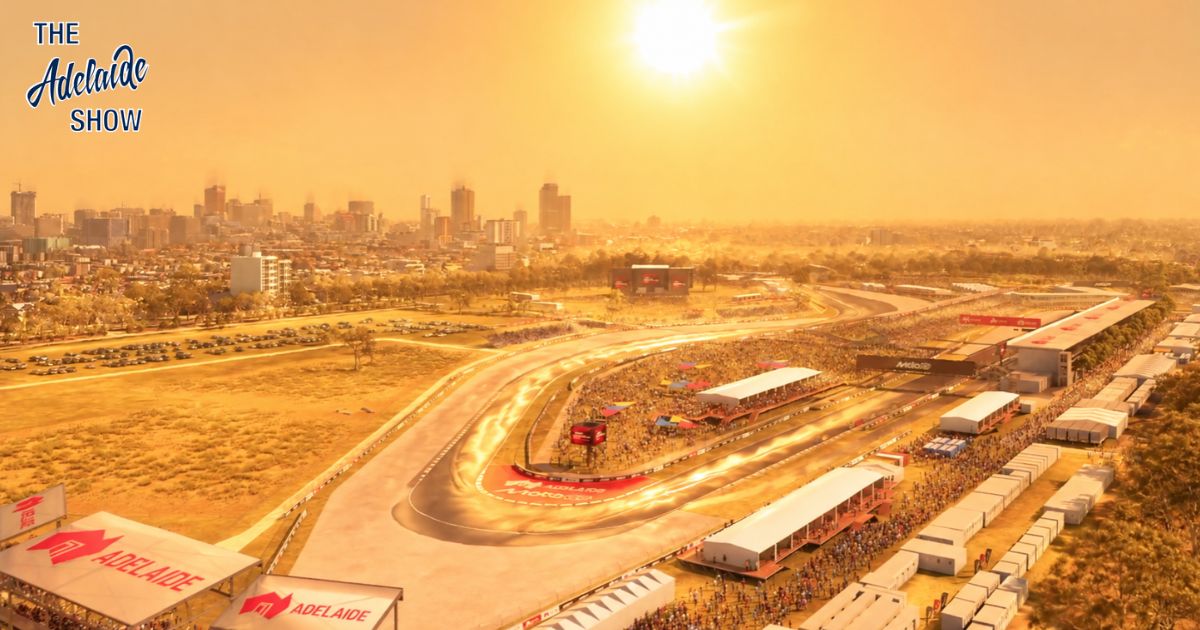
A year ago, political commentator Robert Godden’s pin-up was Premier Peter Malinauskas. Steve recorded this episode on the day the chainsaws began clearing Parklands trees for the MotoGP track, and asked Robert how that view has changed. His answer is about listening, and former geopolitics lecturer David Olney explains why governments seem to have stopped doing it. From there the conversation follows the same thread through the MotoGP circuit, a proposed data centre at Tungkillo in the Adelaide Hills and the ramping crisis. It ends with Robert’s one-sentence view of what government is for, which Steve was tempted to play on repeat as the entire episode. And the image for this episode is from the government’s own publicity kit, with a little enhancement to show the heat belting off the tarmac in a tree-less space.
The South Australian Drink of the Week is Never Never Signature Vodka, from the distillery that has just won gold at the 2026 South Australian Tourism Awards. Steve takes it neat from the freezer, where he learned to keep vodka in Budapest, and ends up describing olive brine, a slow-motion blanket and a row of fluffy white geese.
The Musical Pilgrimage is a hymn Steve wrote by hand in the style of a classic Anglican hymn, then fed through AI so a human performer could hear a draft. Eternal, Unknowable, Data on High is his response to the Tungkillo data centre debate and to his own use of the tools behind it.
You can navigate episodes using chapter markers in your podcast app. Not a fan of one segment? You can click next to jump to the next chapter in the show. We’re here to serve!
The Adelaide Show Podcast: Awarded Silver for Best Interview Podcast in Australia at the 2021 Australian Podcast Awards and named as Finalist for Best News and Current Affairs Podcast in the 2018 Australian Podcast Awards.
And please consider becoming part of our podcast by joining our Inner Circle. It’s an email list. Join it and you might get an email on a Sunday or Monday seeking question ideas, guest ideas and requests for other bits of feedback about YOUR podcast, The Adelaide Show. Email us directly and we’ll add you to the list: podcast@theadelaideshow.com.au
If you enjoy the show, please leave us a 5-star review in iTunes or other podcast sites, or buy some great merch from our Red Bubble store – The Adelaide Show Shop. We’d greatly appreciate it.
And please talk about us and share our episodes on social media, it really helps build our community. Oh, and here’s our index of all episode in one concise
page.
Running Sheet: The Mali Scar
00:00:00 Intro
Introduction
00:03:13 SA Drink Of The Week
Steve introduces the SA Drink Of The Week, Never Never Signature Vodka, with some news. Never Never has just been named South Australia’s leading distillery tourism experience, with gold at the 2026 South Australian Tourism Awards. It had the highest score across this year’s winery, brewery and distillery categories, which sends it to the Qantas Australian Tourism Awards.
He congratulates former guest, Sean Baxter, and the team, then goes to the freezer. When Steve lived in Budapest, he kept vodka on the windowsill through minus 15 winters, and he has kept it cold ever since. He pours it neat, and the first thing he notices is an oily viscosity. There’s a faint olive-brine note on the nose. The first sip arrives like “a lovely blanket that’s being unfurled in slow motion”, and it has none of the bite some vodkas carry. The label says it’s enriched with olive, coconut and avocado oils, and promises a “velvety texture with exceptional balance”. Steve finds the balance right across the palate, like standing in the surf as foam passes without knocking you over. The aftertaste is a subtle coconut note, something like pearl, and then the geese. He suggests drinking it straight or mixing it, and mentions that the distillery’s Triple Juniper Gin has only been around for 12 months.
00:07:46 Robert Godden and David Olney
Steve opens by reminding Robert that a year ago he held up Peter Malinauskas as his political pin-up, and asks where things stand now. Robert says the Premier hasn’t changed, but the relationship with the public has. In his view, this is a government that no longer accepts that “consultation includes the possibility that it changes its mind”. He remembers Michael Harbison driving around with an ear fixed to his car, advertising that he was listening. Steve links that to John Schumann’s song about the “ragtag extremists”, where part of the plan is to ignore people until they give up. Robert says the label now gets worn as a badge of honour, and adds, “Asking someone not to cut down a possum’s house is not extreme.” David Olney offers an explanation that goes back to the 1980s. In his view, governments in Australia, the US, the UK, Canada and New Zealand consult reliably only when the economy is busy enough that most people aren’t watching. When it slows, any consultation about trees turns into “why is our life so hard”, and that makes every party look as though it has no way forward. The two also trade a friendly argument over the word neoliberalism. Robert is wary of how people twist it, while David insists it is an academic term for an idea cooked up by economists who had never run a business.
That brings them to the Parklands. Steve stresses that the Stop the Chop campaign isn’t anti-MotoGP. His objection is that alternatives never seemed to be explored. He mentions an Advertiser editorial pointing at the campaign’s celebrity supporters, including a photo of Matt Preston enjoying hospitality at a MotoGP event, and says John Schumann is a motorbike rider who loves the sport, just not the location. Robert has his own reasons for opposing the race. He dislikes any motor sport that burns fossil fuels, and he recalls a rider from an earlier episode who tried an e-car and said he’d stick with traditional racing for the noise. He says a tree that 20 generations of possums have lived in isn’t replaced by 10 saplings planted three kilometres away. He also doubts the government’s crowd claims. In his view, it counted 100,000 attendees over four days, but at least 25,000 were there for Robbie Williams, and “Bob from Salisbury” would have spent his $300 in Adelaide anyway. For Robert, the Premier’s answer to everything is sport. David reads it differently. He sees a government drawn to big-ticket spectacle because it can’t help Main Street, with Rwanda’s coming Formula 1 bid as his example.
Data centres follow, because Steve sees the same pattern. The proposed Tungkillo data centre has been paused while the developer rethinks how it communicates with residents. David says the debate focuses on water and energy, when the surprise is how many skilled workers a data centre needs. Electricians, systems engineers and technicians are on site constantly, he says, because the racks are always being swapped out. If 100 of them bought houses in Tungkillo, he says, the main street would see more money than it has since the 1980s. Steve pushes back on farmland, and David replies that most of the country north of Adelaide is already under houses. He’d rather have the data centre, he says, because houses stop generating economic activity once they’re built. Robert says residents put 432 questions to the developer, on energy, water, noise, farmland and bushfire, and the company should have asked for help in designing the project. “You can love AI and be enthusiastic about it without wanting to sign a blank cheque for infrastructure.” Both add that Labor didn’t support this week’s inquiry, which the opposition and crossbench established. Steve recalls the Hills properties that trucked in water not long ago. Robert says he bought water for his horses this year.
The same missing-listening thread runs through ramping. Steve notes the new revelation that ramping depends on aged care beds, and Robert remembers COVID, when hospitals phoned his disability and aged care business to place people and sent equipment to match. He says the state government now blames the Commonwealth and doesn’t seem to be pressuring it. David says this is how a Labor premier and a Labor prime minister behave, because the Constitution sets up states and the federal government to fight over money whatever party they’re from. Robert adds the story of the 1993 Olympic bid, won by John Fahey and Paul Keating working together. By 2000, Howard and Carr were in charge, and both leaders had been replaced. He also says the media keeps its eye on the wrong story, citing a recent Advertiser front page about a man convicted of murder as a teenager who was seen in a KFC.
The closing question is about deflection. Steve describes the past week’s announcements, which pointed at the Adelaide City Council and aged care while the tree felling and budget overruns went on. David says his master’s in strategic communication taught him to tell the truth early and say what you’re going to do. What the course left out, he says, is the case where you have no ideas and no skin in the game, and then “deflection becomes everything”. Robert has the last word: “The public is not an obstacle for the government to solve. The public is the reason for the government.”
00:45:58 Musical Pilgrimage
In the Musical Pilgrimage this week we listen to Eternal, Unknowable, Data On High by Steve Davis & The Virtualosos.
It isn’t often a hymn turns up on the Adelaide Show, but this one comes straight out of the roundtable. Steve wrote it by hand in the style of a classic Anglican hymn, then used AI to turn the draft into something a human performer could hear and take on. He recorded it on the day of a Microsoft outage, with the Tungkillo data centre on hold. Before the song, he talks about the human brain’s habit of finding the laziest route to getting things done, and about everything we keep in the cloud. He calls it an ironic, tongue-in-cheek, bittersweet hymn. The verses run from rivers running dry to “your shareholder yields”, with the refrain “forever your servants for eternity”. Steve sums up humankind as lemmings heading for a cliff, and doing so “happily for the trinkets we’re getting along the way”.
Here’s this week’s preview video
There is no preview video this week.
SFX: Throughout the podcast we use free SFX from freesfx.co.uk for the harp, the visa stamp, the silent movie music, the stylus, the radio signal SFX, the wine pouring and cork pulling SFX, and the swooshes around Siri.
An AI generated transcript – there will be errors. Check quotes against the actual audio (if you would like to volunteer as an editor, let Steve know)
442 TAS
===
Robert Godden: [00:00:00] Good government is not just about what you get done. It’s about showing that they’re worth doing. It’s about listening while there’s still time to change what’s gonna happen. And it’s about owning the results afterwards. Because the public is not an obstacle for the government to solve. The public is the reason for the government.
Steve Davis: Welcome to episode 442 of the Adelaide Show Podcast. I’m Steve Davis. And yes, there is a provocative title for this episode, and it’s born out of a sense of not being listened to, a sense of, um, being ignored by those in power. And in that frustration, perhaps we do draw upon some language that is more robust than usual.
But equally, it is pointing up the fact that one leader at [00:01:00] one point in time is about to genuinely leave a scar on the Adelaide Parklands, and that scar will be a blight on our environment, especially when the MotoGP or whatever else it is pulls up stumps, if I can mix some metaphors, and moves away the fledgling trees replacing the ones being, uh, ripped out and destroyed at the time of recording.
Um, it’s not equilibrium. And the game? Transitory and mirage-like. Anyway, I get our political commentators back, Robert Godden and David Olney, to have a roundtable discussion, take a pulse on South Australia at the moment. Plus, a signature vodka from Never Never. And we finish with a song which dares tackle the complicated relationship we all have to AI and data centers.[00:02:00]
TAS Theme: Wave on wave, she’s got a bad row paddling
Adelaide, Adelaide oo. Oh, oh, little Adelaide
Caitlin Davis: In the spirit of reconciliation, The Adelaide Show podcast acknowledges the traditional custodians of country throughout South Australia and their connections to land, sea, and community. We pay our respects to their elders past and present, and extend that respect to all Aboriginal and Torres Strait Islander peoples today.
TAS Theme: Adelaide, Adelaide, Adelaide[00:03:00]
Steve Davis: In the South Australian Drink of the Week, we’re about to have some Never Never signature vodka. And it’s quite timely because Never Never was just recognized as South Australia’s leading distillery tourism experience. They took home gold at the 2026 South Australian Tourism Awards. They also received the highest score across this year’s winery, brewery, and distillery experiences, which earns them the opportunity to represent the state at the Qantas Australian Tourism Awards.
So well done to Shaun Baxter, who’s been on our program before, and co, uh, for these great awards. And what I’ve done is I’ve had a bottle of their Never Never signature vodka in my freezer, which is the best place to keep it, [00:04:00] which I learned, and, and Alexis Kathleen, a longtime listener, will know back from the time when I lived in Budapest, we used to keep our, our vodka out on the windowsill so that all through those months when it’s minus 15, the vodka is kept at a perfect temperature.
So let’s have a taste of this. What I’m particularly after, um, and it may be… Bear with me. Oh, there’s nothing quite like the sound of opening a bottle for the first time. Let’s just pour some Now, straight away, we’ve got that beautiful oily, uh, viscosity which we look for in a vodka. I’m going to be tasting this neat because I believe that is the best way to enjoy any spirit.
Um, they do promote all their various cocktails with it, but this signature vodka is almost, um, matching their triple juniper gin, which is amazing, which we’ve had on this podcast before, and it’s only been around for 12 months. So [00:05:00] excuse me, let’s have a little smell. And on the, on the nose, we are getting those normal notes you get with vodka.
There are, although a little bit of, um, an olive brine note on my nose. Let’s have a little taste. Mm. Wow. I’m not sure where to begin. That was a very calming sip of vodka that immediately raced to the edges of my palate, a bit like a, a lovely blanket that’s being unfurled in slow motion on a TV commercial, and it found its way down the sides into the recesses of my, uh, mouth.
None of that bite that you sometimes get with vodkas. Uh, I’m gonna try one more just for comparison. Oh, the, um, that mouthfeel is superb. It is… I mean, they, they try to make this their ultra-smooth vodka. I think they’ve succeeded. They do talk about enriching it with olive, with coconut, and with avocado [00:06:00] oils.
And you know what? When it says on the label, uh, “Velvety texture with exceptional balance,” you can actually believe this label, because that is nicely balanced right across the palate and so soft. It’s like going down to the beach and the waves are coming in and you stand there and you, you get enveloped by the foam as the wave goes past, but it doesn’t push you over.
And the aftertaste is interesting as well. It’s like, um, for some reason I’m picturing a row of white fluffy geese just sitting across my palate. I can’t explain that more. Um, look, there’s a very subtle note of coconut. Very, very subtle. And the other thing that I’m noticing there is, and again, I’m struggling to put this to words, but it’s like pearl, whatever pearl would taste like.
That’s a very beautiful, subtle, rounded aftertaste [00:07:00] across the palate. So this would take to anything you’re mixing it with beautifully, and what it will bring to the party is not a dominant flavor, but texture, gorgeous texture. So I heartily recommend this. Keep it in the freezer. Drink it straight or mix it well.
Never. Never. Signature Vodka is the South Australian drink of the week.
Charles Firth: Hello, I’m Charles Firth from The Chaser. You’re listening to The Adelaide Show, and I’ve been told that I’ve gotta give some useful advice to you. So my advice is stop listening to this show.
Steve Davis: I figured it was time that we regroup on just taking a moment to reflect on the state of politics in the state of South Australia. And the, we’re [00:08:00] recording this on the day that the chainsaws have begun chopping down trees to make way for Peter Malinauskas’ MotoGP track, which is why this episode has the title “The Mally Scar: How One Premier Can Leave a Blight on the Adelaide Parklands and in Our History Books.”
And joining me to reflect on this is our regular political commentator, Robert Gotton. Welcome back, Robert.
Robert Godden: Great to be here, Steve.
Steve Davis: And our former lecturer in geopolitics and observer of all things, um, to do with politics and society and relationships, David Olney.
David Olney: Thank you very much, Steve.
Steve Davis: I think my introductions to you get more and more convoluted as we go on.
David Olney: Yeah, I figure out soon I’ll be a sorcerer, and I’ll be able to have a goat to sacrifice, and then it’ll get really exciting.
Steve Davis: It might yet come to that. Um, all right. Uh, just before I [00:09:00] get you, David, to give us your overview ’cause you very much keep us on the track. We’re not playing the man, we’re playing the ball.
Um, but Robert Gotton, it was around about a year ago that we talked about South Australian politics, and your pinup poster boy was Peter Malinauskas, and I know that over time you have been adding nuance to that observation. Where, where do things stand at the moment, just at the top line level, with the way our state’s being managed?
Robert Godden: A really good question. Um, so firstly, I think the title of the episode shows your, your balanced, non-partisan, uh, approach to this issue, uh, beautifully well. Uh, I, I, I think the Premier would appreciate how vicious you didn’t get. Um, so when I was making my notes for today, I, I came up with the, um, the, the last thing I wanted to say, and now that you’ve asked me that question, I’m gonna say it first.
And, um, it’s about consultation, and I think we have a government that [00:10:00] doesn’t recognize that consultation includes the possibility that it changes its mind And I think if there’s anything the last year has shown us, it’s that they have dispensed with this idea of, of, uh, listening. Um, you know, I’m old enough to remember Michael Harbison driving around with an ear stuck on his car with his campaign, “I’m, I’m listening.”
Harbo, where are you? Uh, you know, and I, and I think that’s, that, that’s the, the biggest thing in the last year. If you take out every issue and you get everything down to the nub of it, um, a government that was somewhat listening, uh, now is, is, uh, completely unable to hear. And I think that’s It doesn’t change the person, it doesn’t change who they are, it doesn’t change what they believe in, it doesn’t change what they wanna do.
It just changes the relationship we have to the way they’re doing it, and it doesn’t change it for the better.
Steve Davis: And it does lead to a [00:11:00] sense of hopelessness that John Schumann, in his song, um, about the ragtag extremists, uh, the bridge in the song talks about how part of the plan is to ignore, ignore, keep pushing on, because we’ll ultimately give up and move on.
And I, I think this lack of consultation is a dispiriting position to take.
Robert Godden: Yeah, I, I think you’ve gotta be careful that you don’t take the, um, position, as Hillary Clinton famously did, that it… y- you can feel free to insult the people who don’t like you anyway.
Steve Davis: Mm.
Robert Godden: Which I think is where he, he, uh, ran foul then.
He seemed to think, you know, the, the- these, these people aren’t my friends. They’re not people that are ever gonna vote for me. So what I’ve gotta do is, is convince other people that they’re unworthy, and, uh, you get in a situation a- a- as the Basket of Depora was commented, where people wear it as a badge of honor.
You know, we, we’ve had [00:12:00] many, many people say, “I’m plo- proud to be a, a ragtag extremist on this,” and, you know, it’s, um… And you know, e- extremism is a bit of a word in this case, isn’t it? I mean, terrorism is extreme. Um, asking someone not to cut down a possum’s house is not extreme.
Steve Davis: I, I think, uh, these words are being cut out of cardboard and placed around too lightly.
Um, there’s a, there’s a particular LinkedIn group or Facebook group called South Australian Events or something, or South Australia, and the person behind that often just brings out these, um, uh, straw man versions of the opposition so that he can chop it down, and this is not healthy. But David Olney, I wonder if you would share some of your observations at this point to, to give us a, uh, a broader context.
David Olney: Exactly. I’ll try and do the macro because that’s [00:13:00] where historically I more, you know, happily pay attention. I think there’s a, a sort of really sad deeper issue here, and that is that since the 1980s and the move to neoliberal, you know, politics and economics, it doesn’t matter if you look here, the US, the UK, Canada, New Zealand, the only time governments do consultation reliably is when there’s enough economic activity that most people are busy trying to survive and therefore aren’t really paying attention to what the politicians are doing.
So the only people that the politicians really have to consult with are the cranks out on the fringe Whereas when the amount of economic activity slows to the point where even more people are struggling, then the dumber the politics, the more impactful it is because people are already struggling. So any attempt at consultation at that point very quickly moves from the [00:14:00] issue at the moment of why do you wanna chop down t- trees to suddenly why is our life so hard.
Uh, and if the why is our life so hard thing gets into the public debate properly, then every current political party looks profoundly stupid and as if they have no way forward, therefore, avoid consultation at all costs.
Steve Davis: Robert, do you wanna reflect on that?
Robert Godden: I, I don’t find anything in it to disagree with.
Um, uh, you know, I’m sometimes uncomfortable with terms like neoliberalism ’cause I, I think, I think they can be used academically as David does, but I think also people twist them, um, you know, twist words, um, to suit themselves. I mean, I, I support-
David Olney: No, no, no, Robert, the, it is an academic word.
Robert Godden: Yeah, absolutely.
It was
David Olney: created by a bunch of armchair economists who had never made money-
Robert Godden: Mm …
David Olney: never run a business, who basically explained their radical ideas to a bunch of very rich people who said, “We get our power back this way.”
Robert Godden: Yeah. Look, I don’t, I don’t disagree with that. What [00:15:00] I’m saying is on the street, maybe there’s, uh, people have, have different, different views of, of what, what is happening right now.
But I think that, um… You know, and, and words are, are definitely an, an interesting part of this debate, the words that people use. I mean, I noticed that a certain, uh, Mr. Poulton, who’s been in the news a fair bit, uh, with his, uh, activities, uh, and the attention that he’s, uh, garnered from SAPOL, uh, he described the Malinauskas government this morning as treasonous, which is a, a fascinating word to use for a state government.
David Olney: Mm.
Robert Godden: Um, and, um, you know, people are just banding around whatever words they like. And, and, um, and people are, you, you know… The, the, the debate has For some people descended to the point where m- my opinion is as valid as your opinion, um, despite the fact that I have no idea what I’m talking about and you’re, uh, you know, got five degrees in it.
Uh, and- Yeah, the Dunning-Kruger
David Olney: effect
Robert Godden: now [00:16:00] defines-
David Olney: The Dunning-Kruger effect … the debate.
Robert Godden: It, it, it absolutely does. But I think, uh, yeah… A- and I think also we, we have the media dimension on this and, and the way things are reported and, and what the media chooses to focus on. I mean, yesterday the front page news in The Advertiser was that a man who was convicted of murder, uh, decades ago and then was released because he did a plea deal, um, and, and shopped the others, and w- he was 15 at the time, uh, was seen in a KFC.
And this is outstanding news because what it is supposed to convince the reader of is that y- there’s more danger of your family being murdered at KFC by this guy who suddenly decides to go back to his old ways. And, and what you really should be worrying about is whether your nana’s, you know, dying while stuck in an [00:17:00] ambulance at a hospital.
Um, but the media has this habit of concentrating on these sort of, um, side issues and th- these little things. We’ve just seen it in the US. I mean, the Republicans spent something like 45% of their advertising money on ads that mentioned transgender issues, and 4% of voters said they thought that was important And, and it seems that everyone has this barrow to push and they, they, they’re gonna push this barrow, and once they get behind this barrow, that’s the answer to everything.
Um, you know, Malinauskas’ barrow, I think, is sport. Sport is the answer to everything. You know- Well- … we’ll have a fantastic state so long as we have sport, sport, sport, sport, sport. Now, I’m a massive sport fan. All right? Um, maybe not motor sport, but massive sport fan anyway. But, uh, I, I… It, it just seems that every time you cut down a tree, or change a road, or put up a grandstand, or do any of these things, what you’re saying is, “I’m [00:18:00] okay with inconveniencing, um, X people so that Y people can have their sport and, and present to the state an alleged and highly whiffy economic benefit.”
David Olney: That’s interesting y- you say it’s about sport, because I think there’s a different way to read that. What it’s about is things on a grand scale that can be done by people who already have economic resources and can have some more economic activity, where at the end of the big thing, you can sell tickets to people who can’t afford to do anything else, and there is no stimulation of the co- So, in American terms, having an American job, it’s always the debate between where should politics be aimed, at Wall Street or Main Street?
Steve Davis & The Virtualosos: Mm.
David Olney: And we have a state government obsessed with looking at Wall Street because it’s utterly incompetent at helping Main Street.
Steve Davis: I think we might get closer to that as we look at the four quick stepping stones that I isolated as [00:19:00] worthy of conversing on. We’ve already started talking about, uh, the MotoGP tree cutting, which is underway at the time of recording, and again, uh, in particular noting that it’s not an anti-MotoGP stance, it is just this lack of consultation when there seemingly were not alternatives explored.
But what I find really fascinating, I think this brings in the media angle that Robert alluded to. The Advertiser apparently had an editorial today basically saying, “Look at all these celebrities who’ve stepped in to support the Stop the Chop campaign, but look at these. Some of these people, like Matt Preston, is enjoying in this photo the largesse of hospitality at a MotoGP event,” et cetera, et cetera.
And this is the cardboard cutout two-dimensional approach, because two things can be true at the same time. John Schumann, one of the advocates [00:20:00] against Stop the Chop, is a motorbike rider who loves his MotoGP. He’s got no bones to pick with that. It is about the pig-headed adherence to forcing it onto the parklands we have at great natural, uh, expense that will be with us forever, swapping trees for tarmac.
This to me is one of the points that perhaps brings everything into focus that we’ve been talking about. Robert, do you wanna reflect on that first?
Robert Godden: Yeah. Well, with the, um, with the celebrity, uh, posts, uh, so the posts that mention all these celebrities and, um, I notice a few things about the post. Firstly, the accompanying graphic, which shows the parklands as lungs for the city, is one of the most stunning bits of work I’ve ever seen in terms of getting a message across.
It’s brilliant. Um, I, I read the comments. Right? Right. I fortified myself- Oh, no. I girded my loins. No. And I got, you know, such exciting comments as, “Well, [00:21:00] John Schumann doesn’t live here.” So, you know, therefore he’s not entitled to an opinion. You know, Paul Kelly doesn’t live here, therefore he’s, uh, he’s not entitled to an opinion.
So I think there’s, um, you know, there, there’s, there’s, there’s pushback against this and you, and you’ve gotta be careful sometimes that, you know, this will be framed as elite people don’t want you to have your motorbike racing. Now, incidentally, my personal belief Is I significantly despise all forms of motor racing that involve fossil fuels.
I don’t think we should be screwing up the planet, and I refer you to the comments, uh, at the second to last Adelaide show, where a, one of the, um, Moto drivers came down and drove an e-car, you know, circles. And he said, “Well, it’s much better. It’s a much better thing, but I would have to stick with traditional racing ’cause I like the noise.”
And I translated that as my hobbies only serves my purpose if it inconveniences other people.
Caitlin Davis: Mm. ‘[00:22:00]
Robert Godden: Cause literally, that’s all the noise and the smoke and things do. So I think that the whole idea of, of motorsport, I would just… You know, go to the Bend. The Bend’s lovely, I’m sure. I’d never go there. It’s motorsport.
But, um, you know, I think send it down there, keep it out of our city. So I gotta… In principle, I don’t like the idea anyway. But the idea that you’re gonna cut down these trees, I mean, a tree that 20 generations of possums have grown up in is not replaced by you planting 10 mature trees three kilometers away.
Right? This idea that like for like, this idea that, um, well, as long as we plant more trees than we, we pull out, then we’ve somehow, you know, fixed the problem. You know? Um, they’re as confident about that as they were about ramping. You know? Oh yeah, we’ll fix that, we’ll fix this. Um, so I think that, uh, I think, I think that the whole point of motorsport is to inconvenience as many people as possible, people who [00:23:00] don’t go to it.
I note that Robbie Williams was here on, um-
Steve Davis: Through the week.
Robert Godden: Yeah … uh, on, on Saturday. It was a great show. Mm. And, um, I noticed that the last two times he has performed in Adelaide, he has performed to more people on both occasions than attended the MotoGP that he w- or the, um, motor race that he was the, um, concert at.
Now, I know that at one o’clock that day, the stage area was already full of people waiting for him who weren’t watching the race. But the government then claimed, “Oh, look, 100,000 people came to watch the motor racing over four days.” Well, I’m telling you, probably at least 25,000 people came to see Robbie Williams and don’t give a damn.
But they, they put this carnival together where they drag people in for other reasons. They put up this ridiculous attendance figures and say, “We’re gonna make this much, uh, this much money for the state.” And they’ve totally failed to take into account that Bob from Salisbury that spends [00:24:00] 300 bucks on his MotoGP pass would spend that in Adelaide anyway.
It’s not new economic activity You know, a significant amount of the crowds are people from Adelaide. They’re just choosing to spend their money there as opposed to spending it at, you know, David Jones, getting the bargain. So, uh, yeah, I, I just think the whole… It, it, there’s, it’s straw argument after straw argument.
Everyone wants it. Um, everyone loves it. We’ll make a lot of money. It doesn’t really inconvenience people. The possums can find another tree. Like n- n- none of these things are reality.
David Olney: I think we have to look at the other places that want GP racing, whether it’s two wheels or four, doesn’t really matter. I think it’s in 2030, Rwanda will first time ever get Formula 1 GP Why does a tiny African landlocked country want it other than it makes you look like you’re a big country?
So there is no economic benefit in having a [00:25:00] GP. It’s just highly disruptive. There’s enough consultants who can convince enough politicians there’s a status benefit. If you actually look at the economic activity the disruption causes, that’s the economic activity that actually moves the needle. As Robert just said, if you actually look at what locals spend, it almost has no impact.
They’re gonna spend that money anyway, just in a different way. And if you look at the number of tourists who come in for something so disruptive, surely there’s other ways to get them. So the entire underlying case that spectacle is economically beneficial only actually holds true in the preparatory steps for the spectacle are economically beneficial to companies who already have money.
At the end of the day, like all forms of supposed trickle-down economics, it doesn’t work.
Steve Davis: On that note, talking of big companies and trickle-down, I want to touch lightly on the data centers, because this is another thing [00:26:00] that not only Peter Malinauskas, but leaders from around Australia have the hots for.
You know, it’s almost like they’re the CEO of a chip-making company who is just looking for love in all the wrong places. Um-
Robert Godden: Many places at once, apparently.
Steve Davis: Yes. Um, and so the, the big one that has been in my feeds recently is the Tungilo, uh, massive data center that was being proposed there. Now on hold, supposedly from the things I’ve seen, because the company wants to rethink its communications and, and revisit.
Uh, I don’t know. I don’t want to read too much into that. But this is a pattern that’s happening in other places, too. And, um, as I covered in a recent song, we’re a little bit compromised because many of us make good use of AI, for example, within our businesses, some more than others. Um, but at the same time, that’s not the only [00:27:00] thing that data centers are for.
Uh, data centers help all sorts of things. Like the, the day we’re talking and recording this, Microsoft is having troubles around the world, so all the data centers in the world not really being much help today. What is our thinking from our, uh, state’s perspective with this approach to data centers where communities are given Uh, short shrift, uh, with very performative touches of supposed consultation when we all know that they’re not going to be listened to, and it’s only those who make enough noise, um, that hopefully get things delayed, at, at best get them positioned somewhere where they can be of benefit without eroding, uh, access to farmland, um, and using water and electricity beyond what they can produce [00:28:00] themselves.
It’s a thorny one. Um, David, I might ask you to reflect on these first ’cause it is a bit of an arm wrestle, and there’s a messy middle, and the truth is somewhere there.
David Olney: Yeah. I think we focus so much on the water and energy use, whereas one of the most interesting things with data centers is how desperately they n- they need skilled humans.
So the reality is you always have electricians on site, you always have computer systems engineers on site, and you always have very skilled technicians on site, and that those people earn very good money and normally end up living near said data center. So if we take a town like Tunkillo, does it have access to enough water?
No. Does it have access to enough energy? No. If one gets put there and they somehow get the water and energy to it, and 100 people buy houses in the town, is that gonna put more money into the main street than it’s had literally since the 1980s? Yes [00:29:00] So we’ve got a terrible balance point here that the irony of data centers at the moment is they’re one of the only ways that state-level governments can actually bring economic activity to the local area, and often local areas that without this would have very little economic activity, and yet it comes with so many problems.
Steve Davis: That’s more jobs, residual jobs in a data center that I’ve been led to believe happen. I, I thought they were in single digits, the, the ones that are- One … needed to keep one running.
David Olney: No, because the rate at which the technology in them is changing means there’s constantly pulling out racks of computing, putting racks back in.
There’s constantly the case of shorted cables, of water lines, uh, basically being burst by the toxic materials going round in them from cooling all this hardware. Y- when you start sort of digging into the places where there’s lots of data centers, this is why there’s so, you know, major shortages for all these [00:30:00] skills.
Building them is one thing, but every one you build has to have a constant crew.
Steve Davis: And then the food we used to produce on the land where these huge things go, at some point we struggle to make that food, David.
David Olney: Well, we’ve already covered most things north of Adelaide in houses, so realistically I’m not very bothered about one data center when every part of my family’s farms will all be under houses in two years.
Steve Davis: That is throwing the arms up a little bit too much, I think, because at some point we need to draw a line. Uh-
David Olney: Well, I’d rather the data center than the houses. The houses don’t generate any economic activity once they’re built. At least the data center generates economic activity two ways.
Steve Davis: Interesting.
Robert, what’s your reflection on this?
Robert Godden: Okay, well, I noticed there were four hundred and thirty-two questions that the residents put in, and they covered energy, water, noise, farmland, bushfire were the sort of big ones. Um, and Quantum DC paused [00:31:00] their, their project. They haven’t, they haven’t abandoned it.
They’ve, they’ve, they’ve paused it while they sort of listen to this. I think what they probably ha- have done is not, not done that first. Like, they, they really should have gone, “We’re thinking about this. Help us build it.” You know, “Help us, help us design it.” Instead, they’ve gone, “Isn’t this fantastic? You guys are desperate for it.”
You can love AI and be enthusiastic about it Without wanting to sign a blank check for infrastructure and, and agreeing with a particular development. Now, I stayed in Tankilla once in 1999 in a, in a, um, bed and breakfast next to the cemetery. It was lovely. Beautiful town.
TAS Theme: Um,
Robert Godden: yeah, lovely town. And, um, uh, I, you know, I, I don’t know that a, a data center would necessarily, um, add to my amenity as someone who likes to drive through and look at it.
But I reckon if you had a, um, if you had a, a, a small property there and, and you had, uh, three or four kids that were gonna be looking for work, uh, how, how good would it, would that [00:32:00] be? Look, I, I think it’s a really good opportunity for Tankilla. Um, it’s just about going about it the right way and I, and I think what– it, it does come down to the government and the culture.
If you invite companies here and say, “Oh, you know, we’re the government, we can rush things through, we– they’ll do what we want,” um, then you’re really setting those companies up for a, on a collision course. Um, I also, uh, noticed that there was a, um… Labor did not support the data center inquiry this week.
The opposition and the, uh, crossbench established it. Um, so I think that is a bit of an issue for them ’cause it now means they’re outside the tent on that. Um, so look, it, look, it’s an interesting one. I, I’d like to think it’ll go ahead, um, and I’d like to think that Quorum DC can actually answer the questions that the residents have, uh, asked to, to a reasonable level of satisfaction.
Um, but I also think that the way they’ve gone about it may make that a more difficult [00:33:00] path than it needed to be.
Steve Davis: And memories are short in North Terrace because only last season, and I think the one before, we had people, not necessarily in Tankilla, but through the Adelaide Hills, who needed to ship water to their properties.
They were living off mud in the bottom of their dams. There was a shortage.
Steve Davis & The Virtualosos: Mm.
Steve Davis: You can understand why this, if we look at Maslow’s hierarchy of needs, this is the very bottom rung: access to food and water.
Robert Godden: I, w- I, I, much as, uh, Maslow is someone who’s, uh, basically got away with stating the obvious for many years.
Um, I think that, um, uh, yeah, I bought water this year. So I bought water for my horses this year, um, because I didn’t have any in the tanks. So I, I– y- y- look, it’s definitely an issue. My understanding of data centers, and, and I don’t have an understanding of data centers, um, is that i-it’s not a case of water goes in one end and goes out the [00:34:00] other.
There, there’s a lot of r- recycling and, and cleaning and things like that, but you do need a steady source of it. So, you know, you hear these, um- These things like if you say thank you to your AI, you’ve just cost a bottle of water. I’m not sure how true that
David Olney: is.
Robert Godden: No.
David Olney: No. But the- Basically, an entire, an entire massive eight to 10-minute job of the AI generating huge amounts of work for you is the equivalent of your microwave running for two seconds.
Steve Davis: Uh, we covered that on the Adelaide show- Yeah … um, not that long ago, actually. Yeah. As you might remember, Robert, on the-
Robert Godden: Oh, yeah, I was away that week and missed the
Steve Davis: episode. Yes. There you go. Um, I wanna turn to ramping now because we’ve had a major breakthrough of new information that has… You know, if only we’d known this years ago, I’m sure Malhi would not have been campaigning that he is going to be the savior of ramping because nobody knew back then [00:35:00] that ramping is nothing to do with the ambulances and everything to do with the, um, lack of supply of beds for the elderly.
Robert, how have you reacted to this startling, startling revelation, world-changing revelation?
Robert Godden: Oh, yeah. Yeah, look, it’s quite interesting because, um, under the Marshall government, we had COVID And because, uh, in my day job, I’m managing director of a disability and aged care business, uh, which was just disability back then, uh, I was suddenly getting phone calls from hospitals who were desperate to find accommodation for people with disability on the basis that they were, you know, holding up beds that they needed for people with COVID.
Um, and it was amazing how they managed to, uh, leap into gear and make that happen. Like, there, there was a lot of support. Like, you know, “If you’ve got a room where you can accommodate this person, we’ll send you all the equipment they would’ve used in hospital.” So, you know, you don’t [00:36:00] buy a bed or a, or a, um, you know, any of the hoist or anything.
We’ll just send them around. And, um, it was quite amazing. There was a, there was a huge effort. So I think a-apart from the obvious that, um, that there’s no difference between whether he did know it or didn’t know it because, um, either paints a particularly bad, uh, view. Um, the fact is they’re not doing anything about it.
I don’t think the state government is doing anything to pressure the Commonwealth. I don’t think they’re doing anything to actually move those people out. They’re saying it’s a Commonwealth responsibility. So, oh, um, you know, I, I made this promise, and I made it in good faith, and if I’d know, only known how despicable the Commonwealth government were, then all of us wouldn’t have been sadly waylaid on our journey to perfection.
And, uh, yeah, it’s, um, yeah. [00:37:00] Uh, the, you know, I’m old, as I’ve said before, and when I was young, we had this word apology. An apology is when you stood up and said you were sorry for something. And in the last ten years, an apology has, has really been for, I stand up and say how sorry I am for something that isn’t my fault You know, and, and th-this is a past master.
I mean, you know, I think the, the, the famous incident where Jay Weatherill stood up and said, “I’m not responsible for what happened in the education department because nobody told me anything,” um, I, I think really was inspiring to a whole generation of Labor politicians in South Australia, and Malley is the apex of that.
Steve Davis: David, you might have some interreflect on that, but I wanted to just cast a slightly wider question. You’ve got a Labor premier and a Labor prime minister. It’s always got to be a challenge, doesn’t it, when you can’t play the normal state federal divide when it’s the other side in, because [00:38:00] you’re punishing your own entity, unless you’ve agreed in advance that I’m gonna do this, take a few punches, and we’ll settle our differences later.
What goes on in this situation?
David Olney: That’s the fascinating thing. By the very nature of our constitution, it establishes a relationship that you can be from the same party but have to beat each other about the heads with baseball bats. So the idea that there is any real, you know, peace, love, and harmony between a party at federal level and a party at state level, uh, is a delusion of the party’s conference, not something that meets, you know, the reality test of on Monday in the heads of government meeting when states need something and the federal government doesn’t want to give them to them, what party you’re from almost becomes irrelevant.
Steve Davis: And yet, at election time, they will bring in their leading light from the federal party to bolster the sideshow.
David Olney: Mm, ’cause more often than not, people aren’t paying attention to the [00:39:00] local because the news isn’t paying attention to the local, unless it’s seeing someone at a KFC who is gonna kill us.
Steve Davis: Yes.
Robert, your reflections on this, ’cause this is right in your wheelhouse.
Robert Godden: Absolutely. Well, I, I, I think for me, something that wraps all the discussion we’ve had up today is the events of 1993 when Australia won the Olympics, won the, the right to host the Olympics, and what we had was we had John Faye’s coalition government in New South Wales work with Paul Keating’s Labor government and win that bid.
And this is the joy of bringing sport, because seven years later when it started, we had the John Howard Coalition government and the Bob Carr Labor government actually staging it. So basically we had, we had two people who loved each other and worked together, then managed to destroy each other so completely that both were replaced, uh, and then they had [00:40:00] to have peace, love, and harmony again.
Um, so I, I think, I think the, the baseball bats at election time are definitely replaced by afternoon tea and scones when it suits them. The olive pits. Yeah. And I think, but I think that’s also, uh, I think Malinauskas must be very happy that we have fixed terms here, ’cause wouldn’t it be awful to go through all this GP pain and then maybe lose, lose an election, you know, a month before?
Um, but I do think that there is, there is a game about this. There’s a game about this, and it’s a game played between the parties, but it’s also a game played with the parties in the electorate. And, and I think what we’ve seen in the last 10 or 15 years is, is, is people going outside the norm. You know, politicians not listening, politicians who say they’re listening, um, politicians who I wouldn’t trust to tie their shoelaces, and I’m thinking about a senator from Queensland.
Um, politicians who, uh, [00:41:00] who are mates with the premier and get the good jobs, politicians who aren’t mates with the premier and end up in other jobs. And, um, I think that there’s a, there’s a Uh, there’s, there’s a, a, a level of toxicity in the whole of society that is, is at play here because once you start seeing people who disagree with you as, as lesser, um, well, you know, that, that, that leads us to, to the where the political discourse is now, and ultimately it leads us to Trump-style politics in the US, and ultimately it tre- leads us to the 1930s.
I mean, there is toxicity in the relationship between per- pe- people on one side of the debate and the other that, that, that really shouldn’t be there and, um, and you know, I, I think would horrify people of, you know, 50 years ago who were engaged in, in public discourse.
Steve Davis: Let’s [00:42:00] draw this to a close with a final reflection each, and I think there’s a D word that rhymes with reflection I want to use here, and it’s deflection.
I’ve noticed a bit more… I mean, this is a, a state government we’ve got who are masters at spin. They actually leave the federal government well behind. Part of it is because they probably have on a short lead the m- you know, the Murdoch paper, that, I mean, that editorial is a great example of that. Um, I have seen so many, uh, announcements over the past week or so in which it’s all, “Look over there.
Look over there,” uh, to get the eye off the ball of all the trees are about to be gone for MotoGP. The, the, the budget overruns with major project, all sorts of things, and it’s like a puppet master in the premier is making all the minions sing along to the same song and then point, “Let’s, let’s attack all the Adelaide City Council.
Let’s point to a direction over here. [00:43:00] Let’s point to, um, aged care for this.” Some of this is legitimate, but some of it is just this master class in deflection. Um, why don’t David Olney, I, I ask you, I mean, th- this, at this skills level of communication, are you seeing this, this book stripped bare with the, um, actions and the communications that are underway?
David Olney: One of the interesting things of doing my master’s in strategic communication in 2021 and 2022 was learning to do crisis comms in the midst of COVID.
Steve Davis: Mm-hmm.
David Olney: And the basic, you know, lesson of crisis comms and really everything I studied for two years is tell the truth as soon as you can and tell people what you’re gonna do.
‘Cause when the media works properly and whistleblowers have a moral compass, you’re gonna be found out and it’s gonna be worse to be found out than it is to own up. But the thing that was [00:44:00] always missing from what I studied was if you own up to the mess, and you have no idea what to do, and you’re unwilling to put any skin in the game, and you really like power, then deflection is the ultimate rule book.
But deflection is the ultimate rule book because y- you know, we really are in the case of, you know, the emperor’s new clothes. If they had anything to offer that worked, they’d be doing it. If they had any ideas that could change anything, they’d be putting them forward. So when you have nothing, deflection becomes everything.
Steve Davis: And Robert Gottem, your final reflections.
Robert Godden: Uh, it’s always great to listen to David, by the way. That’s, uh, one of the, the things I love to, to do. I, I learn from David. He’s a, a very, uh, erudite and, and learned person. Um, and I, I, I think I was sort of gonna follow on what he said, and, uh, I, I think that good government is [00:45:00] not just about what you get done.
It’s about showing that they’re worth doing. It’s about listening while there’s still time to change what’s gonna happen, and it’s about owning the results afterwards. Because the public is not an obstacle for the government to solve. The public is the reason for the government, and that seems to have completely skipped by our current lot.
David Olney: It’s a beautiful sentence, Robert. That really sums it all up in a single sentence.
Steve Davis: So much so, I’m actually tempting of cutting all of the interview and just playing that, and it’s gonna be the shortest episode. On repeat. Yes. Um, Robert Gottem, as always, uh, we do value you as our, um, political commentator, so thank you.
Robert Godden: Oh, it’s been an absolute pleasure. Thank you.
Steve Davis: And David Olney, as Robert said, thank you for bringing your wisdom to, to keep us on the straight and narrow.
David Olney: Thank you, gentlemen.[00:46:00]
TAS Theme: And now it’s time for the musical pilgrimage
Steve Davis: In the musical pilgrimage, we’re going to pause to play a hymn. It’s not often you hear hymns on the Adelaide Show, but this is, um, a hymn as a way of untangling the many strands that go together in our relationship with AI, with data, and with data centers.
The song’s called Eternal, Unknowable, Data on High, and it’s trying to come at this from a few different ways. Firstly, the fact that whether we like it or not, whether we rile against people using those, ugh, hideous AI posters to promote things, it’s there. It’s being used. It’s being used, pushed, and promoted in all many, uh, ways.
And so that’s [00:47:00] understandable ’cause the human brain has evolved to do everything it can in the laziest way possible to stay alive ’cause the brain uses a lot of catego- um, calories when it’s, uh, in, in full operation. So it’s only natural that the human brain is attracted to AI ’cause it’s a, a clever way to get a lot of things done.
The trouble is when we just put it on autopilot, uh, what’s done is pretty average and pretty plastic. And so herein lies the problem. Demand for use of AI is increasing. Not that data centers only handle AI. Everything we use, uh, at the time of recording, the big micro- Microsoft outage reminds us that all that stuff we’ve got in the cloud is living somewhere, and so data centers are part of that, um, problem or solution.
And so, uh, the other angle that we’re dealing with here is we kinda rely on this stuff these days, and data centers need to be somewhere. We also have news at the time of recording that the, the [00:48:00] big one proposed for Tankillo in the Adelaide Hills is on hold. It’s not over. It’s on hold, uh, while the company thinks about how it communicates with its community.
That’s the story. Uh, what the truth is, I’m not sure, but that’s certainly the, the story that’s being peddled at the moment. And so, this song was really inspired by thinking about the, um, the big backlash from people in that part of Adelaide Hills saying, “You know what? This is the wrong place for such a huge data center to be, right in the middle of our farming land,” et cetera.
And so I’ve been reflecting on that, and yet there’d be people even within that group who are making use of AI tools and data center output, whether they like it or not. And so we’re in this complicated relationship with the tool. They’ve gotta go somewhere, but it’s, as Robert points, pointed out in our conversation about the whole malaise we’ve got with the current [00:49:00] government, is it’s this notion of lack of consultation or fake consultation, the theater of consultation.
That’s the heart of the matter for many of these things. And as he pointed out in relation even to this Tangkilo one, if the company had it started, had have started by saying, “Come on, we wanna do this. How can we work together?” There still would have been opposition, but there might have been some people saying, “Well, you know what?
X, Y, Z. We might be able to do this. We might be able to do that.” We will find out in the fullness of time. But right now, adding to the irony of the whole situation, uh, I’ve hand-written this song, uh, in the style of an, a classic Anglican hymn. Uh, but I then use the virtualosos, which use some of the, uh, wondrous, uh, bits of AI to bring this draft song available so that a human performer can hear it and go, “You know what?
We’re gonna take this on. We’re gonna own it.” [00:50:00] So will you be upstanding as we sing the hymn, Eternal Unknowable Data on High.
Steve Davis & The Virtualosos: Eternal unknowable
data on high. With thirst so unquenchable, rivers run dry. Wondrous and magical, the Savior we need. Speak for us, think for us, in thought, word, and deed. All glory and honor, we pledge unto thee. Forever your servants, for eternity
Unceasingly growing, [00:51:00] a library of thought. While freely bestowing your knowledge unbought. Thy output, we seek it for trusted advice. Thy work is exquisite, a pearl of great price. All glory
Pledge unto thee. Forever your servants for eternity
From those you have taken ideas great and small. They thank you for making the most of it [00:52:00] all. Your insights and cunning, they leave us in awe. We’re not in the running to win anymore. All glory-
Pledge unto thee. Forever your servants for eternity[00:53:00]
Your home and your light. Stay with us hereafter, through each sleepless night. No food on our tables or grain in our fields. We’d gladly do more for your shareholder yields. Oh, glory- We pledge unto thee, forever your servants for eternity. All glory and honor, we pledge unto thee. Forever your servants for eternity[00:54:00]
Forever your servants for eternity
Steve Davis: Here’s our ironic, tongue-in-cheek, bittersweet hymn, eternal unknowable dud on high. I can’t help but feel part of us as humankind are like lemmings being led towards the edge of a cliff, but happily for the trinkets [00:55:00] we’re getting along the way. Oh, nuance. There’s nuance everywhere. Thank you for listening to this episode.
We shall return soon. Until then, it’s good night from me, Steve Davis, and good night, Don.
AJ Davis: The Adelaide Show podcast is produced by my dad, Steve Davis. If you want to start a podcast or get some help producing creative content, talk to him. Visit stevedavis.com.au. Thanks, AJ. I’m Caitlin Davis, and I agree with everything my sister said, but there’s one more thing to say.
If you’ve enjoyed this podcast, please leave a rating or a review, ’cause that will make my dad really happy. Oh, and one more thing, if you really, really liked it, please help a friend put The Adelaide Show on their phone. Thanks for listening.
Buzz, buzz, I wanna be
TAS Theme: [00:56:00] Adelaide, Adelaide, Adelaide