
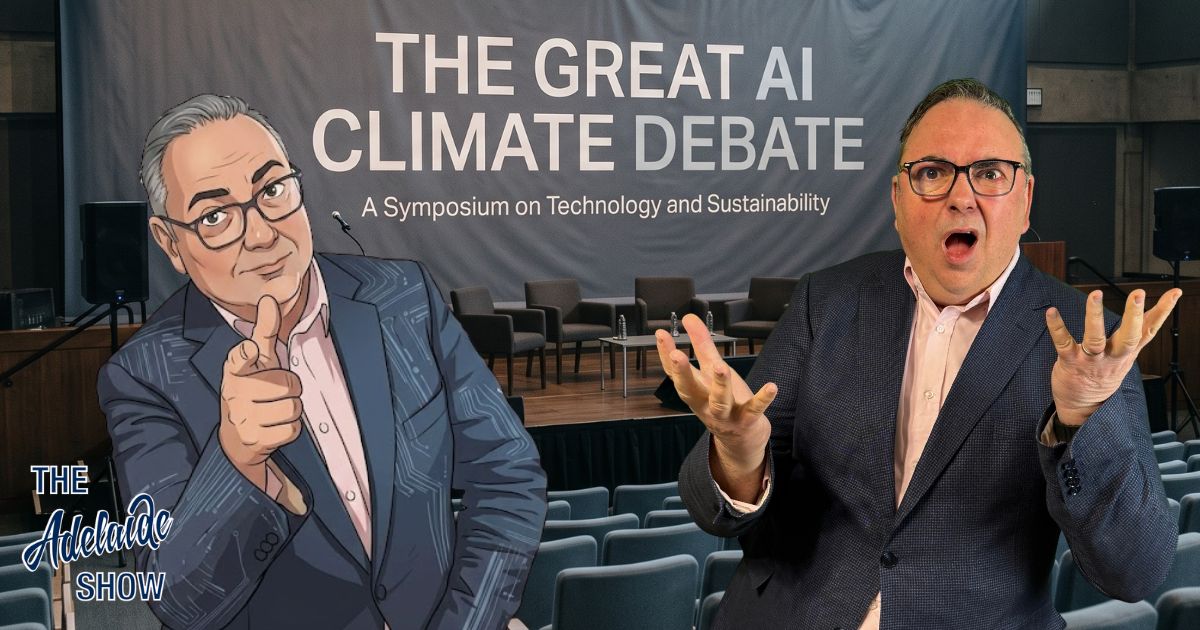
Mark Rowland, co-founder of Adelaide Climate Action Week, walks Steve Davis through the nuance behind the Great AI Climate Debate — carbon gluttons versus silicon saviours, the time value of carbon and the Jevons paradox — while 23rd Street Distillery’s award-winning single malt takes out the South Australian Drink of the Week and a new original song, Higher Legacy, honours the parkland gardeners tending Adelaide’s civic inheritance.
Adelaide Climate Action Week co-founder Mark Rowland joins Steve to unpack The Great AI Climate Debate, the Oxford-style contest his organisation staged this week between the “carbon glutton” and “silicon saviour” camps. Rather than settling for headline alarm about data centres guzzling power like mid-sized nations, Mark walks through the nuance: how much of that energy use is genuinely AI rather than general cloud computing, why the time horizon people use to judge AI shapes their verdict, and how concepts like the Jevons paradox and the “time value of carbon” complicate any tidy answer. He leaves listeners with a practical, human-scaled way to think about their own digital footprint.
Renmark’s 23rd Street Distillery supplies the South Australian Drink of the Week, and it’s a genuine coup: their single malt has just been named Australian Distillery of the Year at the New York International Spirits Competition, outscoring Glenmorangie, Highland Park and a 31-year-old Crown Royal. Head distiller Paul Burnett returns to the show to talk peat, oak and the fine art of finishing a whiskey in casks that once held tawny, muscat and Tokay.
The Musical Pilgrimage closes the episode on a reflective note, with Steve premiering his own composition, Higher Legacy, written for two Adelaide City Council gardeners whose combined century of service tending the city’s parks and squares is honoured on a plaque in Rymill Park — and for everyone, past and present, quietly building something worth protecting.
You can navigate episodes using chapter markers in your podcast app. Not a fan of one segment? You can click next to jump to the next chapter in the show. We’re here to serve!
The Adelaide Show Podcast: Awarded Silver for Best Interview Podcast in Australia at the 2021 Australian Podcast Awards and named as Finalist for Best News and Current Affairs Podcast in the 2018 Australian Podcast Awards.
And please consider becoming part of our podcast by joining our Inner Circle. It’s an email list. Join it and you might get an email on a Sunday or Monday seeking question ideas, guest ideas and requests for other bits of feedback about YOUR podcast, The Adelaide Show. Email us directly and we’ll add you to the list: podcast@theadelaideshow.com.au
If you enjoy the show, please leave us a 5-star review in iTunes or other podcast sites, or buy some great merch from our Red Bubble store – The Adelaide Show Shop. We’d greatly appreciate it.
And please talk about us and share our episodes on social media, it really helps build our community. Oh, and here’s our index of all episode in one concise
page.
Running Sheet: The Great AI Climate Debate
00:00:00 Intro
Introduction
00:04:00 SA Drink Of The Week
There SA Drink Of The Week this week is 23rd Street Distillery Australian Single Malt Whisky.
Steve opens with a pop quiz: name a South Australian product that just outscored Glenmorangie, Highland Park and a 31-year-old Crown Royal at a fraction of the price. It’s whiskey, specifically Renmark’s 23rd Street Distillery, freshly named Australian Distillery of the Year at the New York International Spirits Competition, with their single malt scoring 96 points against entries from 39 countries.
Head distiller Paul Burnett, returning for another visit, credits the win to restraint rather than showmanship: a low-level peat profile, around half a percent in the finished blend, used as what he calls a “complexing agent,” paired with an unusually wide range of cask finishes, from first-fill bourbon barrels to old tawny, muscat and Tokay casks. Steve, tasting alongside him, works through notes of honeyed fruit, fig, all-spice and a citrus edge that shifts as the glass warms in his hand, while Paul walks through the distinction between “heads, hearts and tails” in distillation and how the team’s small-batch, six-way finishing blend has quietly shifted in proportion release after release.
The pair also compare notes on serving it right: a proper tulip glass, a touch of water, room temperature rather than ice, and, in Paul’s case, a slice of chocolate or nuts alongside it. Steve, for his part, admits an evening spent testing whiskey sours and old fashioneds the night before only confirmed his preference for drinking it neat.
00:35:20 Mark Rowland and Adelaide Climate Action Week
Steve opens by declaring his hand: he uses AI daily for work, has solar and a battery, drives an EV, and admits the more he learns about what sits behind that lifestyle, the less smug he gets to feel about it. It’s a fitting frame for a conversation built around nuance rather than tribal certainty.
Mark explains why Adelaide Climate Action Week chose an actual Oxford-style debate over a polite panel discussion, tapping into people’s competitive instincts to get them to actually take a position rather than scroll through it. The audience voted before and after: undecided voters dropped from 24% to single digits, and belief that AI will be a net negative for climate rose from 56% to over 70%. The real story, though, was in the follow-up conversations, where the deciding factor wasn’t the argument itself but the time horizon people used. Ask about the next five years and the mood turns pessimistic; ask about 20 to 50 years out and people start to believe things will improve.
The pair dig into the “carbon glutton” case, distinguishing AI-specific energy demand from data centres in general, since cloud storage and streaming were already drawing power long before AI arrived. Mark points out that air conditioning, EV charging and industrial electrification are all expected to outgrow AI’s energy demands in the years ahead, and that steel and concrete for data centre construction already account for roughly 14% of global emissions. He also raises a genuinely alarming case: a data centre approval in an African nation that led authorities to cut off a village’s water supply, with fatal consequences, the kind of guardrail failure he says South Australia needs to avoid as its own data centre legislation opens the door to rapid growth.
On the more optimistic “silicon saviour” side, Mark describes a proposed Barossa data centre project that would generate two to three times the renewable energy it needs, feed the surplus back into the community, and capture atmospheric moisture from its waste heat to supply water to nearby farmers and wineries, reducing pressure on the Murray. He frames this as “hybrid intelligence” in action: letting machines handle the split-second optimisation work, like grid load-shifting to squeeze more renewables in without new poles and wires, while humans retain the judgement calls machines aren’t suited to.
Steve presses on the Jevons paradox, the pattern where efficiency gains simply invite greater use rather than genuine savings, and confesses to his own sprawling AI toolkit, from Claude to NotebookLM to Suno. Mark’s response is refreshingly proportionate: an individual’s prompt volume is negligible against industrial-scale use, and Google’s own sustainability reporting shows the energy and water cost per prompt has dropped by roughly half in a couple of years, even as overall usage climbs. The conversation lands on the “time value of carbon,” the idea that AI’s emissions are happening now while its promised climate benefits, if they arrive at all, are speculative and delayed. It closes with Mark’s own conviction, shaped by a master’s degree in climate change, that humanity’s Anthropocene-era warming is real, drawn partly from personal memory of snow days in his native England that simply don’t happen anymore.
Asked to leave listeners with something to hold onto, Mark returns to a theme James Clear would recognise from Atomic Habits: start with the smallest available step. Downloading rather than streaming a favourite album, watching YouTube at 720p instead of 4K on a phone, deleting old emails sitting in a data centre somewhere: none of it solves the problem alone, but it restores a sense of agency against the temptation to slide into overwhelm or apathy.
Further information
Google’s 11th annual Environmental Report
01:27:56 Musical Pilgrimage
In the Musical Pilgrimage this week we listen to Higher Legacy by Steve Davis & The Virtualosos
The Musical Pilgrimage takes an unexpectedly personal turn this week. Prompted by a photograph shared in a local Facebook group of a plaque in Rymill Park honouring brothers Antonio and Carmine Lepore, whose combined century of tending Adelaide’s parks and squares began back when Clydesdales still pulled bakers’ carts through the suburbs, Steve wrote an original song called Higher Legacy.
Inspired by the plaque’s closing line, borrowed from the idea that a society grows great when people plant trees whose shade they’ll never sit in, the song also nods to Jane Goodall’s advice to Adelaide listeners years ago: when the world’s problems feel overwhelming, start with the square metre you’re standing on. Brought to life with Steve’s virtual session band, The Virtualosos, it’s offered as a piece for anyone who wants to take it, own it, and perform it as their own.
Here’s this week’s preview video
There is no video this week.
SFX: Throughout the podcast we use free SFX from freesfx.co.uk for the harp, the visa stamp, the silent movie music, the stylus, the radio signal SFX, the wine pouring and cork pulling SFX, and the swooshes around Siri.
An AI generated transcript – there will be errors. Check quotes against the actual audio (if you would like to volunteer as an editor, let Steve know)
437 TAS
===
Steve Davis: [00:00:00] Hello, Steve Davis here. Welcome to episode 437 of the Adelaide Show Podcast. We have an interesting episode. Um, we, we’re going to have a lovely indulgent tasting of a South Australian whiskey that has just swept the board with awards in New York. It’s from 23rd Street, and, uh, Paul Burnett, the head distiller, is going to be, uh, joining me for a sip and a discussion about all things whiskey, from peat to barley to oak to South Australia and to some of his other favorites.
The main course is Mark Rowland. He’s a co-founder of the Adelaide Climate Action Week, which is still underway at the time this episode goes out. Runs until, uh, Sunday the 2nd of August 2026. They had a fantastic event earlier this week called The Great AI Climate Debate, and AI, of course, close to many of our hearts with [00:01:00] uneasiness, uh, because it promises much, but there is a toll that is paid by the climate and by society for its usage.
How bad is that toll? Are there ways of lightening that toll? Uh, Mark is gonna give us a deep rundown on the, the nuances, the pros and cons within that debate and leave us with some actionable things that we can do to lessen our footprint. And then we’re going to finish with a song by Steve Davis and The Virtualosos, which of course is my handwritten lyrics, and they’re brought to life with the help of my virtual session band, and, uh, it’s called Higher Legacy, and it’s my reflection on a couple of Adelaide City Council, um, gardeners who have together put more than a hundred years of service towards maintaining the civic inheritance, as Stuart Sweeney calls it, of our parklands and our [00:02:00] squares, things that are being, uh, ridden over roughshod by the government at the moment as it chases, um, some thrills and dollars and also threatens to lay heaps of concrete down and rip trees up, which you cannot get back easily.
Once they’re gone, it’s easier to slice another piece of the cake. So I’ve got a song that, um, reflects on the work of those two gentlemen, but also others before us who have laid down building blocks for this state that we can take for granted and erode or honor and build upon. Hope you enjoy it, perhaps with a glass of whiskey in your hand from South Australia.
Brett Monten: Wave on wave she’s got a band room. Paddlin’, yaddlin’, along[00:03:00]
Caitlin Davis: In the spirit of reconciliation, The Adelaide Show podcast acknowledges the traditional custodians of country throughout South Australia and their connections to land, sea, and community. We pay our respects to their elders, past and present, and extend that respect to all Aboriginal and Torres Strait Islander peoples today.[00:04:00]
Steve Davis: For the South Australian drink of the week, I’m gonna start with a pop quiz for Adelaide and South Australia. Name something from our state that just outscored Glenmorangie, Highland Park, and a 31-year-old Crown Royal at a third of the price. And I’m not talking about any sort of bizarre football teams.
I’m talking whiskey. And Renmark’s own 23rd Street Distillery has just taken out Australian Distillery of the Year at the New York International Spirits Competition with their single malt scoring 96 points. That’s the highest whiskey score in the entire competition against entries from 39 different countries.
It retails around, you know, 100 and a bit, 108 bucks thereabouts. Head distiller Paul Burnett is returning to the Adelaide Show again to explain how this distillery on the Murray using barley from [00:05:00] KI is quietly rewriting what the world thinks Australian whiskey can do. Paul, welcome back.
Paul Burnett: Great to be back.
Thrilled. Uh, yeah, great to have a whiskey on a Friday-
Steve Davis: Yes …
Paul Burnett: and toast our success to our, our single malt.
Steve Davis: There is so much I want to just tuck under the covers and ask you about. So that actually sounded wrong, didn’t it, Paul? There’s so much I wanna get stuck into in our conversation, and I wanna start with this.
Your trophy cabinet is growing just a little bit. Australian Distillery of the Year, single malt, double gold, highest score. When those scores came in, tell me what was the reaction? Are you jaded by this success yet, or did it hit you for a six?
Paul Burnett: Oh, no, you’re always thrilled. Um, I mean, the first thing you think is, right, all of the effort has paid off.
Um, and you know, there’s really… We only talk about two things, the distilling team, and it’s a very small team, [00:06:00] uh, quality and safety. That’s all we talk about. So it’s really easy to control our culture when we’ve only got two focuses.
Steve Davis: Yeah.
Paul Burnett: We wanna do everything slowly, everything right, everything in a, a, a team environment.
So when we do our cuts, we’re tasting as the, the three distillers. We’ve got a, a wine maker in our team as well. We’re always tasting, debating. Um, but I guess you think straightaway it’s great to be acknowledged. Um, we believe it’s a great product, so, um, the judges liked it. Um, it’s great to be, um, placed alongside, you know, those guys that you mentioned.
Um, you know, Glenmorangie, or, you know, I, I said it wrong, I expect.
Steve Davis: However we say it,
Paul Burnett: yeah. We think that’s a, we think that’s a wonderful whiskey. Uh, we like Aberlour. Um, we’re very low-level peat.
Steve Davis: Mm.
Paul Burnett: So, uh, maybe that’s something that the judges really liked. We use that low-level peat as a complexing agent.
Um, we’ve got lots of peated, uh, whiskey. [00:07:00] Uh, but the actual blend, it’s, it’s about half 1% peat really.
Steve Davis: Gee, now-
Paul Burnett: And I, I think maybe that’s what separates us, is low-level peat, really bright, uh, whiskey, uh, high-level malt. Uh, and it’s our finishing that I believe what separates us from others, is we’ve got this capacity to finish in such a huge myriad of different oaks, different, um, casks like, you know, things that have been, um, had tawny in them, muscat, Tokay.
Steve Davis: Yeah.
Paul Burnett: Um, that’s what, that’s what separates us, I believe, and use of new oak.
Steve Davis: There, I, I wanna come back to all those little points bit by bit. I probably should get some in my, on my palate first. I haven’t poured mine yet, so bear with me. Um, I have got a bottle of your Australian single malt whiskey and, oh, and just like yours, mine has some of it missing because last night I had a tasting with, um, [00:08:00] Alexis Catley, who is my go-to spirits and cocktail man.
Um, and I, I, in particular, I wanted to try a whiskey sour and a, what’s the other one? The old something.
Paul Burnett: Well, the old fashioned.
Steve Davis: The old fashioned. I wanted to try them because in the tasting notes that 23rd put out, they did say this whiskey’s good with that. But I, I need to confess, A, I’m not a big cocktail fan, and I didn’t enjoy either of those much because when I had the whiskey neat, I was in my happy place.
Um, the sour was overwhelming, uh, and the, the… What do you, what’s the other one? The old, I can’t remember. Old fashioned- The old fashioned … or the sidecar or- That was, that was more subtle. Uh, the whiskey was definitely prominent, but then I just wanted the whiskey. So I don’t know if I’m talking out of school by saying that, but-
Paul Burnett: No, I, look, I totally agree with you.
I used to laugh at people that had, uh, you know, cocktails [00:09:00] and gin and tonics, and I mean, I do like them, but, um, Shani, our, um, restaurant venue manager-
Steve Davis: Mm …
Paul Burnett: uh, made up for myself and Chris, uh, an, yeah, an old fashioned and a sour, and we both thought they’re just so nice, and, you know, you slurpable and drinkable and…
But basically you’re like, “Okay, this is great, but when am I gonna have a whiskey? When am I having it?” And I have it with a tiny bit of water. I don’t have it on ice.
Steve Davis: Yep.
Paul Burnett: Uh, because you do wash all those flavors out. Uh, cocktails are great, and they’re, they’re fun, and they’re sessionable, and it’s a good way to start the night.
But yeah, as soon as you want intensity, flavor, power, you, you go back to having whiskey by itself.
Steve Davis: Now, I have just put a little teak pipette’s worth of water in mine. Um, so thank you for assuaging my guilt on that. Um, Alexis did say as I was leaving, he said, “You know what? This was nice, but I’m never,” in quote, in quotes, “wasting this whiskey [00:10:00] in cocktails before.”
The cocktails, they’re for the low shelf stuff. So there you go. I, I, I’ll pass that on as a nice compliment. Um, if you remember from our previous visits, before we taste, we need to toast our late patron, Queen Adelaide. So to the Queen.
Paul Burnett: To the Queen.
Steve Davis: All right. I just want to have another sip to remind me what I tasted last night
And I have a question, ’cause I’ve been drinking your Australian single malt for a couple of years now. It seems even more grown up now than when I first had it. Has it changed, or has my palate adapted to it?
Paul Burnett: It’s certainly changed. Um, so the oldest… Uh, it’s normally, um, about six different types of finishing of the same m- whiskey that gets made.
Steve Davis: Okay.
Paul Burnett: Um, ultimately, not to divulge too [00:11:00] much- … um, like f- first-fill bourbon barrels, uh, new American oak, new French oak, some, um, old, uh, red wine barrels, uh, some very old tawny that have had Shiraz, Grenache, Mataro in them up to 30-year-old, um, and some very old Tokaj barrels. Some 1994 Tokaj has come out, or Tokaj, ’cause you can’t say Tokaj anymore.
Um, or Muscadelle, let’s say that. That’s the
Steve Davis: white wine. Can I say, can I say for the record, um, ’cause Alexis, a long time listener as well, knows that I mention the fact that I lived in Hungary almost every episode, and I had a lot of Tokaj when I was there. I think that’s the home of, or one of the homes of it.
Paul Burnett: Yeah, they say, uh, Tokaji, I think.
Steve Davis: Yes. Tokaj, Tokaj. Not that I’m, my
Paul Burnett: Magyar is, uh, very good. W- I’m not, I’m not fluent in Magyar.
Steve Davis: Yes.
Paul Burnett: Or I can’t even say it probably. Hungarian.
Steve Davis: Yes. I, I used to. Um, but what I’m getting now on it is there’s a beautiful heat [00:12:00] across the tongue. It’s, it’s f- it’s the full package.
It, it, it doesn’t miss anything. It, it fills the palate completely, and that heat is not overbearing but it shows we’re here, we’re serious. And then it, it rises. A bit like those cartoons you see of a loaf of bread or cake out of the oven, the old cartoons, or apple pie, and there’s that steam wafting off the top.
It just, when you haven’t smothered it with orange and lemon and everything, it just creates its magic ecosystem in your mouth.
Paul Burnett: I just realized I didn’t, I didn’t answer your question either. You, you are right. It does change.
Steve Davis: Mm-hmm.
Paul Burnett: Um, I’ve only put together three, um, single malts in my nearly four years, uh, ’cause they’re, we do sort of small productions.
Um, but each time, those six different oak finishings-
Steve Davis: Hmm …
Paul Burnett: that percentage has changed.
Steve Davis: Okay.
Paul Burnett: I remember being so steadfast and thinking, “Oh, [00:13:00] the French, the new French barrel, that’s gonna be, that’s gonna be the base going forward. It’s gonna be 60, 70, 80%.” That has reduced each blend down to about 10, 15%, and the finishing in the Muscadelle barrel-
John Schumann: Hmm
Paul Burnett: has become far more prominent Um, the, the bourbon finish is part of the style across all of our whiskeys.
John Schumann: Yep.
Paul Burnett: But yeah, they, there is gonna be subtle changes, and so for the collector to get two or three each release, I think it’s really clever, ’cause then you can go back and… We always taste the previous production, ’cause we want a little bit of continuity and consistency, but we’re also prepared to, um, at that taste approval stage, have tiny differences between those releases.
Steve Davis: Mm. And
Paul Burnett: I’m- We’d like to do two a year. Like, we’d like to have one released for Father’s Day-
Steve Davis: Yep …
Paul Burnett: and then one for Christmas. That’s sort of ideal.
Steve Davis: Now, when it comes to peat, uh, because [00:14:00] part of me is I, I’m, I’m the smoky/peaty whiskey guy. Um, Laphroaig is one of my favorite go-tos, et cetera. And for a while there, when money was tight, there was a Smokehead or there was some other whiskey that was really low price, and they just poured the smoke in it, and that’s when I discovered you can go too far.
And I’m gradually learning how to release… I, I cling on to peat and smoke like I’m on the edge of the Titanic and it’s the last lifeboat, but I’m gradually releasing that, and I think there’s might be some sophistication in the way you do it. But how do you achieve peat? Because doesn’t that mean the w- has to be filtered through blocks of peat, or what’s, what’s the story there for a novice who just loves his whiskey?
Paul Burnett: Well, so y- most of the peat, I think, in the world is from Scotland.
Steve Davis: Mm.
Paul Burnett: Um, and [00:15:00] it’s, it, it’s evolved through that degradation of vegetation in the soil, I believe. I’m not an expert. Um, and you can get Australian peat. Uh, I reckon it’s south of Coonawarra is a really good spot.
Steve Davis: Oh, wow.
Paul Burnett: But it, you need to introduce that smoke to your barley, um, prior to the fermentation.
Steve Davis: Right.
Paul Burnett: Well, prior to the creation of the wash.
Steve Davis: Mm-hmm.
Paul Burnett: Um, so yeah, we have, um, one particular vase of whiskey, it’s a 2019 whiskey, very, very high level peat. And for us, it’s probably about, uh, about 18% peat in that particular whiskey. And then, like I said, it’s so sparingly used at… We’re only doing, like, 1,000 liter productions.
Steve Davis: Yep.
Paul Burnett: Um, and you should talk in liters, I guess, in- instead of liters, but I’ve- … you know, still like liters. Thank you.
Yeah, we’re, we’re really doing the blend, and then we’re [00:16:00] putting into that 1,000, you know, four or five liters, or three liters of that, of that peaty whiskey. Um-
Steve Davis: I
Paul Burnett: see … and that’s enough for us. But, uh, like you referenced, I used to love Ardbeg.
Steve Davis: Oh, yes. That’s
Paul Burnett: another one. And Laphroaig’s always, if we have our Christmas drinks and celebrate the year, the, the one of the most experienced distillers we have here, he loves Laphroaig.
That’s his favorite.
Steve Davis: Mm.
Paul Burnett: Um, but I started out with Ardbeg and Laphroaig, and I think Talisker.
Steve Davis: Oh, yeah. Talisker, yes, yes.
Paul Burnett: And they’re, they’re fantastic whiskeys. But now when I have a choice, I pick the… I tried a really good Irish whiskey the other day, um, and it was low-level peat, and I really enjoyed it
Steve Davis: Hmm.
Just, just before we leave Ireland and Scotland behind, ’cause over there they’ve got the, the rule that their whiskey needs to be matured for three years in their respective countries, otherwise you can’t [00:17:00] say they are whiskey from that place. We don’t have that here in Australia, as far as I’m aware, in our regulations.
Paul Burnett: But- Two years. Is
Steve Davis: it two years, is it?
Paul Burnett: I’m pretty sure. Uh, I am sure, ’cause that’s what we work on. For rum, whiskey, brandy-
Steve Davis: Yep …
Paul Burnett: must be in oak for two years.
Steve Davis: Now, this one though, if I’m, unless I misread it, there’s three years of maturation that’s gone into this Australian single malt, is there not? When you didn’t-
Paul Burnett: Yeah, and, uh, so- When you
Steve Davis: didn’t have to.
Paul Burnett: When you, um, when we say, like, it’s a three-year-old-
Steve Davis: Hmm …
Paul Burnett: uh, with whiskey, uh, you, you can’t do your average age. Like, I was a fortified wine maker by trade, where you blend the 10-year-old and the 15, and you say, “Oh, its average age is 12.” If you blend a three-year-old whiskey and a one-year-old whiskey, you just got one-year-old whiskey.
Steve Davis: Gotcha.
Paul Burnett: But you can’t. Um, but yeah, so the, the minimum age is a three-year-old. It’s got much, it’s got some five-year-old whiskey in it too. [00:18:00] Um, but the, the blend, you’ve gotta say it’s a three-year-old, ’cause that’s the youngest component in it.
Steve Davis: Mm.
Paul Burnett: Um…
Steve Davis: And, and talk me through the Kangaroo Island barley. What does that bring to the table that maybe barley from somewhere else doesn’t?
Paul Burnett: Just… Well, I mean, Kangaroo Island, as a, a natural resource of farming, it just has amazing soil.
Steve Davis: Mm-hmm.
Paul Burnett: Amazing conditions, you know. So it still gets a, a beautiful summer, uh, it gets far more rain than, than we get in the Riverland. I don’t know the exact, but I reckon it might say it might get three times the rain of the Riverland, even though it’s been a wet year here.
Steve Davis: Yep.
Paul Burnett: Um, so you’ve got really good soil, you’ve got lots of rain, and you’ve got lots of sunshine. So you’ve got everything you need to create an amazing raw material of barley. And, uh, the transport from there to here, you know, you’re not looking at big distances. It’s not a, it’s not a huge effort. Um, it’s easy for me to say that, ’cause I’m not a farmer or a truck driver.
Steve Davis: Yes.
Paul Burnett: But getting those raw materials, [00:19:00] uh, into a wash is not, it can be done fresh. So, you know, you’re using- Mm … the best possible material. There’s, there’s very good South Australian mainland and there’s very good Queensland barley. Um, but we’ve ascertained that for high quality consistency, that Kangaroo Island is, is a fantastic option.
Steve Davis: Well, it really does stamp the, um, South Australian DNA into it, doesn’t it?
Paul Burnett: Mm.
Steve Davis: Uh, the other thing I wanted to ask, and, um, by the way, that, the touch on muscat that it’s had there, with all the influences in this- It’s like seeing an abstract art exhibition of Muscat. Like, you, you know it’s in the mix, like haunting like a ghost, but it…
I couldn’t name it if I had to name it straight away. There’s like this, um, lovely symphony of just this beautiful array of different flavors and influences from [00:20:00] the different, uh, pre-soaked barrels that just lends to a pleasant pleasantry. I mean, this, this is not my question. That was just… It hit my palate as I was talking there, Paul.
Uh, my question’s about the oak. We hear French oak, we hear American oak al- talked about a lot. Is there much Australian oak i- in use? So I’ve got two questions, one about that, and the second one is when you bring over oak from these other countries, do they come as whole barrels, or are they dismantled and re- reassembled when they’re here?
I
Paul Burnett: mean, you can.
Steve Davis: Mm.
Paul Burnett: You can import barrels from France and America, and we do. We, we have, um, a limited budget for brand new.
Steve Davis: Yep.
Paul Burnett: Um, and I don’t wanna digress to brandy too much, but I mean, brandy was the reason why I wanted to work here first and foremost.
Steve Davis: Oh.
Paul Burnett: Um, so French oak for brandy.
Steve Davis: Mm-hmm.
Paul Burnett: Um, I mean, we get American oak.
Um, but most of it, to answer your question, is made… Uh, there’s a couple of coopers that we use. Yep. [00:21:00] And they’ll assemble them here. They’ll come… Sometimes they’ll come as, um, those staves, individual staves, and watching the coopers produce that is a, that’s a noble art.
Steve Davis: It is. It’s
Paul Burnett: such craftsmanship. And there’s a fair bit of variety, uh, in those.
So we use hogsheads, these barrels that are around, around 280 to 320. There’s a lot of variance in those, whereas bourbon barrels, they’re made very, um, very similar. There’s so much control on the bourbon barrel. They all hold about 191 liters. There isn’t variation amongst those. They’re all charred a similar way.
Steve Davis: Yep.
Paul Burnett: So there I, I would say there’s a lot more craftsmanship in the French and American hogsheads, and there’s a bit more production in the bourbon barrel. And the thickness is different. Um, the effects of storing it are different. French oak, you know, for me, a lot greater tannin and a higher quality of tannin.
American oak, more vanilla, [00:22:00] um, more obvious aromas early on.
Steve Davis: Yep.
Paul Burnett: But yeah, I mean, these projects are so much fun. Each time we go back at them they are changing. I just realized then I, I do see those raisin and fruitcake finishes of that complex Muscadelle, uh, but I see a bit of citrus today. I see that sort of real citrus complex coming through, too.
Steve Davis: Yeah For me, it’s a bit more pithy at the citrus end than the fruit.
Paul Burnett: Mm-hmm.
Steve Davis: Uh, but this is why, and this is my lament. I mean, I love whiskey. I know what I enjoy. If you put a wine in front of me, I could give you 7,000 hours of inspired description. I, I don’t have the vocabulary with whiskey to name it. I just know when it sits properly and I’m drinking something that’s been well-crafted.
Can you talk, talk us through what else you’re getting on your palate, just to help me? ‘Cause I’m a babe in the woods in putting words [00:23:00] around what I’m
Paul Burnett: tasting. Well, I, I suffer the same fate when I drink spirits sometimes, ’cause it, they’re so powerful-
Steve Davis: Hmm …
Paul Burnett: um, and mouth-coating that sometimes you really struggle to say, “Oh, I think there’s cinnamon spice there,” or, “I get these, uh, cream corn characteristics,” and stuff like that.
Um, but for me, I guess what I see in our whiskey and what we target as a team is brightness. We want very bright, sweet oils in terms of our distillation.
Steve Davis & The Virtualosos: Mm-hmm.
Paul Burnett: So, uh, it, put it simply, the distillation is heads, hearts, and tails. Yep. So removing the heads, undesirable, um, varnish-y, you know, poisonous alcohols.
Steve Davis: Yeah.
Paul Burnett: The hearts is what’s gonna go to barrel for two years or longer, and the tails are, are the things that are a bit more grassy, chewy. Once again, they’re not, they’re not desirable aromas or flavors.
Steve Davis: Yep.
Paul Burnett: Um, so I see brightness. I see that, the purest of hearts. [00:24:00] That’s what we’re targeting. Um, I see lovely sweet oils.
Uh, I see lovely bright malt. Um, I hardly see any peat. I don’t, and we’re not looking for it. Um, I see- Funny,
Steve Davis: so funny you mention that. Just as I’m exhaling, as you said you can’t I got a sense of that, but I interrupted you. Sorry, it just, it just coincided with what you were saying. So you’re not getting a lot of peat.
Uh, we’re not getting a lot, but I got some of that. ‘Cause at first I was thinking it’s almost like there’s cut grass or cut hay or something here, and then no, no. It’s, it, it was verging towards that soft peatiness, just that earthy, natural essence that that brings.
Paul Burnett: It’s a, it’s amazing you say that, cut grass.
‘Cause I, I say cut grass, but my boss, when we’re tasting, he’ll say, “No, they’re the [00:25:00] congeners.” They’re all the beautiful things that are coming from the esterification of the ferment, the distillation, the interaction with the copper. You’re getting these congeners. Coincidentally, the congeners are the ones that give you the hangovers too.
Steve Davis: Oh, okay.
Paul Burnett: Yep. Anything that’s high in congeners- Okay … like brandy, whiskey, rum.
Steve Davis: Yep.
Paul Burnett: Unlike vodka, very low in congeners.
Steve Davis: Yep.
Paul Burnett: Uh, but these congenerics, I always see, oh, it’s got that sort of grassy, uh, lifted sort of, um, barley notes and grainy notes and, and yeah. My boss will say, “Well, that, that’s the congenerics.
That’s what we’re wanting.”
Steve Davis: There you go. And for some reason, I’m getting, again, not strong, but I wanna say there’s a combination of some cardamom and some nutmeg, but again, I’m not, I’m not shoving it right up my nose. It’s on the side of the kitchen cupboard where I’m doing some cooking, and I’m just, there’s just a little bit of that when the room is still.
Paul Burnett: My, um, my notes the other day, I had, um, sort of all spice, baking [00:26:00] spice. Mm. Um, yep.
Steve Davis: I was heading there, but it didn’t have that- Th- th- those spices are a bit more, aggressive’s not the right word, uh, vibe, uh, active. These were more relaxed.
Paul Burnett: Well, and the temperature at, at what you’re enjoying it at. Oh. Like, so that’s why I’m, I’m not really a prude for many things.
Like, you know, nice ice cream-
Steve Davis: Yep …
Paul Burnett: nice steak, nice spirit. Everything else I’m happy to have low level. Um, but, and good water if you’re gonna use, uh, if you’ve got really nice rainwater, great, but don’t use inferior water. Don’t use anything with chemicals in it.
Steve Davis: Yep.
Paul Burnett: Um, the temperature at what you taste is gonna affect the aromas, it’s gonna affect your palate, how you’re feeling.
You know, if you’ve had a big night on the whiskey, the next morning when you do your tasting notes they’re probably gonna be quite critical ’cause you’re not feeling at your best.
Steve Davis: Yeah.
Paul Burnett: Um, but I, yeah, I like to drink at room temperature. Um, even [00:27:00] make sure the water’s room temperature. Um, I get some of those real honeyed fruits, uh, and sometimes even a bit of fig when I look at whiskey.
And then yous- Yeah … you think, “Oh, am I looking at it wrong?” But, um, as you’re tasting it, you know, it’s gonna dovetail in your, in your palate as well.
Steve Davis: I’ve been deliberately heating it in my hand as you’ve been talking, and some of those latter things you just mentioned, the, the honey in particular, the fig, uh, they’re there.
They’re there. But they weren’t there before. I, I’m actually heating to give them permission to put them as… They’re like a peacock that’s too cold and its tail is all shrunken, and I want its fan- Yeah … to be bigger. There you
Paul Burnett: go. I, um, I, we really want oak to be part of our style.
Steve Davis: Mm.
Paul Burnett: So that finishing in different oaks and-
Steve Davis: Yeah
Paul Burnett: that complexity of oak tannin, oak aroma, oak flavor, good structure of oak. But we also, we want it to frame the s- the whiskey. We don’t want it to dominate. So yeah, the [00:28:00] same way I, I move away from really peaty whiskeys, I’m gonna move away from very light oak or over-oaked. Mm-hmm. It has to be in balance. So balance, to answer your question- Yeah
balance is what we’re targeting very much.
Steve Davis: And my last comment here is the Tokaj, the Tokaj, um, that’s what it- that’s where it’s landed. I’ve gone around the, the game board and I’ve come back and I haven’t landed on Mayfair, I’ve landed on Tokaj. That’s where I’ve landed. ‘Cause there’s some… They have a star system in Hungary from one to five, and that’s talking about really the quality in particular, and this is a really clean, beautiful, dry, uh, expression of…
Not, not 100% dry, but not overly sweet. It’s in that middle spot. It’s the Goldilocks Tokaj.
Paul Burnett: I can’t remember the, was it puttons or something like that? The, there was a
Steve Davis: term for- Ah …
Paul Burnett: the level of sweetness in those [00:29:00] Tokajs.
Steve Davis: Yes, there is. Uh, but I had what they called konyhanyelv, which is kitchen language.
That’s as far as I got, so.
Paul Burnett: Yeah.
Steve Davis: And- I’m
Paul Burnett: sure I just completely ruined, uh- … any chance I’ve got of any exchange with Hungary, but.
Steve Davis: Yeah, I’ll go with you as a chaperone if, when you do. And my, my last question, Paul, because I am, uh, you know, about to hit into your weekend, um, how do you recommend, ’cause you’re, this is one of the three food groups that you t- pay attention to closely, how do we get the most?
If we’re gonna buy a bottle of your Australian single malt whiskey, what will give it the best chance of showing off like a showgirl?
Paul Burnett: H- a nice glass Yeah So I mean, these are beautiful glasses ’cause you’re giving it every chance to, uh, for the aromas to come up and-
Steve Davis: Yeah, these are, what, are these called tulip glasses?
Paul Burnett: This- I don’t know. I’m so naive. Like, you know, the covers, the watch glasses, when I first started here, someone said, “Can you order some watch glasses?” And I said, “Sure.” “What are they?” [00:30:00] Um, a
Steve Davis: good glass- For the people li- for people listening who can’t see, these are the glass with the small base. It’s got a little bulbous bottom, and then it thins itself towards the top.
Yep. Go on.
Paul Burnett: Um, yeah, a good glass, and the glass has to be, you know, free from any debris or anything like that. So I rinse it with water.
Caitlin Davis: Mm-hmm.
Paul Burnett: Um, then you’ve gotta work out, a- as you have worked out, how you want to drink your whiskey. Do you wanna dilute it slightly? Um, you know, they can… Let’s, let’s say they’re at 40.
Most whiskeys are about 40. Yep. I’ve worked out that I like about 35.
Steve Davis: Okay.
Paul Burnett: Yeah. Uh, when we did our… We did a big study tour of Tasmania when we first started, and they were wonderful. All the distillers were so kind with advice and support.
John Schumann: Mm.
Paul Burnett: Um, but some of them were just, they were so much tougher than me.
They were drinking at 50, 55. Um, whereas I just found I couldn’t pinpoint the sweet oils. I couldn’t pinpoint the distillation. I couldn’t [00:31:00] ascertain the oak. So I’ve worked out 35 Uh, I think, you know, you don’t wanna be freezing cold even though the whiskey will warm you up. Um, you know, a nice 20 degrees.
And then it’s not that hard to be patient and warm it up in your hands, but you don’t want it too hot. No. Um, and then I like, I don’t like drinking whiskey by itself. I, I like whiskey with chocolate, I like whiskey with nuts. Um, I think it’s a, a great food beverage. Um-
Steve Davis: See, ch- chocolate to me would be a bridge too far, but I that’s just me.
I could see nuts actually working here very well because the, the taste profiles are in a similar register. It’s like having a beautiful, you know, woodwind section or a brass section. They all belong together.
Paul Burnett: Yeah.
Steve Davis: Chocolate though is, you know, your timpani. It’s your, it’s your drum. It’s, uh, it’s a different flavor to me but-
Paul Burnett: Yeah, [00:32:00] I don’t think the judges when they were tasting this had chocolate-
at the same time. So, uh, but as I was with my mate last night and we were doing some thorough research on it- Yeah. … and we, we s- we were enjoying double desserts, so we were having ice cream and chocolate and things like that but-
Brett Monten: Okay.
Paul Burnett: Um, I certainly think you need to drink whiskey with friends and you need to be discussing it.
Brett Monten: Yeah.
Paul Burnett: And you need to decide whether you like the oak or not. Um, I mean, I love oak. I, I love oaky chardonnays, I love oak in shiraz and cabernet. Um, but we do a lot of debate about, you know, what sort of grain, what sort of yeast are we gonna use for our wash, how are we gonna do our cuts? But the greatest amount of debate is o- how it’s gonna be finished.
Once it’s already three years old, how are we gonna finish it for another six, nine months before we bottle it? In what type of oak to give us what finish we want? And then hopefully people are gonna say, “This [00:33:00] is a very well put together whiskey. It’s got great balance, it’s got lovely oak.” And it makes them try other whiskeys and, um, you know, find exactly what spirits they like, and maybe they might have a sour.
Maybe. Not if they- But hopefully they go back to, uh, neat and, you know, drinking it between 35 and, and 40%.
Steve Davis: Not if they listen to the Adelaide Show, they’re banned. Uh, but no, I hear what you’re saying. Um, Paul, thank you again for making some time to have a chat about this. I, I really do say, I mean, ’cause there, there are some people who still poo-poo Australian whiskey.
It’s not purist for them. There are less and less of them, I will say. Um, this is like a, this win that you’ve just had in New York to me is like the coming of age party for 23rd Street and your Australian single malt. Seriously, this is a darn good whiskey. This is, [00:34:00] this is the whiskey where you don’t think you’re, you’re dropping down a notch or compromising by not having something from Scotland or Ireland.
This is there, and the judges in New York got it. I get it, and I can be a bit of a curmudgeon, and hats off to you and all the hard work, especially what you did with your mate last night, going above and beyond, ’cause I’m sure they weren’t billable hours. Uh, you know, it’s the extra mile that you go. Thank-
Paul Burnett: Well, we’re so proud, and thank you so much.
It was so good to talk again. Would love to have you here for a tour, and I can show you, um, the whole process of what we do here. We might even have to have a brandy or a gin, you know, coupled with a whiskey tasting.
Steve Davis: I think we need to do that. Just lock up the ice cream and the chocolate. Um, but your nuts are welcome.
I’m-
Paul Burnett: Happy to be wrong …
Steve Davis: I’m not sure that sounded right, Paul. But anyway, thank you very much for being part of the Adelaide Show again. There’s only one thing left for me to say, and that is proudly the 23rd Street [00:35:00] Australian single malt whiskey is the South Australian drink of the week. Cheers, Paul.
Paul Burnett: Cheers.
John Schumann: Uh, I’m John Schumann, a singer-songwriter, um, and I live in Adelaide for reasons which escape me. Um, you are listening to the Adelaide Show, and my advice is to get a life.
Steve Davis: Climate experts and different answers on whether AI helps or hurts the planet. That was literally the premise of a debate held in Adelaide earlier this week.
Two teams went head-to-head, one side calling AI a carbon glutton, pointing at data centers now guzzling enough power to rival mid-sized nations. The other side, the silicon saviors, arguing AI is the thing that finally lets us squeeze more renewables onto the [00:36:00] grid we’ve already got. Well, my guest today helped bring that debate to life.
Mark Rowland is co-founder of Adelaide Climate Action Week. He spent his career getting government, industry, and community to actually talk to each other about climate, and if you’ve ever been in one of those rooms, I mean, that’s kind of a miracle. And just before I bring Mark in, I will declare my hand early because I’ll do that anyway, as you know.
Um, I use AI most days for work, for work I actually value. I’ve got solar and a battery on my house and office. I drive an EV. I’ve built a fair bit of my life around trying to do the right thing technologically, and the more I learn about what sits behind some of that, the less smug I get to feel about it.
So I’ve promised Mark no tabloid headlines today. We’re gonna get into the nuance, and if I come out looking like I’m part of the problem, so be it. Mark Rowland, welcome to the [00:37:00] Adelaide Show.
Mark Rowland: Thank you, Steve. Appreciate it. Glad to be here.
Steve Davis: I don’t know where this is going to end, but I’m here for the ride, and I’m all ears.
So now, you ran an Oxford-style debate on this rather than a panel where everyone sort of sits around and politely agrees. Mm-hmm. Why did the great AI climate debate need an actual contest with winners and losers rather than that more nuanced discussion format?
Mark Rowland: Well, I think humans are innately competitive, and I think it just taps into sort of our inner urges.
When you can center someone, there’s gonna be a winner, there’s gonna be a loser, there’s gonna be a competition, our ears prick up, we get more interested. And then when people realize they have to offer an opinion on something, they would tend to listen more and not necessarily just be looking at their phone with the people talking on the panel in the background.
So we actually led the debate with… We had four arguments from each of the [00:38:00] debaters. Um, they both went head-to-head, and then we actually let the audience debate it themselves. Then we had a vote, which, which of the arguments won round one, which won round two, round three, round four, et cetera. And then we had a vote prior to the debate even happening of where people sat.
Did they sit on the side of AI in the, in context of climate is, is gonna be bad, so that was the carbon glutton team, or is AI gonna be good for climate, and that was the, uh, the silicon saviors, as you said. So we had a vote at the very start of the debate, and then we had another official vote at the end of the debate just to see where people had shifted, and there was a shift, and it was, uh, it was, it was awesome to see.
Steve Davis: That’s what I wanted to find out next before we dive into some of the arguments. How did the room land, but also how did the room travel as the debate-
Mark Rowland: Yeah …
Steve Davis: went along?
Mark Rowland: Well, the cool thing was as far as the, there was 24% of the people in the debate undecided [00:39:00] at the start.
Steve Davis: Okay.
Mark Rowland: At the end, that was single digits.
Steve Davis: All right.
Mark Rowland: So if nothing else, the debate helped people take a position So that was good. The, um, the winning team was the same before and after. Um, but after, the margin of difference between the two teams was greater. So the carbon glutton was the, was the predominant vote. So it was 56% of the vote at the start, and it was over 70%, um, at the end of people believing that, um, AI will actually be a negative for climate.
Now, the interesting thing when I was talking to people afterwards about what led to their vote, the difference was, um, how much, how far into the future do you look when you make that decision? And most people were looking in more the short term, like over the next five years. Mm-hmm. Is it gonna be good or is it gonna be bad?
And the predominant feeling there was definitely [00:40:00] bad. Um, hence over 70% by the end. But then if you asked, if I then said to them, “Well, what do you think 20 years, 30 years, 40 years, 50 years from now?” Then it started to shift where they were thinking, “Oh, no, no, actually by then it’s probably gonna be much better.”
So it was interesting. It was more like the time horizon that people would take, um, that led to that decision.
Steve Davis: It’s like they were, um, pondering that it’s jumped out of the gates fast, but we’ll, we’ll gradually get our heads around it and tame the beast. That seems to be what you’re intimating there.
Mark Rowland: Yeah, and I think there’s also the feeling of a lot of waste because we are doing it too quickly without maybe the necessary guardrails.
Um, we’re allowing data centers to proliferate when we haven’t yet fixed the grid, and the majority of, uh, electricity on our planet is currently driven by fossil fuels. So if you grow more data centers around the world, they’re gon- it’s just gonna increase the amount of energy that’s needed, and that’s gonna be fossil fuels.
Uh, so we’re gonna [00:41:00] have more emissions going there. Plus the data centers themselves are buildings, and they require building materials, and they require steel, and they require concrete. Both of those are very carbon intensive materials. So it’s about 14% of the world’s emissions are in steel and concrete.
And then there’s, there’s lots of other rare mineral issues when it comes to the servers and then the land, the chopping down trees to build data centers. So there’s, you know, there was a- a- I think a, a lot of angst about the, uh, the initial sort of impact of building lots and lots and lots of data centers.
Steve Davis: I will say they chop down trees for lots of reasons, but that’s a different debate. Um, I- I wondered… Let’s, let’s start with the carbon glutton case because I really want to get my head around that. That’s where the- the- the bulk of our audience, um, sat. Yes. ‘Cause it is one of the scariest headline numbers.
I mean, the, the using electricity in quantities that rival mid-size nations. Yeah. And when, when you take away the, the alarm and you think it through- I do [00:42:00] have a question of nuance, though. How much of that usage is actually AI specific versus data centers in general? Because you’ve got cloud storage, there’s streaming, you know, all that stuff we were doing before AI turned up on the scene
Mark Rowland: Yeah.
And another point just to make as well is in terms of the future growth of energy requirement, there are other things that, that way more impact than, uh, data centers.
Steve Davis: Oh,
Mark Rowland: like? Air conditioning is expected to grow more than the energy needs of data centers. Charging EVs is expected to grow more than, um, data centers.
Industry, use of industry as we switch from, you know, uh, using coal for things and using, uh, natural gas for things and actually electrifying the energy needs of that also is, um, is, is gonna be a lot more than just data centers. But the data center itself just answers your question. Actually, Mark, be-
Steve Davis: before you come, before you come to that answer, please don’t lose your track.
You just mentioned something about the charging of [00:43:00] EVs, and there’s one observation I want to share, ’cause I’m relatively new to having an EV. Good. We’re lucky enough to have a, a nice big battery on our home and- Mm-hmm … you know, lots of solar capture. But one thing it’s taught me is I now pay more attention to the weather, in particular-
sunlight, and so I need to be strategic in when I drain some of our battery into my car, knowing that, look, if it all goes to hell in a hand basket, I’m just gonna have to feed it off the mains. Luckily, I’ve only- Yeah … had to do that once or twice. It’s actually taught me, as a city dweller, to actually be more like a farmer and watching the weather.
Th- there must be some good thing that comes from that raised awareness of our, the ecosystem within which we live. Have you got any thoughts or reflections on that? ‘Cause that, that caught me by surprise. Yeah, good.
Mark Rowland: Well, [00:44:00] firstly, you and I are very privileged that we have that resource. We have solar, and we have batteries.
That’s not the case for a lot of people. Um, I switched to wholesale electricity when I put my, uh, my first battery on the side of the house. So I use Amber, and because of that, I actually pay the wholesale rate for electricity. I don’t know if you’ve done the same.
Steve Davis: Not yet, no.
Mark Rowland: So it’s very handy to do. You can actually, uh…
Yeah, that, and I got a smart meter on my house, so I could actually see the energy being pulled down from any device in my house, so I could… That was really cool to gamify that. Um, what I’ve realized just with using the wholesale prices, during the day, um, regardless of whether it’s sunny or not, the, the cost of electricity drops to almost, almost nothing because somewhere in Australia it’s sunny, it’s windy.
Um, and because of all the solar, during, during the day, it actually is, is, uh, it’s very green. The grid is very green. It’s only in the evenings when the s- you know, the sun goes down, and we haven’t got enough battery [00:45:00] storage across the country that, um, that then it becomes dirty electricity at that point.
Mm. But during the day, it’s pretty… Any- anyone can pretty much plug in their EV and, uh, have a very green grid and, uh, not be, not be impacting, uh, climate change in that respect. But I, I was the same. When I put my… When I got my solar, when I got my battery, I bought my EV. Um, yes, I was, I was initially paying more attention to the sun outside and thinking, “Oh, I better charge my car now because it’s sunny.”
But then I realized it’s, if I out- outstrip what my ability to, to actually generate energy from my solar panels, which I will because my EV’s very, very hungry- Mm … when it comes to, um… And it’s much bigger than my, my battery. Uh, it didn’t really matter because the grid was green anyway.
Steve Davis: Fascinating. I wonder how long this sensitivity will last.
I hope it does last because I want to be more attuned to the land we live in. Um-
Mark Rowland: Indeed …
Steve Davis: but we’ll see. Now, back to the question. Sorry, I’d… I will try not to take us off down rabbit holes. Oh, no,
Mark Rowland: it’s-
Steve Davis: Um, so [00:46:00] this thing about- Yeah, so- … the data centers … you were asking
Mark Rowland: about, yeah, the AI. AI- The
Steve Davis: AI question
versus all the other stuff they do.
Mark Rowland: Mm. Indeed. Yeah, so w- during the, prior to the debates, we actually had, uh, some context setting. So I shared some, um, information with everybody. So there’s been some amazing reports by the, uh, International Energy Agency, the IEA. Um, Google has just released some am- amazing reports as well in their latest sustainability report.
So we shared some of that information. So interestingly enough, when it comes to, um, you know, if we just look at the, say, 2020 through to today- Yeah … data centers energy needs was growing by, you know, roughly about sort of 10% per year And it was when they, when they look at the data center, the energy needs of the data center, there’s the, uh, the cooling cost of the data center, the, the use of energy of the data center.
There’s other IT equipment usage within the data center. And then when it comes to the servers, they usually separate out the energy needs of conventional servers, and then the [00:47:00] energy needs of accelerated servers. It’s the accelerated servers that AI needs.
Steve Davis: Okay.
Mark Rowland: That’s the most data-hungry, energy-hungry, um, servers that we have.
Steve Davis: Mm.
Mark Rowland: And that is the one that’s expected to grow faster than anything else over the next sort of, you know, five to 10 years. And that is purely AI. So you can actually strip, and if you go to the IEA, you can see beautifully colored graphs that show you the, uh, the impact of, of AI use. So then it really becomes, okay, well, AI’s with us, the energy use of AI is with us.
How do we make sure that we, you know, we use it for good and not use it for bad? And, uh, and that was, that was what a lot of the debate was on- Okay … which was, which was really interesting.
Steve Davis: Wow. Okay. Well, look, now there’s another thing that would’ve come up, and that’s the Jevons paradox, if I’m pronouncing that- Indeed
correctly.
Mark Rowland: Yeah.
Steve Davis: That’s the argument, and this problem probably gets under my skin the most. Every time AI gets cheaper and more efficient, we don’t bank- More people
Mark Rowland: use it.
Steve Davis: Yeah. We don’t bank the savings. We just use it a lot more. [00:48:00] And look, I’ll put myself under the microscope here, too. I use Claude on a pretty short leash, but I use it well-trained to amplify my writing.
NotebookLM, which is now Gemini, uh, Notebook, for crunching lots of data to look for patterns. Mm. Gemini for some, uh, Google-specific tutorials, image creation as needed. I even use a bit of, uh, Perplex- or Perplexity does my searching for me. And, uh, I even touch on Suno from time to time to take some of my lyrics and get a draft song crafted.
So I’m… In fact, the Adelaide Show even has an app called the Spin Detector, which allows you to take inflammatory posts and get some context and get them, uh, de-angerfied so we can understand what’s going on, and that’s drawing from this as well. Am I in the school that’s trying to use these things efficiently ’cause I try to use them sparingly, or am I just part of this paradox in action?[00:49:00]
Mark Rowland: Well, we’re all part of the paradox in action, hence the paradox.
Steve Davis: Yeah.
Mark Rowland: Um, I mean, the good, the good news is, from your perspective, the amount of AI that you are using is, is just, is such a small percentage of the use that if I were in your shoes, I wouldn’t really worry too much about it.
Steve Davis: Okay.
Mark Rowland: There’s lots of other use cases of, uh, industry, of people utilizing AI, which uses a heck of a lot more than, than you do.
But obviously, if every single human uses it every single day for things that we didn’t use to use it for, but now we just got lazy, and then we u- then yes, of course, we’re gonna have, we’re gonna have a lot of, a lot of waste. Mm. But for example, if you– I referenced the, uh, the Google, uh, sustainability report.
Yes. So definitely there is a sense that, you know, Google is reducing the amount of energy and carbon dioxide and water for every single prompt that is now being used, and they report that in their annual report. So, you [00:50:00] know, a couple of years ago, it was, it was, it was really big. Now, it’s actually, I think, I think it’s dropped, like, sixty percent in terms of the, um, I’m not sure exactly that.
It’s, it’s, it’s over- Yes … fifty percent in terms of the, the efficiency.
Steve Davis: Is
Mark Rowland: that- But at the same time- Yes … more people are now using it.
Steve Davis: So it’s– Are we talking about, uh, Gemini, which is Google’s AI model, or we’re talking about Google Search? What, what sort of prompts?
Mark Rowland: No. So Gemini, well, the– one of the, one of the stats that I referenced in the debate- Yeah
was if you look at, like, a median Gemini text-
Steve Davis: Okay. Yes. Right …
Mark Rowland: right? So you… naught point two four watt hours of energy, naught point naught three grams of CO₂, and about naught point two milliliters of water.
Steve Davis: Yeah.
Mark Rowland: Which is the equivalent of your microwave in your house running for one second.
Steve Davis: Okay. Right.
Mark Rowland: So if you use your microwave twenty minutes a day-
Steve Davis: Okay …
Mark Rowland: which I think a lot of people probably would.
Steve Davis: Yep.
Mark Rowland: Warming things up for breakfast, warming things up for lunch, warming things up for dinner, or even [00:51:00] using your air fryer, you’re using a lot more energy than you are on, you know, how many prompts would you use, um, which only takes a, you know, a very short amount of time.
Steve Davis: That is helpful
Mark Rowland: context. So again,
Steve Davis: it’s,
Mark Rowland: it’s just, yeah, it’s just interesting to look at that. But, but the– I think the thing that the Gemini’s paradox is saying is, um, four years ago, you would never have used AI to do your Google search. No. Now, now you’re probably not using traditional Google search at all- No
and now you’re actually using AI.
Steve Davis: That
Mark Rowland: is true. And now you’re, now you’re probably even talking to AI while you’re driving in your car.
Steve Davis: And because the results are better through Perplexity, I think I use it more. There you go. I am the Jeven’s p- wow, even-
Mark Rowland: The pressure we have to put on, the pressure that we need to put on these big tech companies-
Steve Davis: Yep
Mark Rowland: is for them to only use renewable energy, for them to, in their data centers, for them to only use recycled water in their data [00:52:00] centers. There’s a lot of people around the world now that are actually doing some good with data centers. I used to live in Las Vegas. There’s a company in Las Vegas called Switch, which is one of the fastest growing data center companies in the US.
Mm. The, the CEO of Switch has over 400 patents that he has now for cooling s- efficient cooling systems, and in Las Vegas water is one of the scarcest resources- Yeah … uh, as, as in most states around. But so he, he basically gets given an allocation of water for a data center, puts it in a, in a reservoir that’s sealed, uses that water through the data center, collects that water, cleans that water, deals with the, any of the waste products that come through the water in an environmentally conscious way, and then uses that water again and again and again.
And it’s pretty much a closed system. Not quite, he still needs to keep topping it up from time to time, but, um, but yeah, that, that’s the sort of thing that we really need to enforce data centers around the world to use, not to use drinking water of, of humans, not to use water that could have gone into the agricultural [00:53:00] sector that’s now gonna impact food security in certain places.
And there’s a horrific report that I read, I forget which country it was, but it was, it was in Africa. Uh, the government approved a data center to go in, and they literally just turned off the water that went to a village, and it led to deaths in that village Just because they turned it off. So, you know, these are the things that are the horror stories.
I’m sure they’re the outliers, but, you know, they’re the things that just people, uh, really gets me upset when I, when I hear that. And then when you hear the data centers are just growing, proliferating without, you know, without many guardrails, even in South Australia, you know, you’ve– the act has just passed to essentially make it easier to build data centers.
And I think the community, in terms of the social license, we’re all sitting here going, “Hmm, not quite sure, not quite sure about this,” because it’s just happened so quickly. And, uh, you know, we’re not– we haven’t, we haven’t had the, the conversation. We haven’t had all the discussions. We haven’t had all the fact-sharing.
So now [00:54:00] we are– it’s, I think it’s just normal human nature for us to start feeling a little bit nervous about
Steve Davis: it. E-e-especially in South Australia’s case, because on one thing we see a map, we see a river, we’ll put something next to the river, there’s lots of water. But those of us who’ve lived here our lives know that, well, yes, there is water there, but we’re in the driest state in the driest continent, and we have to really be careful with what we do there.
Not just the quantity- Yeah … but maintaining quality, et cetera.
Mark Rowland: But especially with the waste that comes from the data center.
Steve Davis: Yeah,
Mark Rowland: what is the waste? So if that waste just goes, it’s just che- you know, it’s chemical waste going through the water, going through the, the servers. It– so it’s, um, if, if, if we just let people pump that straight out into the soil, and then it gets into the water table, and then it gets into the rivers, then we just l- then we just created more pollution.
So we need to be careful- Mm. To make… Again, it’s just, I think it’s just about putting those guardrails in.
Brett Monten: Yeah.
Mark Rowland: I know some of the discussion in Australia is, you know, if you wanna build a data center, you have to have renewable energy where [00:55:00] possible. You know, we, we have a lot of ability to have relatively cheap electricity generation from, you know, from wind and solar in our country.
We’re very lucky about that, uh, especially South Australia. So there’s really no reason for us not to, not to say to a data, data center company, “Okay, if you wanna build a data center here, we want you to create two X, three X the needs of the data center through generating renewable energy, and then that excess renewable energy goes into the community, and that actually helps.”
So because otherwise, if we just use the da- if we just allow the existing renewable energy to power the data centers, you know, currently South Australia is heading towards 100%, um, renewable energy. But if, if you suddenly have a proliferation of data centers and then industry starts to switch from natural gas to electricity, very quickly you won’t be 100% because the demand has just gone up and you’ve…
But if we can match the demand going up with the delivery and the supply of renewable energy, then, you know, we can actually balance that out.
Steve Davis: It’s like a macro version of my little [00:56:00] micro thing at home. If I’m gonna charge my car-
Mark Rowland: Exactly.
Steve Davis: Even today, I turned it off at a certain point to give the battery time to charge up again before nightfall.
It’s a balancing act. Wow. Uh, you-
Mark Rowland: But we did have, um… I just wanted to point out, there was a– the day before we had the debate, there was an evening session. So a, um, friend of mine from Chicago was on that call, Alina, and then we had Adrian from, um, Barossa Green talking about, um, putting in a, a data center in the Barossa.
And I just wanted to share with you the, the plans for that. I mean, it’s not happened yet, obviously, and they’re raising the money, but it’s got approval. The plans for that is that the, the data center will be powered by renewable energy. They’re gonna be putting solar across, uh, there’s a vineyard on the property, so the solar will be above the vines.
Mm. There’s some benefits to the actual vines of having some solar panels above it. It protects it from the harshest, uh, sunshine. It protects it from wind. It creates a microclimate underneath the solar panels, so there’s more moisture in the soil. [00:57:00] So there’s a lot of benefits to the, to the actual winery.
They’re gonna be generating two or three X the amount of energy that they need from the data center. So they’re gonna be giving energy back into the community, so that benefits the community. I think there’s plans for a community battery as well. And then the, the heat that comes from the data center, they’re gonna utilize that heat to basically create water from the atmosphere.
So there’s gonna be a condensation that’s gonna be happening. They’re gonna be collecting millions of liters of, of water, and they’re gonna then give that water to the… Well, the data center will use some of it, but then they’re gonna give the rest of the water to the farmers and the wineries around them, which then means we’ll not be drawing as much water from the, from the Murray River So if you plan these- Yes
carefully, then you can actually generate some really epic systemic, you know, community benefits. And what they’re also talking about, ’cause the head of the regional development area for, um, for Barossa was, was there as well, and he [00:58:00] was saying that he’s also now interested in, okay, well, if we do build these data centers in the Barossa, what additional industries could benefit from that to create jobs?
There’s not a lot of jobs created by a data center.
Steve Davis: No.
Mark Rowland: It’s, it’s, you know, it’s, it’s servers- Lights going on and off … and lights going on and off and- Yeah … a couple of people just making sure it’s okay. But, um, Alina was saying that in Chicago and through Illinois and through the US, they have seen these, uh, places where data centers are now growing, actually having research bodies, research arms, or, um, quantum computing, things that actually need access to very fast, um, internet, being right next to the data center and essentially being able to plug into the data center, zero latency.
So some advanced research, um, facilities can come up. So you can create these peripheral Industries like clusters around where enough data centers are. So whilst the data center itself doesn’t create jobs-
Steve Davis: Mm.
Mark Rowland: It does then actually attract. [00:59:00] And the, you know, the offsh- I, I, I’m a huge believer in circularity.
Steve Davis: Yeah.
Mark Rowland: So if you can take the byproduct of one company, which is the feedstock, into another company. So heat is obviously being generated by the data center, but there’s lots of businesses that need heat. So instead of burning gas, uh, coal, electricity to generate heat, if they can just take the heat from the data center and utilize it, and store it, and use it in their own manufacturing facility, then, um, hey, we’ve actually just now created lots of efficiency.
So if you think broad enough, um, strategically enough and plan, um, I can see there could be a lot of benefits, but if it’s just a, you know, haphazard, “Oh, let’s put a data center here, let’s put a data center there” without much thought, without much planning, um, then we might not get any of those benefits.
Steve Davis: Intentionality is what you’re talking about.
Mark Rowland: Yeah, bit of foresight. Yeah, bit of just… It’s not, and it doesn’t take a lot. Like, I’m an entrepreneur at heart, so, you know, I, I always wanna do things quickly. But even as an entrepreneur, you still wanna [01:00:00] be strategic. You don’t just wanna, you know, waste resources and do things that are silly so- Yeah
it’s having that consultation, I think, ’cause people are going, “Okay, if we’re gonna build this here, what else could be the benefit? Who else could come in on this?” And, and then it might help my investment decision because I’m trying to raise money to build my data center. If I can then have a partnership with another company that wants to use my heat, I can then sell my heat to that company, that then makes the investment case for me building my data center better.
So it’s, you know, if we just look at it from a return on investment perspective at a community level, you can see there’s gonna, the potential there could be a lot of benefits.
Steve Davis: Look out soon for Steve’s Barossa Sauna. Uh-
Mark Rowland: Uh, now, y-
Steve Davis: uh, now that we’ve ventured on some of the positive ways of thinking about it, let’s have a look at a couple of things from the grid optimizer side of the AI debate.
Mm-hmm. ‘Cause there was talk about AI helping with load shifting and peak shaving to get more renewables into the grid without more poles and wires. Is that, to your knowledge, Mark, [01:01:00] actually happening at scale anywhere, or is that still a promising sort of pilot idea?
Mark Rowland: No, I think it’s, it’s definitely happening.
Whether or not it’s happening at scale, I don’t know. But, um, but no, I mean, the complexity of having to try and manage the load as… You know, our grid was not designed for solar, for wind. It was designed for coal and natural gas to gen- oil to generate electricity. Um- I’m definitely not an expert in transmission lines and energy distribution, but I’ve, I’ve spoken to enough people that have told me that, yeah, it’s, uh, it is a thing.
We do, we do need to either reinvest in how we’re gonna, how we’re gonna build these transmission lines in the future, um, or how to localize it within a community. Um, but I know AEMO, A- AEMO, A- E- Yes … M-O. Yep. Um, they… I read a report from them where they said, yeah, AI could be really useful in, um, in actually helping get more renewables on the grid and moving things around and [01:02:00] deciding how much to put in storage and not, only because it’s, it’s just complex, complex data analysis that AI can do a heck of a lot faster than humans.
It’s not to say that humans couldn’t do it. It’s just AI, AI can do it faster. And that’s one of the things that I, I talk a lot about in my work, is this idea of, um, hybrid intelligence, where you have… we have human intelligence on one side- Yeah … we have machine intelligence on the other side. If we, if we make sure that humans are making the decisions and doing the things that humans are best suited to do, but then we allow machines to do the things that machines can do better than humans, and we don’t get the two of those confused, then that’s where hybrid intelligence comes in.
So I think if we look at it from a… Yes, making those really quick split-second decisions on where things should be, a human is not the best at that. AI is, is much better at that. When it comes to, you know, empathy and reasoning and nuance [01:03:00] and relationships, and humans are way better than machines at that.
Brett Monten: Yeah.
Mark Rowland: So I think, you know… I’m sure you in your AI use, you don’t just solely rely on the AI to, to do things for you. You, you let it do things that might take you a bit of time, but then you still pass your own human sort of filter over it.
Steve Davis: Yep.
Mark Rowland: That would be an example of hybrid intelligence.
Steve Davis: Ironically, I often use the analogy of a horse.
You know, I ride it, I steer it, but it can get me from A to B faster once I’ve put those things into place. Um, it’s, it’s ironic because it’s, it’s going back to yesterday’s technology. And that’s a good analogy.
Mark Rowland: Well, well, if you think… Well, this is it from a human perspective. You think of, you know, we have horsepower.
Steve Davis: Yes. Yes,
Mark Rowland: absolutely. So it’s a, it’s a, it’s a, it’s a measure. So yeah, we went from horses with one horse, one horsepower, to then tractors, to then cars, to then EVs. Correct. There’s a lot more horsepower, so we are more efficient.
Steve Davis: Yeah. Now, um, a lot of the topics you talked about, I kind of felt like I understood them, but the [01:04:00] Dunning-Kruger effect reminds me that there are some things I…
When I say time value of carbon- Hmm … I could probably fluff around a bit. But that discussion- … was about- There are emissions from AI happening right now- Mm-hmm … but the climate benefits or the other side, they’re speculative. They arrive later, if at all.
Brett Monten: Mm-hmm.
Steve Davis: You’re about climate action rather than climate hope.
So what… How do we understand this concept of time value of carbon in relation- Yep … to our AI usage?
Mark Rowland: Okay. So do you know how long carbon dioxide stays in the atmosphere for?
Steve Davis: I’m guessing a long time or even forever.
Mark Rowland: Not forever. No. Hundreds of years.
Steve Davis: Okay.
Mark Rowland: So if you said, you know, let’s say it’s, uh, it’s 100-plus years, uh, that carbon stays in the atmosphere.
Some of the other greenhouse gases, uh, more warming, but they stay in the atmosphere less. Okay. Like methane, nitrous oxide, they’re more warming, but they stay in the atmosphere. So carbon dioxide will be with us for a long time. [01:05:00] We’re on a… You know, we are trying to, um, reduce the amount of carbon dioxide molecule in the atmosphere.
So we’re, right now, I think… I mean, that you can go to a website and have a look at what it is every single day. It’s… I think it’s gonna be averaging around about 430 parts per million. For a million years, prior to us digging up coal and oil and gas and burning it, we never went above 300, in a million years on our planet.
So we passed that in, I think, 1911. We actually went up beyond, beyond that.
Steve Davis: Mm-hmm.
Mark Rowland: And it’s predicted that we’re gonna get to 600 or 700 parts per million So everything that we’re talking about, we’re trying to get to net zero by 2050 is, is all about, well, how, you know, to stop, not to reduce the temperature, but just to stop the increase of carbon dioxide molecules, which is obviously a, a glo- a, a greenhouse gas that warms us up.[01:06:00]
We have to stop putting it into the atmosphere, but then we want it to get back down to those levels around about the, you know, the 3 or 400 levels to have any chance of, of not completely moving into uncharted territory when it comes to climate and everything else that might happen. And there’s some scientists talking about tipping points and, you know, if we go past a certain point then it could be catastrophic.
So who the heck knows? You know, we’ve never… As long as humanity’s been on this planet, carbon dioxide has never been at this level before. So it’s, uh, we’re definitely in uncharted territory. So anything that we do that pumps out more carbon today is not good We’re trying to, we’re trying to get carbon out of the atmosphere.
So at the minute, because we have not got– we’re not net zero in terms of energy production, we still use coal, we still use oil, we still use gas all over the world. And so these, um, AI usage and data centers is [01:07:00] now using more energy. So we’re now, we’re now burning more oil, we’re burning more gas, we’re burning more coal.
That’s putting more carbon dioxide into the atmosphere. And then not only that, like I said, the, the data centers themselves use concrete, use steel. That’s fourteen percent of the world’s emissions come from those two materials alone. And then not only that, but we might then be chopping down a whole bunch of trees to f- build the space for them.
So now we’ve, now we’ve taken something that sequesters carbon from the atmosphere, so there could be, you know, a really bad short-term, uh, impact. Then once we’ve got the AI, once we’ve built the data centers, we’re not gonna build them again. Like, well, you know, once we’ve got enough data centers in the world, that’s just like a once-off hit, um, all the steel and the concrete and stuff.
So, you know, that’s fine. Then hopefully we st- you know, we gradually get the renewable energy to power these. Not now. And then hopefully we get, um, more efficiency, more, uh, positive [01:08:00] decision-making because of AI that will then reduce the emissions. So in the future, you could argue, yeah, looks pretty rosy in the future, but it’s this short-term pain today, and then those emissions are gonna be in the atmosphere for a hundred years.
So that’s, that’s that issue that we, that we referred to in the debate. It’s the- Yeah …speculative future benefit. I mean, it’s the classic, I don’t know, you know, I’m, I’m in, I have a, I’m a chartered accountant. The amount of hockey sticks in revenue forecasts I’ve seen of companies where they say, “Oh, no, no, it’s gonna be great.
We’re gonna launch these new products, and the revenue’s just gonna go up exponentially. It’s gonna be fantastic.” But then when you actually look at it in ten, twenty years, it’s like, yeah, that didn’t happen . So it’s these things that I think people are just a little bit worried about that, uh, you know, if we put all our eggs in this basket and we say, “Oh, yes, fine, let’s completely go over all of our emissions, uh, targets now because in the future we’ll benefit from it.”
You chuck the Gemin’s Paradox in, you chuck these, you know, what if they’re not that– what if they don’t actually come true, then yeah, we might actually [01:09:00] be making our situation a lot worse.
Steve Davis: If I was doing this on talkback radio, I imagine someone would come in and say, “Yeah, you say it’s never been above 300, but climate changes all the time, and carbon would’ve changed, and there would’ve been explosions of volcanoes and everything.”
Do we know that? Or can we hand on heart say, “Well, look, there’s no record of it ever being above 300 parts per million”?
Mark Rowland: It depends if you trust science or if you’re a conspiracy theorist and you think scientists are BS. Yeah. I, I trust science.
Steve Davis: Yeah.
Mark Rowland: I think, uh, scientists peer-reviewed, getting thousands of people agreeing on something.
So yes, in- since the 1950s we’ve been measuring carbon dioxide levels in the atmosphere in Hawaii. So that’s been happening. Yeah. Prior to the ’50s, we used, um, ice core data. So we- Mm-hmm … we drill in, in- drilling, go to the Antarctic or the Arctic and you drill down, and then you pull out a beautiful cylinder of, of ice, and then they segment it.
Uh, and then they [01:10:00] do analysis on the water that’s in the ice and how much carbon dioxide is in that. And it’s been proven to be incredibly accurate.
Steve Davis: Yeah.
Mark Rowland: So that’s what we get the historical data on.
Steve Davis: Yes.
Mark Rowland: And because there’s been a lot of ice for a lot of time, you know, they can go back 800,000 years and actually show that, yes.
And then there’s also some satellite data now that we can actually get, which can go back as well. And so yeah, there’s, um… It’s pretty accurate, I would imagine. And it’s, and it’s not… I mean, it makes sense that our planet has been stable. I mean, yes, it’s fluctuated, but it’s never gone over 300 parts per million for a millennia, uh, for a million years.
And we have the carbon cycle, so it’s, you know, it’s just a natural system. Yeah. Um, you know, plants die. They get, they go, trees die, they fall onto the ground. They then get covered by soil. They get crushed. So all the carbon that was in a tree, for example, or in a body, has now gone into the ground and been crushed and turned to [01:11:00] coal and turned to, turned to oil, and it always stayed there Until we realized, wow, this is a pretty epic power source, which it was.
Brett Monten: Mm.
Mark Rowland: Um, wow, if we just burn this, we can actually do all this amazing industry stuff. You know, our forefathers had no idea that what they were doing was actually gonna potentially impact planetary climate change. Um, so they were doing it, you know, but I think we have been complicit in the last 50 years.
So our forefathers didn’t have a clue. I mean, pollution was bad, but you know, they didn’t realize they were actually increasing the climate, uh, changing the climate. But yeah, in the last 50 years we have definitely been complicit and there’s definitely been a cover-up campaign, and there’s definitely lots of disinformation and it’s polarizing.
Um, throwing social media and everything else, and fake news and populism and it’s, it’s, it’s, it’s hard to know where to look. I decided to do a master’s degree in climate change just so I could actually like study it for two years and come up- make my [01:12:00] own opinion, have my own opinion on whether I thought it was true or not.
And after doing all of that research, I, hand on heart, believe humanity is causing, uh, massive amounts of greenhouse gases to go into the atmosphere, and those greenhouse gases in the atmosphere are warming up our planet. Yep. I mean, you don’t have to be a rocket scientist to, to realize. When I was a kid in England, um, we…
It snowed every year. We had snow days. We got sent home from school because it was, it snowed too much. The buses couldn’t work on the roads. There hasn’t been a snow day in England in, I think, a decade. And then earlier, earlier last month- Oh … they were shutting down schools ’cause it was too hot. So It’s definitely, it’s definitely, in my opinion at least, it’s, um, you know, I’m, I’m probably biased ’cause just the research that I’ve done, but in my opinion, yeah, this Anthropocene idea is, is real.
Yeah. And I came from Bolton, which is where the Industrial Revolution started, so I think, you know, I have to hand on heart say it was my [01:13:00] forefathers that … were responsible for creating the problem that we’re in.
Steve Davis: Wow. Mark-
Mark Rowland: But wouldn’t it, would it, wouldn’t it been different, Steve, if so- one of our forefathers said, “You know what?
There’s lots of water on our planet. What if we split the water into hydrogen and oxygen, and what if we used the hydrogen as a power source?” I mean, imagine if someone had that idea instead of just digging up, uh, coal and going, “Wow, look at this.”
Steve Davis: I can’t cope in reflecting on that, because that is heartbreaking that we didn’t go down that pathway.
Mark Rowland: It’s a shame.
Steve Davis: Yes. Uh, look, last couple of things I wanna pick up on. The, the innovation accelerator case that would’ve come up- Yeah … in the debate, that AI will help us make better batteries, um- Yeah … better siting of where wind and solar goes, uh, even, um, you know, just a bit more efficiency in the way we use these tools.
Yeah. Are they real world right now at scale, or are they perhaps in the near future we hope?
Mark Rowland: No, in, in my opinion, that’s [01:14:00] 100% with us right now.
Steve Davis: Okay.
Mark Rowland: Yeah. I mean, even just in my work and your work, you could argue that we’re seeing that right now.
Steve Davis: Yeah.
Mark Rowland: I use AI every single day. I, I think I make better decisions.
I’m more effective. I’m definitely more efficient. I’m doing the work of probably 10 people with me and my, my AI tools. Um, I hope what I’m doing is, is, uh, is for good. I do a lot of work in climate action. But no, a lot of the companies, the tech companies that I work with, they’re also using a lot of AI tools just to be more efficient and more effective.
The challenge that we had in the debate was, uh, the counterargument to utilizing AI to be more innovative and creative and actually come up with new, new improved things, works in the fossil fuel industry as well. So the fossil fuel companies can also use innovation to make it easier to find oil reserves, make it more efficient to get oil from oil reserves, um, make new machinery that actually needs oil and gas stuff.
So it works on both [01:15:00] sides. Which is why I always say, if anyone’s progressive and they go, “Oh, I don’t know if I really wanna use AI,” um, then, you know, you’re potentially leaving it to the, the other side of the argument. If they’re, they’re more willing to use it, then they’ll definitely win.
Steve Davis: Should there be more attention put to that side of the story of the fossil fuel companies using AI to basically amplify our access and use of fossil fuels?
Mark Rowland: Well, I think any, n- n- no, um, no side of the argument of any industry, um, can control innovation and creativity from use of AI. So to me it’s just, obviously, it’s just human nature. We all wanna be more, more, better, quicker, faster than our competition. And if AI means that we can actually do that, sadly it comes at a, you know…
Obviously we would, we would, we were leading debate purely from… Well, not purely, predominantly from the perspective of climate.
Steve Davis: Mm.
Mark Rowland: But when you, when you also think about, you know, the issues of the impacts of AI, it’s, there’s impacts in [01:16:00] the environment, there’s impacts socially, there’s impacts for economic development.
You know, it’s hard to sort of separate out just the climate aspects of it. But yeah, the social disruption of, you know, lots of people losing their jobs. You know, one of the big arguments I know from the fossil fuel companies was, well, why should we sh- if we shut down this mine, if we shut down this, um, this coal power plant, the communities are gonna, you know, they’re gonna go bust.
There’s, uh, everyone’s gonna have to leave, and how heartbreaking is that? AI is essentially doing the same thing, but people aren’t giving that as much, um, talk at this point in time as it’s starting to happen, I think, with people starting to see, oh, wow, unemployment is gonna be increasing because AI is now taking humans’ jobs, because AI can do it faster, cheaper, and it’s, uh…
You know, I can, I can hire my AI agent employee and, uh, I get no back chat. They do everything I ask them to do. They work 24 hours a day. They cost me, what, 20 bucks a month?
Steve Davis: Yeah. [01:17:00]
Mark Rowland: The human equivalent of that is a lot more expensive. They do give me back chat. They are not as clever as my AI tool, so I don’t need as many humans in my team.
That’s this huge social dilemma, and there’s no cost to that. There’s no, you know, there’s no, um, there’s no extra tax that I pay because I’m now displacing humans from jobs and laying off people because now I’m using AI tools. We don’t, we don’t charge the robots in manufacturing plants the same minimum wage as we do a human.
You know, it’s, it’s biased de- definitely to those companies that can have the means to actually automate and use advanced tools and use AI. So there’s the huge social dilemma.
Steve Davis: There are some people in the environment circles who say, what we pay for a widget at a shop and its nice plastic wrapping, um, is actually the hidden cost that the company is not capturing is the cost of disposing of or recycling that material.
So [01:18:00] you could almost argue that the 20 bucks a month we’re paying is a low price, but what are we not paying? Uh, what is the cost- Oh, that’s 100% … that’s being borne by the society, by, by the economy?
Mark Rowland: Yeah. I mean, it’s the same argument. There’s, there’s no sort of true cost of things that utilize fossil fuels.
Steve Davis: Mm.
Mark Rowland: The damage in, you know, the damage to our environment, the damage to public health, um, you know, people dying of cancer living near coal mines because all of the coal dust that they’re breathing in. What’s the cost of a human life? That, that company doesn’t pay it. So there’s… Yeah, I mean, this is just one of the huge social dilemmas that we have with, uh, anything that is a, is either a, is a pollutant.
The fact that you can buy a barrel of oil for 90 US dollars, I mean, it- if you think about the, the, um, the horsepower equivalent of one barrel of oil, it should cost a heck of [01:19:00] a lot more than $90. And then you look at the pollution from that barrel of oil and, you know, the, the oil is then used to make plastics.
Plastics now turn into microplastics. They’re in the ocean. They’re affecting marine life. We’re drinking it. We’re eating it. It’s affecting human life. There’s no cost that’s now borne by any of these companies. Um, you know, it’s like the asbestos example that, that I, I like to give in terms of that analogy, that asbestos was the best thing ever.
It was cheap, it was amazing, it was very effective, and then we’re like, “Oh, shoot. It, it actually causes cancer.” And now those companies are now being sued for billions of dollars and have to have these huge funds. Um, you know, it’s, it should be the same for some of these other pollutants in the atmosphere.
Whether it’s pollutants in the atmosphere which is causing climate change, whether it’s… It’s just the, the some of the time delay of the actual sort of acknowledged impact on someone is, is in the future.
Steve Davis & The Virtualosos: Yeah.
Mark Rowland: Um, I did a, I did [01:20:00] a research paper for one of my degrees on the difference between the impacts of COVID and the impacts of climate change on the human psyche.
You know, why did, why did we agree to stay at home, wear masks during COVID, but we don’t agree to do various things for climate change? It’s because it’s not immediate, it doesn’t affect us today, it’s something in the future, it affects other people. There’s, you know, there’s a lot of factors there that go into it from a, just from a social perspective, making decisions.
Steve Davis: Nigel Dobson, who’s been a long-term co-presenter with me, is a cognitive scientist and a grouchy old bugger who believes in evidence all the time. Uh, he often laments the fact that humans, he himself included, are terrible at thinking ahead and thinking of future impact. We, we have lofty words and ideas, but we’re, we’re, we’re living in the here [01:21:00] and now.
We’re reactive to, “I’m hungry now, I’m gonna eat a cookie.” Or it’s… Does that, is that changeable? Could AI help us rewire that, what I would consider once a very helpful thing in the state of nature, now not so helpful in civilized society, that little flaw? Do you… Does it need to happen at that level for the other things to-
Mark Rowland: Well, I mean, so yeah.
I mean, I, I studied behavioral economics. There’s, um, yeah, there’s, there’s lots of interesting debates around, uh, you know, what actually does it take for a human to change their decision? How do we factor in the pros and cons of different things? Like you say, I, I, I know I shouldn’t eat the cookie. I’m trying to lose weight.
My doctor told me I, you know, I need to look after my heart. But the cookie’s there and it tastes nice, and it’s only one cookie.
Steve Davis: It’s only one
Mark Rowland: cookie. What does it take? Does it, does it take a giant sign next to the cookie- Yeah … that tells me how many calories are in the cookie? And, you know, that’s, that’s what we tried to do to get people to stop smoking [01:22:00] cigarettes.
We put horrible pictures on the sides of the packets and stuff, but some people still do smoke cigarettes, but maybe it changed for others. But I don’t think that’s an AI thing. I think that’s just more a human, a human behavioral thing that we’ve just got to try and figure out how we actually help people to make the right decision.
Steve Davis: On that note, in closing, um, what would you like to leave in our minds as we are, as we’ve explained, flawed, wonderful humans trying to, as John Lennon said, you know, make it through the night somehow, whatever gets you through the night. What, what would you like us to use as a, a rule of thumb in assessing things we do, or a mindset for contemplating climate?
‘Cause that last example we just talked about, you could go mad going down every single aspect of the debate of trying to trap the cost of something fully. There’s a pragmatic [01:23:00] point we have to get to. Mm-hmm. What… Can you leave us with some thoughts around that, that we could sit with and, and try on in relation to climate in particular?
Mark Rowland: Yeah. I mean, I, I have this conversation with my kids all the time. It’s easy to go into sort of overwhelm. It’s easy to go, “Well, there’s nothing I can do. What I do is not gonna make an impact.” In reality, you know, it is. What we can all do as individuals… I mean, if every single human being on our planet decided tomorrow we were not gonna eat meat anymore, and I’m not, I’m not advocating that that’s what we should do.
I’m just saying if we all just decided for whatever reason tomorrow we’re not gonna eat meat anymore, that would have an immediate effect
So obviously, if every single human on the planet decided to do something for whatever reason, and I just watched Disclosure Day, the movie, something that [01:24:00] was just a perfect example of something that could happen that could actually, in a minute, in a second, change the psyche of, of all of humanity, something earth-shattering that would allow us to, to sort of change.
Yes, it would. But obviously it’s really hard to get all of humanity to make a decision and do something together. But it really just does start with you. It’s like, what could… what one little thing could you do that would make a difference? Like for example, I, I, I, I try and when I listen to Spotify, when I watch YouTube, I listen to the same album on Spotify all the time.
I download it on Spotify. I don’t stream it, ’cause if I stream it, every single time I listen to that album, a data center somewhere is churning to give me the music and feed that music to my mobile phone, which then I play through my car. If I download it, it only does that once If I’m watching something on YouTube on my mobile, do I really need it to be in 4K?
Could I do with 720 because it’s [01:25:00] just on my phone and I’m on the bus and I’m watching it? You know, so it’s just trying to, I think, just push it down to the very simple decisions that we can all make. You know, can we delete emails from our, from our email server because they’re all living on a data center somewhere.
Do we need all those photographs on our phones ’cause they’re all living on a data center, and oftentimes they’re replicated across hundreds of data centers around the world for, for backup and stuff. So, um-
Steve Davis: Really? …
Mark Rowland: just, just, uh, oh, yeah. I mean, if you look at your carbon footprint, just have a look at your digital footprint of, of, um, yeah, all the emails that you have that you’ve never deleted are living in a data center.
Where else are they? I mean, it’s a… unless they’re stored on a hard drive and you don’t have it in the cloud anywhere, which I think would be unusual for most of us. We’re all, you know, we’re using Google, we’re using various things, but yeah, all those emails are there. I- So our, our use of, our use of data centers is, um, is massive prior to AI coming into it.
Steve Davis: At the moment, Mark, one of my [01:26:00] email accounts has 18,658 emails just sitting in it. J- the other one has- They’re all
Mark Rowland: in a data center …
Steve Davis: the other one has 15,759.
Mark Rowland: They’re living in a data center too. So again, it’s like what little thing could you do? So if you say, “Okay, I’m gonna… I want to use AI, but okay, what I’m gonna do, I’m gonna use AI ’cause I like AI, and I wanna do it, and I don’t wanna be left out.
Um, but what I’m gonna do is I’m gonna clean up my, uh, my old emails. I’m gonna delete some of the old photographs that I have. I’m gonna download it to an actual hard drive and just store that somewhere, not have it in the cloud replicated four times. I’m gonna s- I’m gonna stream movies to my phone at 720 instead of 4K.
I’m gonna download things on Spotify.” Like, they’re all things you can do, and you have agency. And I think a lot of it is just making sure we as humans believe that the choices that we can make will actually make a difference, and that we’re not… it’s not just this, “Oh, well, there’s nothing I can do,” um, and then we just move into, like, [01:27:00] apathy or, um, or overwhelm.
Steve Davis: Is wha… I used to say with a good friend, Max Martin, who used to be a contributor on this podcast, he’s an exercise physiologist. I’d say, “Look, I know you’re telling me what I could be doing at this top level, but what’s the least worst thing I could be doing now? And let’s start from there.”
Brett Monten: Yeah.
Steve Davis: And I think there’s actually something sound about that ’cause James Clear with Atomic Habits and his work says little changes one by one add up, and I think that’s what- They do
you’ve just named though in a very practical way. So thank you very much for that.
Mark Rowland: You’re welcome.
Steve Davis: And Mark, thank you. Thank you for co-founding Adelaide Climate Action Week, uh, and for being part of The Adelaide Show. I hope to have my act into gear to be more involved next time one comes around. Is there a plan for another year?
Mark Rowland: Oh, yeah. Yeah, we- we set out for a minimum of three years. Yes. So yeah, the same, same time next year.
Steve Davis: All right. There’ll be links in the show notes to everything. Thank you very much.
Mark Rowland: You’re very welcome.[01:28:00]
Brett Monten: And now it’s time for The Musical Pilgrimage.
Steve Davis: In The Musical Pilgrimage, I want to shift gears completely because something has been sitting with me all week since I understood that the great AI climate debate was underway. In one of my Facebook groups that I’m part of, the Possum Park Protection Platoon, um, someone shared a photograph of a plaque on the corner of Dequetteville Terrace and Bartels Road in Rymill Park.
It honors two brothers, Antonio and Carmine Lepore. They got this plaque made in their honor to note their combined one hundred years of tending our city’s parks and squares. Antonio since 1960, Carmine since 1979. And back when Antonio started, there were still [01:29:00] cows grazing in our parklands. There were Clydesdales that were pulling baker’s carts from door to door throughout the suburbs.
The plaque ends with a line that I love. I first heard it mentioned by Harry Moffat, a wonderful, uh, writer in Australia, and it’s this line. I’m sure you might have heard it before. “A society grows great when old men plant trees whose shade they know they will never sit in.” I think that applies to the work that these two gentlemen have done.
But not just that. As I was sitting there on, on Sunday of, uh, this week reflecting on that story and their work, I also thought about people like Mary Lee, the suffragist, Don Dunstan, our former reformer premier. They’re the ones we tend to file away in our minds as the special people. They’re almost otherworldly [01:30:00] because of what they were able to craft and leave as a legacy here in South Australia.
The uncomfortable truth, though, is they were just people like us Except they were people who not only gave a damn about South Australia, they actually acted on it, often at real personal cost. So instead of frittering their time away in front of Netflix, which, you know, thank God wasn’t around when, when they were walking the earth, they were doing something.
And it also reminded me of some words that we had of Jane Goodall, uh, on The Adelaide Show many, many years ago. Um, and it was this, “When the weight of the world’s problems is so heavy that it’s overwhelming, so much that it can freeze us from doing anything,” she said, “If you actually look down at the square meter that you’re standing on and start there, [01:31:00] that’s how you regain a sense of agency, step by step.”
And so I wrote a song. It’s called Higher Legacy, and it is for the Antonios and the Carmines and the Marys and the Dons. But it’s also for anyone who’s stirring right now as they watch our natural heritage get talked about as vacant space, just ready to put a motorbike race over or heaven knows what comes next.
So I’m gonna close today’s episode with it, and I hope you enjoy it. I’m playing it, um, with a degree of discomfort because, yes, AI is used to make it something you can listen to, but of course, the goal is to pass this on to humans who wanna take this song and own it and perform it as their own, which I hope happens.
Here’s Higher Legacy, Steve Davis and The Virtual Osos.
Steve Davis & The Virtualosos: You planted trees for us, even [01:32:00] though you will be gone before their shade. You
did what’s right for us, even though we take for granted what you’ve made. Know that one day, know that one day soon, we’ll understand your wisdom, and we’ll try to follow you.
When everything seems bleak, and every cause feels lost. Start with where you’re standing. Each small step means a lot. Take a stand against destruction. Take a stand against the greed. Take a stand for something noble. For a higher legacy[01:33:00]
Gave a damn for us even though it cost you many sleepless nights
You forged a path for us even though we rarely celebrate our rights. Know that one day-
Channel righteous anger and we’ll try to follow you
Feels lost. Stop Small step means a lot. Take a stand against destruction. Take a stand against the greed. Take a stand for something noble, for [01:34:00] a higher legacy
Pick a weed and plant a flower is the smarter way to live. But when greed holds the power, it’s all take and never give. So when our leader holds an axe and proudly boasts about the blows, we must ignore the sycophants and shout[01:35:00]
The emperor has no clothes. When everything seems bleak, and every cause feels lost, start with where you’re standing. Each small step means a lot. Take a stand against destruction. Take a stand against the greed. Take a stand for something noble, for a higher legacy. Take a stand against destruction. Take a stand against the greed.
Take a stand for something noble, for a higher-[01:36:00]
Steve Davis: Steve Davis and The Virtual Osos and Higher Legacy. And, you know, I hope in some small way it’s put that spring back in your step if you were getting a bit overwhelmed by the bleakness of what it’s like at the moment with, uh, with people in power who don’t seem to be listening with sincerity to righteous concerns that many of us have.
Uh, instead, um, chasing the neoliberalist goal of just turning anything they see into money and to heck with the ramifications in the future. Until next time though, it’s good night from me, Steve Davis. Good night, Don.
AJ Davis: The Adelaide Show podcast is produced by my dad, Steve Davis. If you want to start a podcast or get some help producing creative content, talk to [01:37:00] him.
Visit stevedavis.com.au. Thanks, AJ. I’m Caitlin Davis, and I agree with everything my sister said, but there’s one more thing to say. If you’ve enjoyed this podcast, please leave a rating or a review, ’cause that will make my dad really happy. Oh, and one more thing, if you really, really liked it, please help a friend put The Adelaide Show on their phone.
Thanks for listening
Buzz, buzz, I
Brett Monten: wanna be Adelaide, Adelaide, Adelaide
Adelaide, Adelaide