
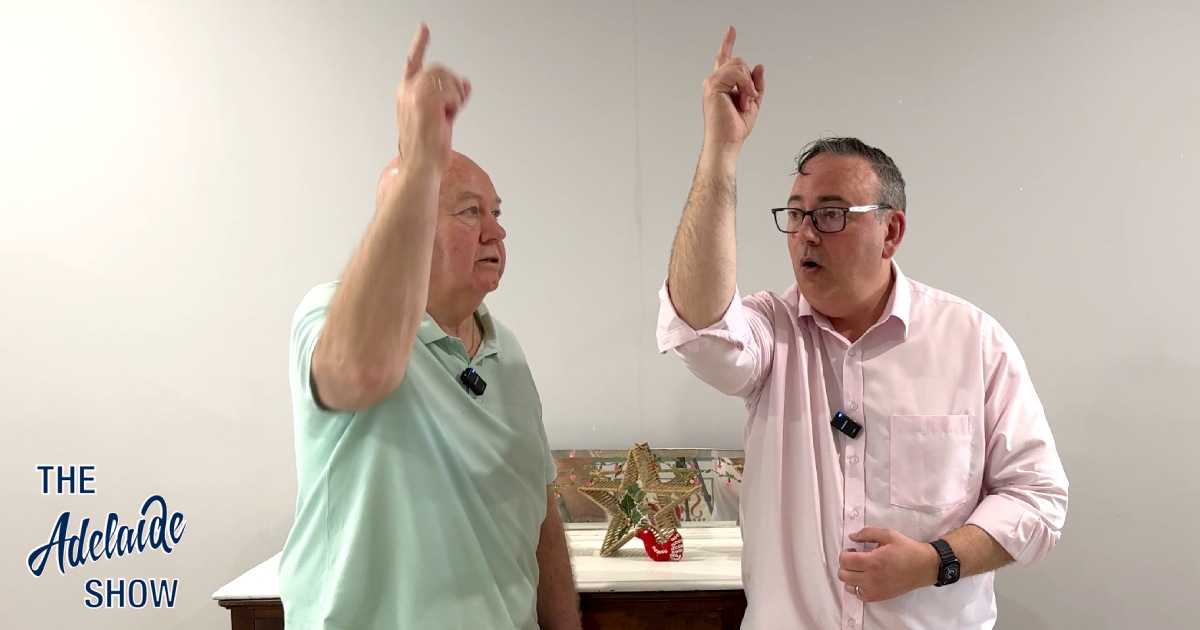
Host Steve Davis chats with retired international cricket umpire Steve Davis about split-second decisions, surviving the 2009 Lahore terrorist attack, and the theatre of raising that iconic index finger, while sampling Ballycroft Vineyard’s 2024 Small Berry Montepulciano over a conversation that reveals the noble spirit running through cricket.
When Indian cricket fans unleash fury on Twitter about disputed LBW calls, host Steve Davis fields the abuse meant for someone else. This episode brings together both Steve Davises for the first time. The retired umpire who stood in 57 Test matches shares what it’s like to make split-second decisions in front of millions, survive a terrorist attack in Lahore, and maintain composure when Shane Warne announces his next delivery to the batter.
The SA Drink of the Week features Ballycroft Vineyard and Cellars’ 2024 Small Berry Montepulciano from Langhorne Creek, tasted and endorsed by both Steve Davises. The wine presents an intriguing contradiction, its dark appearance suggesting heavy Barossa Shiraz, yet delivering a lighter, fruit-forward palette that Joe Evans recommends chilling for summer enjoyment.
The Musical Pilgrimage features Steve Davis and the Virtualosos with “From the Cathedral to the City End,” weaving together Test cricket, Adelaide Oval, and the 1662 Book of Common Prayer into a meditation on how this game brings us together.
You can navigate episodes using chapter markers in your podcast app. Not a fan of one segment? You can click next to jump to the next chapter in the show. We’re here to serve!
The Adelaide Show Podcast: Awarded Silver for Best Interview Podcast in Australia at the 2021 Australian Podcast Awards and named as Finalist for Best News and Current Affairs Podcast in the 2018 Australian Podcast Awards.
And please consider becoming part of our podcast by joining our Inner Circle. It’s an email list. Join it and you might get an email on a Sunday or Monday seeking question ideas, guest ideas and requests for other bits of feedback about YOUR podcast, The Adelaide Show. Email us directly and we’ll add you to the list: podcast@theadelaideshow.com.au
If you enjoy the show, please leave us a 5-star review in iTunes or other podcast sites, or buy some great merch from our Red Bubble store – The Adelaide Show Shop. We’d greatly appreciate it.
And please talk about us and share our episodes on social media, it really helps build our community. Oh, and here’s our index of all episode in one concise
page.
Running Sheet: Steve Davis Talks Cricket With Former Umpire Steve Davis
00:00:00 Intro
Introduction
00:01:50 SA Drink Of The Week
The SA Drink Of The Week this week is a 2024 Ballycroft Montepelciano.
Joe Evans of Ballycroft Vineyard and Cellars made an unexpected connection five weeks before this recording. During a Barossa wine tour for friends visiting from England, Steve Davis the umpire introduced himself at the cellar door. Joe mentioned knowing another Steve Davis from Adelaide, someone involved in cricket. The dots joined. Both Steve Davises then converged on this episode, linked by Langhorne Creek grapes and the patron saint of Adelaide.
The 2024 Small Berry Montepulciano arrives in the glass looking deceptively heavy. Its dark colour suggests bold Barossa Shiraz, thick and commanding. Yet the first sip tells a different story. Light fruit dances on the palette, a brightness unexpected from that brooding appearance. Joe recommends chilling it slightly and serving through summer, perfect with Italian or Mexican food.
Steve the umpire remembers that 10:30am Sunday morning tasting at Ballycroft. When Joe poured this wine, Steve thought immediately of Barossa Shiraz. That’s his drink. But then came the taste, revealing something gentler yet structured. The wine builds as it sits on the palette, gaining weight and presence. Like a pitch heading into day three or four, settling into its rhythm rather than losing life.
The conversation meanders through wine, travel and cuisine. West Indies food has never won Steve’s heart, so more of this Montepulciano would help those meals considerably. Host Steve notes how the wine shifts from what seems like a marriage between Pinot Noir and rosé to something with genuine body and staying power. It’s not Pinot weight, not Grenache or Merlot either. The complexity reveals itself slowly, rewarding patience.
The 2024 Small Berry Montepulciano from Ballycroft Vineyard and Cellars, endorsed by two Steve Davises, stands as this week’s South Australian drink.
00:10:25 Steve Davis and Steve Davis
INTRODUCTION:
So, I need to come clean about something. For years on Twitter, I’ve been fielding abuse meant for someone else. Indian cricket fans would see “Steve Davis” and unleash fury about a disputed LBW or a missed edge – and when I’d reply, mortified apologies would flood in. They’d meant the *other* Steve Davis. The one who stood in 57 Test matches, 137 ODIs, survived a terrorist attack in Lahore, and spent 25 years making split-second decisions in front of millions. Today, finally, I get to meet the bloke whose honour I’ve been accidentally defending. Steve Davis, welcome to The Adelaide Show.
NOTES:
The conversation begins with a revelation. Far from being retired, Steve Davis the umpire spends twelve months a year refereeing cricket across two continents. Every six months he travels to England for County Cricket, returning to Australia for Sheffield Shield and Big Bash matches. When he thought retirement from umpiring might leave him lost, the England and Wales Cricket Board offered him a lifeline that turned into a globe-trotting vocation.
His cricket origins trace back to Elizabeth, newly formed with perhaps eight houses when his parents arrived as ten-pound Poms. His father Dave Davis played for WRE Cricket Club alongside John Scarce, whose son Kevin Scarce kept wicket for Steve at Elizabeth High School and later became Governor of South Australia. Cricket in Adelaide was woven through family, friendship and those Saturday afternoons where you’d stand in as a sub fielder, watching your father’s team and falling deeper into the game’s rhythm.
The path to international umpiring began humbly in D Grade after finishing his playing career at West Torrens. Within two seasons he’d progressed to A Grade, and by November 1990 he was officiating his first Sheffield Shield match. His debut came partly through circumstance rather than genius. When Tony Crafter retired to become Australia’s first full-time umpire manager, a vacancy opened among South Australia’s two eligible international umpires. Steve joined Darryl Harper in that select group.
On 12 December 1992, exactly 33 years ago yesterday, he walked onto Adelaide Oval for his first One Day International. Pakistan versus West Indies. His home ground, but the nerves were overwhelming. Terry Prue, his Western Australian colleague, radioed from square leg to report that Richie Richardson had noticed Steve missing all of Wasim Akram’s no balls. In his nervousness, he’d forgotten to look down at the front foot. When he finally started calling them, Wasim’s response was gentlemanly: “Oh, come on, we’re all friends out here. Give me a bit of warning.”
The umpire’s process demands intense concentration. First, watch the front foot land. The moment it’s safe, eyes shoot straight to the bottom of the stumps, letting the ball come into view. As soon as the ball dies, switch off briefly, then begin again. Steve ran his counter one ball ahead, clicking after each delivery so the number five meant two balls remaining. This meant no clicking back for no balls, just not clicking forward. Tim May once stopped mid-delivery and demanded Steve stop clicking his counter during the run-up.
His Ashes Test debut at Adelaide Oval in 1997, just his second Test match, stands as one of his finest days. He got every decision right on a 44-degree day when England lost the toss and their bowlers were bowling one-over spells in the heat. Steve Bucknor, his partner that day, also had a flawless match. Alex Stewart still calls him “legend” when they meet at English grounds.
The Decision Review System arrived while Steve was umpiring, transforming the role completely. Some umpires, like Mark Benson, couldn’t handle seeing their decisions overturned repeatedly. Benson flew home after two days of a Test match in Australia and never returned to international cricket. Steve embraced DRS immediately. His philosophy was simple: we’re going to end up with the right decision. Better that than five days of a team reminding you about that first-ball error while the batter you gave not out compiles a century.
These days, third umpires call all no balls in televised matches. The technology highlights the foot crossing the line, removing that split-second judgment from the on-field umpire. Steve wonders if he’d survive in today’s game, his neural networks so hardwired to glance down then up that retraining might prove impossible.
The theatre of the raised finger remains cricket’s most iconic gesture. Steve took his time with it, though not as long as his late friend Rudy Koertzen, dubbed “Slow Death” for the excruciating journey his hand took from behind his back to above his head. Some umpires point at the batter instead of raising the finger, a practice Steve abhors. The law says raise the index finger above your head. The drama lies in that pause, that moment of tension before the finger rises.
He carried the essentials: a counter, a wallet-style kit with sprig tightener, pen and pencil, notepad for recording incidents, light meter readings, and lip balm. Some umpires packed their pockets with everything imaginable, but Steve kept it minimal. His process worked. He knew what every ball demanded of him.
Shane Warne’s deliveries would fizz through the air with such spin and accuracy that he’d announce his intentions to batters. “This is my wrong one. This one’s going on your leg stump.” It worked brilliantly, planting doubt even as batters wondered if he really meant it. Murali presented different challenges. Steve couldn’t predict where his deliveries would spin until he noticed Sangakkara’s gloves lining up behind the stumps. The great wicketkeeper knew exactly where every Murali ball was heading, providing Steve a crucial visual cue.
The conversation turns to safety. Fast bowlers send the ball down at 150 kilometres per hour. When batters connect with the full force of their bats, that ball can come back even faster. Steve got hit more than once. At St Lucia during a West Indies versus Pakistan match, he turned at the wrong moment and the ball struck him square in the backside. Looking up at the big screen, he saw himself mouthing the words that immediately came out, while David Boon and Paul Reiffel, his Australian colleagues that day, doubled over in laughter. The Pakistani batter complained that Steve cost him four runs. Steve’s reply: “Bad luck. You cost me a bruised bum.”
The smashing of glass still triggers something in him. Loud noises. Fireworks. His wife Annie says he didn’t get enough counselling after Lahore. She’s probably right. On 3 March 2009, terrorists attacked the Sri Lankan team’s convoy in Lahore. Steve’s van, carrying the umpires, was the only vehicle left in the roundabout after the team’s bus escaped. Every window was shot out. The driver died instantly from a gunshot wound. All five security outriders were killed. Lying on the floor among broken glass, Steve thought: this is not the way I should die. Not here. Not on the way to umpire a Test match.
They survived. The terrorists realised the Sri Lankan team had escaped and stopped firing. Steve returned to umpiring but never went back to Pakistan. He did return to other parts of the subcontinent, to other places that required trusting local security. During the drive back to the hotel after the attack, past kids playing cricket on dust bowls, he knew Pakistan wouldn’t see international cricket for years. Those kids who loved the game wouldn’t see their heroes. The political and ideological conflicts would keep cricket away.
Asked which game he’d relive for eternity, Steve chooses that second Test match at Adelaide Oval. The Ashes. England versus Australia. His home ground. Forty-four degrees. Every decision correct. Recognition from players like Alex Stewart who still speak warmly of his performance. It represents everything he worked towards: getting it right when it mattered most, on the ground where he grew up watching cricket, in the series that defines the sport.
He umpired with characters who became dear friends. Ian Gould, whose father was also named Cyril George, just like Steve’s dad. An impossibly unlikely pairing of names that bonded them immediately. In Calcutta, when Gould was being carted off to hospital with dehydration, he had to fill out a form listing his father’s name while smoking and drinking black tea. Steve looked over his shoulder and saw “Cyril George” written there. On Gould’s final stint umpiring in Birmingham, Steve was the referee. They spent every evening walking the canals with a few pints, the only four-day match where Steve never filed a meal claim. Rudy Koertzen. Steve Bucknor. These were the colleagues who made the profession worthwhile.
The spirit of cricket exists, though interpretation varies. Steve recalls Andrew Strauss making a fair point during the Steve Finn incident at Leeds. Finn had a habit of knocking the bails off at the bowler’s end with his knee during his delivery stride. Both batsmen, Graeme Smith and Alvaro Petersen, complained it was distracting. When Finn did it again and Smith edged to Strauss for a catch, Steve had already signalled dead ball. Strauss came over and said quietly: “Why didn’t you tell me you were going to do that?” Steve acknowledged it was a fair point. He probably should have warned the captain. The laws changed after that Test. If stumps are dislodged at the bowler’s end, it’s now a no ball. Cricket people sometimes call it the Steve Finn Steve Davis law change.
Cricket’s hierarchy remains clear. Test cricket stands at the pinnacle. Always has, always will. Ask any umpire who the best officials are, and they’ll list those who’ve done the most Tests. Steve’s 57 Tests mean everything to him. The 137 ODIs are nice, but Tests define an umpiring career. The Hundred in England draws families beautifully, but Test cricket is where greatness lives.
At the end of play, Steve would call “Time, gentlemen. That’s time.” A simple phrase marking the end of another day’s combat, another day of split-second decisions, theatre, and that noble spirit that still runs through cricket despite everything that tries to corrupt it.
02:00:15 Musical Pilgrimage
In the Musical Pilgrimage, we listen to From The Cathedral To The City End by Steve Davis & The Virtualosos.
IThe Cathedral looms over Adelaide Oval, watching cricket unfold from the city of churches. Steve Davis and the Virtualosos have woven together Test cricket, the Cathedral End, and the 1662 Book of Common Prayer into “From the Cathedral to the City End.” The song opens with the Prayer of Humble Access rewritten: “We do not presume to come to this thy over trusting in our own righteousness.”
Host Steve explains his childhood love for that beautiful English language, attending Church of England services where those words embedded themselves in his memory. The prayer’s cadence and dignity stayed with him. When writing this song, he wanted to capture three elements: Test cricket, Adelaide Oval’s special significance through Bradman and Bodyline, and that cathedral presence overlooking the ground.
The question arises: have you ever stood as an umpire and thought a captain made a terrible decision bringing on a particular bowler at the wrong end? Steve the umpire smiles. Sure, sometimes you think it’s surprising, maybe even adventurous under your breath. But someone who knows better than you made that choice, usually the bowler themselves selecting their preferred end. Most decisions are sound, even if they don’t prove successful. You can’t roll your eyes. You can’t show any reaction.
Commentators now need special accreditation to enter certain areas. The hierarchy maintains that barrier. Umpires can visit the press box, but commentators can’t come into the umpires’ area without risking trouble. It’s a good separation. Before play they chat on the field, saying hello to the numerous commentators modern broadcasts require. Steve never worried about Tony Greig sticking his key into the pitch. Didn’t seem to do much damage.
The song plays, capturing that ritual: hours before proceedings commence, sandwiches thoughtfully made, pushing close to the fence, ladies and gentlemen on the village green putting down their glasses. Two thousand balls, two thousand trials, each one potentially a wicket or hit for miles. Concentration demanded because no two are the same. From the Cathedral to the City End, making cricket bring us together again, forever and ever and ever.
Here’s this week’s preview video
Here is Steve Davis teaching Steve Davis how to signal “out” in cricket.
SFX: Throughout the podcast we use free SFX from freesfx.co.uk for the harp, the visa stamp, the silent movie music, the stylus, the radio signal SFX, the wine pouring and cork pulling SFX, and the swooshes around Siri.
An AI generated transcript – there will be errors. Check quotes against the actual audio (if you would like to volunteer as an editor, let Steve know)
424-The Adelaide Show
Steve Davis Umpire: [00:00:00] How does that sound, Steve? Is it Steve? Yes. Steve. And are you a Steven? I am with a pH, yes. Same.
Steve Davis Host: Hello, Steve Davis here. Welcome to episode 424 of the Adelaide Show Podcast, or as the other Steve Davis says, four for 24, what great bolding figures they would be. Uh, it is all cricket. And what you’re about to endure and hopefully enjoy is Steve Davis chatting with. Steve Davis, all shall be revealed[00:01:00]
Caitlin Davis: in the spirit of reconciliation. The Adelaide Show Podcast acknowledges the traditional custodians of country throughout South Australia and their connections to land, sea, and community. We pay our respects to their elders past and present and extend that respect to all Aboriginal and Torres Strait Islander peoples today.
Theme: That
lady
Steve Davis Host: in the South Australian drink of the week. This week. Uh, I will just quickly, informally, uh, introduce our guest. It is. Well retired now. Cricket umpire. [00:02:00] Yes. Steve Davis. Welcome. Retired from umpiring but not retired. Not retired from Cricket. Tell me she
Steve Davis Umpire: will explore that
Steve Davis Host: a bit more. We
Theme: will.
Steve Davis Host: Okay. I
Steve Davis Umpire: have
Steve Davis Host: to make, I thought I’d done exhaustive research.
Steve Davis Umpire: Ah, a quiet one now and then. Okay. In the, in the 10 years since I’ve been retired. Yes. From umpiring I was offered a, a job in English, cricket as a match referee in county cricket. And that, that I was wondering what I was going to do because I was a bit lost. A long story. Very short. Yes. 10 years. Every six months I go to England and Referee County Cricket, the hundredth County Cricket Vitality blast.
And when I get back home, I referee Cricket for Cricket Australia. Sheffield Shield Big Bash, women’s Big Bash. I’m, uh, 12 months a year in two different countries and [00:03:00] continents. Um, match referee. Now
Steve Davis Host: people say to me, who are supposedly retired that life gets busier when you retire. You’ve just, uh. Well, you’ve really underlined that.
Very much so. But, and we’ll get to the wine in two seconds. Yeah. I promise. I have no concept of me ever retiring. I just don’t know what that means. No, to me. Are you the same?
Steve Davis Umpire: Uh, I, I used to play golf, but my knees are no good. Right. And that I wasn’t very good either at golf. I enjoyed it, but I couldn’t imagine myself doing it more than once.
Uh, every now and then. Yeah. And I did wonder what I was going to do. I wouldn’t go and watch cricket. Um, just like, for instance, this test is coming up this week. I have no plans of going at all. It, it’s, it’s more like, uh, more work and watching cricket. I think that’s because six months a year I do it for a living.
I enjoy it very much. I love it. Uh, and I’ll probably watch it on tv, but I don’t think I’ll be amongst the crowd this week in our [00:04:00] dear old Adelaide.
Steve Davis Host: Well, that’s a petty I was hoping to bump into you. I’m going on the Thursday when it’s 38 degrees. Surely that’s all lure. No, no. Uh, look, the, the reason that we’re having this conversation, uh, has a link to a winery in Greenock.
It’s called Becroft Vineyard and Cellars. Joe Evans, a friend of this program and a family friend, um, he joined the dots and we’re about to reveal how, but we are tasting his 2024 small berry mon Paja. And I thought what we should do, Steve, is toast our late patron Queen Adelaide to the Queen, to the Queen.
All right, let’s have a little sip and then I’ll start the interrogation proper.
What I like about this wine, this is a confusing wine because it actually looks, when you look at the color, quite dark. Very much so, and, and, and thick. You, you, I would [00:05:00] anticipate this, this could pass off. I, if I looked at that, I’d thought, oh, this could be just a, a bright Shiraz. But then on the palette, there’s fruit there.
It’s light and it is a lighter style. In fact, Joe does say, just chill this a little bit and have it through summer. I remember that. Yeah. And so tell me, yeah, you said you remember that. What are you remembering?
Steve Davis Umpire: Um, it was five weeks ago. Uh, we had some friends over from England and, um, very good friends, a couple who came out and we promised we’d take them up, the Bara.
So Annie, my wife, organized, uh, a tour of the Brossa for six of us to other, another couple who have links back to Saffron Walden in Essex, where I stay every year. And, um, we left on a Sunday morning, got back, oh, late-ish Sunday night, and went to the Kensington Hotel for more drinking but not wine. And, uh, [00:06:00] Becroft was the first stop on this organized.
Wine tour in a, in a nice, comfortable car. So at 10 30 on the Sunday morning, uh, we were being lauded the praises of all of Joe’s wines. And this one, I agree with you, I, when he poured it, I thought that’s a Barossa Shiraz because that’s, that’s my favorite. And I drink it in England as well. Bara, any Barasa Shiraz.
But then you taste it and you say, no, it, there’s something else there isn’t there? And, and it’s rather nice even for 10 30 on a Sunday morning. Yes.
Steve Davis Host: But then how did he join the dots between us? Do you remember the moment? ’cause he told me his side of the story.
Steve Davis Umpire: Oh. We introduced ourselves as, and I said, I’m Steve Davis.
And he said, uh, I know a Steve Davis from Adelaide. And he said, and then after a while he said, uh, what do you do? I said, well, I’m involved in cricket. I used to park cricket and Tess Cricket and all the rest. He said, oh [00:07:00] my Steve Davis would probably be interested in talking to you. And wouldn’t that be something Steve Davis talks to Steve Davis apart from when we’ve had too much of this wine when we talk to ourselves.
Steve Davis Host: Yes. I’m so glad. Thank you Joe. Um, yes. And, and also I will just say with this wine, ’cause he knows that my palette is at the heavier end of the spectrum. This wine’s a bit of a pleaser though, because it hits you with that light. Like a, a rose with depth and body. Yeah. But. I’m now, um, dear listener, a few extra sips in the Steve, uh, which is my ploy.
Uh, that’s why I’ll just ask short questions. It’s actually building its body on my palette. The more I, it’s like I pitch heading in today, three No
Steve Davis Umpire: more for you.
I, I wondered whether it was like a pinot for stuff, but it’s not. It, [00:08:00] it’s, it’s more, it’s heavier than a pinot. And then I’m going through all the normal things like Merlo and Grenache and whatever. I dunno, it’s a multi, multi porky or
Steve Davis Host: Mm. In fact, Pinot, I’ll pick that up. ’cause I, I think if Pinot and a Rose, which itself is a brand, um, had offspring it, this lands somewhere there for the first part of the enjoyment.
Yeah. But
Steve Davis Umpire: I’m, the weight is increasing. I’m interested in Joe’s comment about chilling it and presenting it. I, I, I think that’d be worth doing. Not today.
Steve Davis Host: No. Well, he did say, he did say it’s good to chill. And I made a note he said to have it with, um, Italian food in particular. Yeah, it goes very well. Uh, and there was one other on Mexican food too.
Yeah. But I was, with all your travel to different places, is there a cuisine that you’ve become fond of that might also work with this? I mean, ’cause you would have to eat
Steve Davis Umpire: local [00:09:00] wherever you go mostly. Well, the West Indies cuisine has never been a favorite of mine. So the more a alcohol I can have while I’m eating that, the better.
And I think this would go
Steve Davis Host: very well. Fantastic. Well, there you go. That’ll be on the, the, uh, tasting notes next time, uh, when he does the 2025. Um, but this is really, I I, I, this is really finishing Well. Nice. Uh, you know, it’s almost like to just finish off the analogy. It is day three or four, but not turning into a turning pitch like the life’s gone out of it.
It’s playing true the way you want. It starts dancing around a bit, but then it settles down. I love it. So all that, all that’s left for me to say is the Ballycroft Vineyard and Cellars, small berry montepelciano 2024 at Langhorn Creek Grapes. Two is the South Australian drink. Of the week endorsed
Steve Davis Umpire: by two, Steve Davis’,[00:10:00]
Brett Monten: the Bugle audio newspaper for a Visual World. Hi, I’m Andy Altman. You might know me from the Bugle podcast, but statistically you probably don’t. You are listening to the Adelaide Show,
Steve Davis Host: so I need to come clean about something for this interview. For years on Twitter, I’ve been fielding abuse meant for someone else. Indian cricket fans in particular would see Steve Davis because my Twitter handle is at Steve Davis and they would unleash fury about disputed LBW calls or a missed edge.
And when I’d reply, mortified, [00:11:00] apologies would flood in. Here’s an example. I would get abuse held at me saying, I’m the most crooked umpire in the world, and I had a standard reply and I would say, I will say, but two things. Firstly. I am, but a man. And secondly it is, but a game and Indian fans without exception would immediately come back saying a thousand apologies.
We are so sorry. We are so sorry. Mm-hmm. That’s been my life. Now, the, um, the one who’s stood in 57 test matches 137 odis, survived a terrorist attack in Lahore, spent 25 years making split second decisions in front of millions, is actually the person they thought they were talking to. And I finally get to meet the bloke whose honor I’ve been accidentally defending for years.
Steve Davis, welcome to the Adelaide Show.
Steve Davis Umpire: Thank you very much. It’s quite interesting about those Indians, ’cause they wouldn’t do that to my face. But it’s under the guise of social media. [00:12:00] Social media. I, I guess they feel a bit safe until you reply to them and then they are seen.
Steve Davis & The Virtualosos: Yeah.
Steve Davis Umpire: And it’s amazing how it falls back into the human exchange.
It’s, uh, it’s interesting because for all my time umpiring, I never indulged in social media. It, it was difficult with integrity overlooking your shoulder and, uh, saying to be careful with this and be careful what you write. And so I just didn’t, and, and I, I haven’t bothered even when I’ve retired. So
Steve Davis Host: now with your English roots Yes.
And with your profile, have you ever crossed paths with
Steve Davis Umpire: Steve Davis, the snooker player? No, but. Would you believe every person at the gate of every Overland England said, oh, you’re not the snooker player. And they know I’m not. ’cause if you look at me, redhead, skinny, both born in London, but I think he’s a lot wealthier than me and probably a bit better known around the place.
But yes, the, [00:13:00] the uh, the gatekeepers at the ovals, when I give them my accreditation with Steve Davis say, oh yeah, snooker. Yeah.
Steve Davis Host: And you know, I get that as well. And I’ve got no real public profile. I get it. We all get it. Except on Twitter. I’ll do, this is your show. But I will just say one thing. I, he was on, I’m a Celebrity.
Get Me Outta Here on the u in UK version a year or two ago. And I had a woman tweet me saying how much she loves me thinking, you know, the snooker player. And I tweeted back saying, thank you so much for this. If you watch Wednesday’s episode and you see me move my little finger. That’s just for you. You do.
I I think that’s a, a net good in the world, don’t you? Sure. No harm, no foul. Did he move his little finger? I have no idea. I like it. But if she came back to me, I had one response was Oh, they probably edited it out.
Steve Davis & The Virtualosos: Yeah.
Steve Davis Host: Very good. You got all bases covered. Yeah. So now you’ve got a, you know, my character now.[00:14:00]
Anyway. I feel like I vicariously have been a guardian of your reputation. Thank you. That’s least I get to, I’m done Now. You weren’t on social media a lot, but have you ever googled yourself to have a look at what
Steve Davis Umpire: you were talked about? Uh, yeah. When, when someone asked me about stats, I tend to do that and, and I’m not a big one on stats.
Someone, I was in Perth, uh, last week. Mm-hmm. It’s hard to keep up, uh, with the under 19 championships in Australia and, and was asked along with another gentleman in our group to go to a suburban umpires night where they were having a meeting and um, the presenter gave me the 57 tests and 1 37 odis. And someone said, how many first class games?
I said, I wouldn’t have a clue. I would not have a clue. And I’m sure there’s somewhere out there with which would have that. But it hasn’t been a great interest to me. [00:15:00] Um. But I certainly appreciate the 57 tests. That’s, that’s
Steve Davis Host: a decent number. That is a big number. And by the way, just a footnote, another part of the alumni of the Adelaide Show is Andy Zaltman, who is A BBC cricket statistician and commentator.
Yes,
Steve Davis Umpire: he
Steve Davis Host: would know the answer,
Steve Davis Umpire: I’m sure he would. Yeah. He’s just not here at the moment. I think my boss in Cricket Australia now, um, Luke O’Brien. Hello Luke. He’s a very big stats man, so he’d probably know without having to look it up. What is it? ’cause stats goes together with cricket. Oh, unbelievably, it’s Have you got time for stats?
Is that the thing, when when you’re watching cricket, there’s enough time to look up some stats and say, oh, he is getting close to that stat. I, I’m sure that that happens with some radio broadcasters and
Steve Davis Host: others. And the thing that’s always struck me as a big listener to the a b, C Cricket coverage on, on summers is someone off the cuff that says, I [00:16:00] wonder how many, number five, batsmen wearing yellow hats have made 13 runs.
Yeah. And within about 20 minutes they’ve got an answer. It’s a bit sad, isn’t it?
Steve Davis Umpire: There is that, but there’s, that’s the joy of our game, I think, uh, that there are people like that. And I see them every week, um, still. Yeah. And, uh, and they, they’re very big part of the game and forever may they be. Mm-hmm.
Yeah.
Steve Davis Host: Talking of the game itself. Mm-hmm. When did it first get its hooks into you?
Steve Davis Umpire: Oh, playing early. My father played cricket. My father and mother were 10 pound poms. Uh, they brought their 4-year-old Stephen James Davis out to Australia. My mom’s sister was living in Elizabeth, newly formed Elizabeth. I think there was only about eight houses at that time, and that’s why dad chose dad.
And mom chose Adelaide. And we [00:17:00] lived with my auntie for a few months before we moved into her own housing trust home. Mm-hmm. Um, and he, he was a cricketer, very much a social cricketer in England, but a decent enough bowler and always had an interest. And I, I used to go and watch him play and then he played for WRE when he landed over here in the Adelaide turf.
And I used to go along there with, as it happens, the, the. The former governor of South Australia, Kevin Scarce Yes. Was my wicket keeper at Elizabeth High School and his father, John Scarce, played with my dad, Dave Davis, Cyril George, if it really needs to be known for WRE. And um, we used to muck around on a sad afternoon having played cricket in the morning and go over to Penfield and Weapons research establishment Cricket club there.
Steve Davis Host: Oh, there you go. Andy Salzman. If you are listening, how many father son combinations have [00:18:00] paired up with fathers and sons over the, over the history of South Australian district Cricket.
Steve Davis Umpire: Yeah. Thank you for that. Here’s one for you. So you were watching that drew you Yeah. And playing and playing as a kid and all up through, I loved it.
Um, and uh, just kept playing on Saturdays and. Standing in for dad’s team as a sub fielder when someone wasn’t there in the afternoon. Not very high level cricket I might add. Um, but yeah, it, it got me and I played and I coached and I, I played for Hector Ville Cricket Club, uh, and coached them for a couple of years.
Uh, that’s out near your way? It is out my way. And, uh, and I sort of, I lived at Ross Trevor as well. We allowed to say where you live. Yes.
Steve Davis Host: Well we have now, and I’ll forget to edit it anyway.
Steve Davis Umpire: Uh, and then I, I, uh, I felt a bit like I should try for district cricket and I moved [00:19:00] through various circumstances to, uh, Brooklyn Park.
And I, I went along to West Torrance and, uh, ended up playing a few years of B grade there. I was sort of mid to late twenties then, so I wasn’t a youngster anymore, but it was a pretty strong side with David Hooks and a few others. I don’t want to name drop too much, but at one stage the A Grade had David Hooks, Ian Chapel, Jeff Crow, Rick Darling, uh, and Steve Davis, the good club man as hooks, he said, because I was the last to leave the bar.
I think, um, playing be great, uh, but enjoying it very much. And, um. I’ll continue and, and how that hooks in because I finished my playing career at, uh, west to lower grades, knees were shot and thought I’d still like to be involved in cricket. I was very much doing administration work most of the week. [00:20:00] So I, I was on the committee and I didn’t want to go for president or whatever, so I thought I’ll do something else.
And, um, then I, uh, got into umpire. So I started off in degrade the year after I left playing.
Steve Davis Host: Alright. There’s two questions, uh, that have arose, arisen in my mind. One was, have you ever tried to name how it got its hooks in you? Is there something specific? ’cause of all the games, this one is one where every, you are on your own for a moment.
You’re part of a team, but it’s just you and the bowler and those fielders. Yeah. And you can be gone for a duck. And the psychological way to that. Is there anything, can you, have you ever named what it is?
Steve Davis Umpire: No, that’s a bit deep for me, I think. Okay. Uh, I think it was just the game itself. I, I really enjoyed bowling.
I used to think I was very quick and I wasn’t. But, uh, I had these dreams. Uh, I was an [00:21:00] okay batsman. As, uh, a youngster. And then West Highlands found my place at number 11. Beautiful. But I ended up playing in sea grade for West Highlands and winning the bating trophy, opening the batting. So just slogging.
And in sea grade you get a few people dropping catches. So I averaged 30 that, that season, that that was all right. Um, so no, nothing. I just being involved on a weekend, on a weekend because I was, I was building a career elsewhere and I was quite happy work-wise. Yeah. So I know had no, no great shakes on where I was gonna end with this umpiring other than being involved in cricket on a weekend during the summer.
Steve Davis Host: So the other side of the coin of the, the first question, so you did warn me at the beginning that you would go off onto tangents. Yeah, I think I might do. Was was, I’m just curious, when you moved to Umpiring, having had Hookie, Ian Chapel, et cetera, as colleagues, was [00:22:00] there any wanting to just have it over them a little bit just to have a little bit?
No,
Steve Davis Umpire: no, no, no. Not at all. Um, it is a very good thought because when I eventually umpire David Hooks, when he was captain in South Australia, he would give me hell nicely as David could, for example, early. In the Sheffield Shield, my Sheffield Shield career, the fielders had to give the ball back to the umpire at the end of the over most were quite nice hooks, would pel it at me and make sure I caught it.
Now when you’re hanging onto a counter in one hand and maybe someone’s hat and then hooks, throws it in, I’d had to catch one hand. And I did. I made sure I did every time and he’d just gimme a grin and he didn’t stop
Steve Davis Host: there. Is that ’cause sat? I’ve never played organized cricket. I get the Christmas cricket going, [00:23:00] uh, mates and I used to play just backyard shed stuff all the time.
I love it that I’ve, and I think the thing that I have, I regret the most about that. I don’t regret not being smashed around by a hard ball and injured. I don’t, I don’t miss that, that camaraderie of, of being there together. And it’s gonna be slow. It’s gonna be hard, it’s gonna be tense. Could be boring sometimes, but that’s the, that’s the X factor for me.
That I, I think, I think
Steve Davis Umpire: there’s a lot in that. Mm-hmm. A lot in that. And you look back and you say, gosh, you, you’re trying to bowl fast. And in those days, having a drink was just a sign of weakness. So you could only have drinks at the drinks break. So I used to sneak down to fine leg and have, uh, someone just sneak a bottle of water or something there.
But it was frowned upon. Incredible, isn’t it? Yeah. And, and taking salt tablets of all things to, to help you. Probably the worst thing you could take. I don’t know. Um, but [00:24:00] you think on some of these grounds where it’s 40 degrees and you’re trying to bowl fast and why, why are you doing this on your days off?
Well, because you love cricket. And afterwards when you’d showered and got back to the club rooms, there were all your mates there and you’d tell long tails about how well you bowl and how unlucky you were. And yeah, I knew it was as much as you did that. It wasn’t quite the truth. But we were there all as one.
Steve Davis Host: Let, I, I need to just touch base at the beginning, I believe, ’cause you won’t know this because you’re not into statistics, but December, 1992 might ring a bell.
Steve Davis & The Virtualosos: Yep.
Steve Davis Host: Your international debut here at Adelaide Oval. 12th Of the 12th. Oh, yesterday. Yesterday. Um, do the sums. 2025, take nine, whatever that is. 25 plus 8 33 years.
Yeah. Yeah. Pakistan versus who? West Indies. Very good. I’m just, I need to check this. No, no, that’s good. Can you walk us [00:25:00] through walking on
Steve Davis Umpire: for that? It, it’s a bit of a story. In fact, I was with Terry Pru, the Western Australian umpire, and he was my partner in my first one day international. And I’ve just seen him this past week in Perth.
And we revived a few memories. It was around about the time of his birthday and I should have like an idiot forgot to ask him when was his birthday? ’cause he’d probably say, you should already know. 12th of the 12th, 92. Um, Adelaide Oval, which was my home. Now I’d, I’d done first class Cricket at that stage.
I’d started umpiring in 87. 87 when I finished 87, 88. I think I’m looking at you. I’ll, I’ll I’ll
Steve Davis Host: correct you later. That’s all right. Thank
Steve Davis Umpire: you. I think it was that, or was it 88 89
Steve Davis Host: Andy Altman.
Steve Davis Umpire: So I, I was started off in D grade by the end of the first season I was doing B grade. [00:26:00] Second season I was in a grade and I had been picked to do my first, first class game at Sheffield Chew level in November, 1990.
That’s the First Shield game. First Shield game. So two years later, doing your first one day International was a bit of a hike. Uh, now I’d like to say that I was a genius umpire, and that’d shone out, so I got that, but it’s not quite the truth because every state had two umpires who were eligible to do international games.
So six states, 12 umpires. Um, we had in Adelaide, Tony Har, Tony Crafter, and Darryl Harper. Oh,
Steve Davis Host: wow.
Steve Davis Umpire: Uh, that year, Tony Crafter resigned, retired from, um, point to take up the first full-time position of an Australian cricket umpire manager in Melbourne. So [00:27:00] his departure meant there was a vacancy in those two, um, state umpires who were eligible.
And I was going, okay. Then, so I joined Darryl Harper as the two, one of the two states. And I think we, uh, I, I’m a bit hazy, but I, I do remember that first, first shield game with trepidation because I think I was terrible. It was Western Australia, south Australia. The Ashes tests had just finished and Western Australia had Alderman, Bruce Reed, Mike Valletta, uh.
Marshy, uh, gro what was terrible Marsh was captain and they gave me, hell, marshy introduced me to all his players saying, this is Steve Davis, he’s doing, and nodding his head round the dressing room. He’s doing his first shoe game today, fellas. Isn’t that great? In other words, a hint give him, hell yes, they did.
And, and I succumbed a bit. I didn’t have the best game, but I [00:28:00] did better in the second game. So I told you I’d digress. So, yes. Um, to have, uh, a one day international debut two years later was a bit different, but it was at my home game and in Shield Cricket or first class cricket. The, the umpires were always from the home state.
None of us traveled. Right. So my second one day International, which happened in January with the same two teams. Yes. January, following that December, was at the gaba. And I had never seen the gaba, let alone umpired on it. Uh, and, and didn’t know where anything was. And, and that game finished at lunchtime when, uh, the West Indies on a juicy GABA pitch cleaned up, uh, Pakistan for about 87.
And they were looking like going into the post-lunch period when Jo and Mead said, can we just keep going? I said, I said, and my fellow [00:29:00] said, no, under the, under the playing conditions, we can’t. He said, okay. So he put himself on the bowl and they got the required runs in that over I think about 12 or 14, which was unusual then.
That’s so we all, we all finished the game and they wanted the, the powers that be wanted to organize a, a shorter game for the public in the afternoon. By that time, both teams had vanished, so there was no way, so I was in a swimming pool in the Brisbane hotel when I was supposed to be doing the second, and he is my second one day international.
Steve Davis Host: Yeah. I will bring you back to the question. Hmm. What was it like striding onto the oval for your first one day International?
Steve Davis Umpire: Uh, it’s a very hazy, very hazy point. I was nervous as anyone can be, and I do remember, uh, my mate Terry Pru. Coming over the radio and saying, um, Richie Richardson’s just said to me, your mate down the other end is missing All the no balls Off was a mra, his [00:30:00] front foot.
And in my nervousness, I’d forgot to look down and called no balls. Wow. And uh, as soon as I did was Imra said to, oh, come on, we’re all friends out here. You know, give me a bit of warning. Well, I hadn’t even been looking. I can say that now ’cause I’ve finished Uping. Yes. But it’s one of those things you think, you go through all your routine and then you get up there and lose everything and uh, uh, so again, I don’t think I made too many howers apart from missing some no balls.
I think it was pretty straightforward game. I think the West Indies, uh, sorry, Pakistan had five run outs in that game. I’ll let you draw your own conclusion. And they did lose the game, which they probably should have won. Um, were there a bit of weather around? Yeah. Were there
Steve Davis Host: TV replays for run outs at that point?
Steve Davis Umpire: Not at that point, no. So
Steve Davis Host: you actually had to do inverted comma, proper umpiring. Yeah,
Steve Davis Umpire: but the run outs were like four, four meters short of Oh, okay. [00:31:00] Okay. They’re pretty clear
Steve Davis Host: now. One thing that struck me, uh, over this last summer, so we’re almost at the beginning of this year, we were in Port Lincoln where my brother-in-law and his son both play cricket.
Very gifted. And they were going to play their local one day, their 2020 competition that night, and I think they were short an umpire, and I said, I’ll do it. I mean, it can’t be that hard. No wicked court, whatever. Then they started going through just the little things like you have to count every ball.
You have to have to assist them to tell the other team when there’s only two balls left in the over. That’s just the beginning of it, Steve.
Steve Davis Umpire: Yeah.
Steve Davis Host: It’s, it’s amazing that a human can keep up with it. Can you just, what? What do you need to be on top of,
Steve Davis Umpire: let alone the rules? Well, the thing that I wasn’t on that particular day, that is your [00:32:00] process.
You do the same thing every bull. So if I was to say now that every time I ampire, I’d be telling a lie. Okay. First thing is stand as you normally stand. Your first point is looking down at the front foot as it lands. As soon as the front foot lands and you know that it’s not a no ball, your eyes go straight up to the bottom of the stumps Yep.
And let the ball come into view. And then you can see pads, stumps, pitch line and whatever. And as soon as the ball is dead, you switch off and you look around and then you start the whole process again. And in between all that is whenever you click over your counter for the next ball, I, yours used to be one ball ahead.
So in other words, I knew that there was two balls to come when my number on my counter said number five. And people used to look at me and say, how does that work? Yeah, that’s the fifth ball. I said, no, it’s the fifth ball coming up in my mind. So you ran your counter that [00:33:00] way? Yeah, because if, if it was a no ball, I didn’t have to click it back to account for the extra ball that was to both.
I just didn’t click it on. Yes. As long as I remember to do that. It’s a bit weird. Uh, we all have our different ways, but things like keeping, um, my counter in the right hand and hanging on to anything in the left hand, like caps, jumpers over the arm. Um, and then, then I knew that everything was clear for my clicking of the counter in the right.
But you’d never want to click, click the counter while the bowl is in his stripe. Right, Tim May. Yes. Some people did it. And he stopped in just about before delivering. He said, shut that up Mr. Referee. Don’t click while I’m bowling. It puts me off. Yeah, I’m sure he did. But I can
Steve Davis Host: imagine that might not be verbatim what he said.
Steve Davis Umpire: No, he, he a [00:34:00] bit more flowery than that.
Steve Davis Host: But you see, this is what us for me and maybe some other, uh, listeners who haven’t actually stood as an umpire or even played formal cricket, we’re oblivious to. ’cause everything just happens most of the time seamlessly. That’s the way it should be. Because they even told me I then would have to check with the other umpire square leg to confirm two balls.
Leg. Yeah,
Steve Davis Umpire: that’s the two, two, yeah, the two fingers. And some people in the subcontinent wanted you to do three balls to come, which would throw your whole process out. Um, and, and you’d, you’d accommodate them because that was their process, but it wasn’t the norm. But in those days, it wasn’t the norm for some English umpires to signal how many had come at all.
You never got anything from some of them. Uh, so that in thankfully, has changed over the years where you work as a team. Not so much in the early days in [00:35:00] my, in my experience anyway. Um, and then you get to Sri Lanka and the way they knew there was one ball to come because the scorers were at the bottom of the scoreboard.
Yes. And they, they’d wave a white hanky every time there’s one ball to come. And some of the umpires who were used to that didn’t even bother counting. They just looked for the white flag and know there was one bull to come. They were never wrong. They were never wrong. Those scorers.
Steve Davis & The Virtualosos: Yeah.
Steve Davis Host: Which would leave them open to creating some mischief if they wanted to.
Yes. But
Steve Davis Umpire: they didn’t want to. They didn’t want to. Not in my experience. Well, it didn’t stop me counting though. No. You’d look over and, and you’d tap your hat to give an acknowledgement that you’d seen. Thank you very much. One ball to come.
Steve Davis Host: See, I, I like that part of the game. Yeah. I think there is a noble spirit that runs through cricket.
Yes. I could be naive. I hope it’s still there. I think it is. I think it’s, I think it survives. [00:36:00] Yeah. Um, so thank you for walking us through that. And it, it also leads me, do you think we should have more empathy for umpires today? Because now every No ball, they still miss them. And then you see this action happen and then it comes over the big screen.
No ball. Yeah. That,
Steve Davis Umpire: see, they don’t miss them. They’re told not to call them. What? Yeah. Under the televised regime now. The third umpire calls all no balls. So the third umpire, you, even if you’ve seen the foot over, you don’t call it because there’s a chance you might get that wrong. So, so in fact, there, there’s some umpires around the world and I won’t name them that that’s been their savior because they never used to look anyway international.
Wow. But now, uh, it’s always initiated by the third umpire. It, it, the technology they have up there is so good and they have a technician [00:37:00] sitting next to them who highlights the foot being over the line front or sideline. And that then seems to delay the call. And, and we’ll see that on tv. But it’s not, it’s not the on field umpire who has to call him now in today’s game.
I don’t know if I’d survive in my process of 30 odd years of umpiring watching the front foot and instinctively, oh, as I saw it over the edge of the line, no ball. I, that would take a lot of adjustment for me. So perhaps I got out at the right time. Well, so
Steve Davis Host: to speak, because your neural networks would be so hard wired that it would take a lot to reframe out of that.
Yeah.
Steve Davis Umpire: Even, even just the fact, the act of looking down. You, there’s no need to do that. In fact, if you’re not supposed to call ’em, you might be tempted not to. And just focus straight up the other end of the pitch, which would seem like an eternity to me. Yes. Um, rather [00:38:00] than glancing down and then up and that some of those fast bowls, the ball gets down there in a long, in a hurry.
And, and some umpires used to try and watch the flight of the ball down. And we had, uh, an ophthalmologist in from South Africa, uh, in Dubai tell us that’s physically impossible for the eyes to keep changing focus. Watching a ball down 20 yards of a pitch. You, you just can’t do it. You’ll be, your judgment will be out.
So straight down, straight up to one focal point and the ball will come into view from the peripheral and then where you’re supposed to be seeing it.
Steve Davis Host: And you are pretty confident doing that. Yeah. That your brain can calculate the arc of the ball and be fairly confident that you knew where it was heading.
I knew where it had come
Steve Davis Umpire: from. Yes. What angle it was coming in at.
Steve Davis Host: Yep.
Steve Davis Umpire: I’m not saying it’s foolproof, but I was confident that I could judge that pretty well. And then you could [00:39:00] easily see where it pitched because you’ve got the stumps lined up. It’s got a pitch somewhere there and after it bounced what it was doing, where it was heading.
Sounds, sounds a bit. Technical, but you’re still going with what you feel and you’re not gonna get them all right. But a fair, fair percentage
Steve Davis Host: somehow we got to here, this was going to be later, but I need to, I, I actually want to jump to that question because I dunno how I’d feel as an umpire in 20 25, 26, where I feel like an umpire’s agency has been shrunken because of the ability to have reviews.
Yeah. And my question is, do you think with your makeup, would that ultimately make you start double guessing yourself or do you have to put that aside and trust yourself and just take it on the chin if it’s
Steve Davis Umpire: overturned? Absolutely the latter. Um, in fact, I [00:40:00] went through all that because the decision, decision review system was brought in while I was umpiring.
So I, I, I saw its initiation and its growth to when I retired in 2015, where it’s not a great deal different to now other than the cameras are better.
Mm-hmm.
Their frames per second are unbelievable. And, and there are some umpires in the past that haven’t been able to handle that. Um. And I, I’ll, I’ll give, I’ll give the best example of that.
And, and it’s fairly well known during a test match in Australia, Mark Benson from England flew home after two days. It, it just got to him amongst that, those things were getting to him that he had quite a few overturned decisions and he never umpired at international level again. Um, it can be that frightening or devastating or mind blowing or whatever.
For me it wasn’t because I told [00:41:00] myself we’re gonna end up with the right decision. Alright. It might show that I made an error and believe me it did. Okay. And sometimes on the first ball of a test match, oh. However, in the days prior to that first ball of a test match, if I got one wrong, I’d have five days of that team telling me I got it wrong.
And if I was unlucky that that batsman I gave not out going on and got a decent score, I got reminded very regularly. So there was none of that. Once, once they’d got the decision that was correct. Mm-hmm. Uh, according to technology, yeah. Then there was no arguments and, uh, everyone moved on. The players wouldn’t refer to it.
They might not like it too much if you made too many of those. And that’s fair enough. You’re supposed to be the elite. Level and getting most of them right. Um, but they accepted that, okay, he might have made that error, but it got corrected. So things are okay. [00:42:00] So I was quick to embrace that if you like.
Um, I, I used to have a think about, well, this is changing the game and what happened to the luck of the draw swings and roundabouts. Well, benefit of the doubt a person sitting at home is watching replays and seeing that you’ve made an error. Why not be able to use that in a technically more exact way to have it have the game?
Right.
Steve Davis Host: I suppose I did say benefit of the doubt before there wa what, wasn’t there a protocol of the batter getting benefit of the doubt? It was never written
Steve Davis Umpire: anywhere.
Steve Davis Host: No.
Steve Davis Umpire: But yes, in practice and a lot, a lot of the, a. Um, pre Steve Davis umpires. As soon as a foot went halfway down the pitch, it was not out, you know, uh, too far down the pitch, but there were no replays to show that they were wrong.
So they’d tell you they were the best umpires ever, but I’d like to [00:43:00] see them under the full review system, but I’m not having a go at them. That’s, that’s the protocols that were there. Uh, it was, it was just accepted that, you know, you’d see, uh, batters padding up and, and putting the pad royal down the pitch.
Well, Shane Warren was one to say that’s all rubbish. And when decision review system code, it was proved that a lot of those were in fact going on to hit the stumps.
Steve Davis Host: So on that note, yeah, sometimes when I’ve had a Joe Evans small Berry Shiraz and its very nice, too late of the evening. I wonder if we had this technology at the beginning of cricket, how might our record books.
Look today, would Don Bradman have 99.94? Would other greats be as great? Would things have balanced out in the wash? My feeling is because of the unwritten [00:44:00] benefit of the doubt, some scores would be much curtailed. And some of those, I hate using this word with Tess, cricket, boring patches, where particularly England would just pad up, pad up, pad up, pad up.
Steve Davis Umpire: Yeah. Might be gone. I think you’re right. I think, I think that’s in fact the case. However, if you look at the broader game in those years, uncovered pitches, oh
Steve Davis Host: yes,
Steve Davis Umpire: you know, subject to all the weather that could come in the, the batters, if they’d had covers, then Bradman might score 199.4. However, I think the balance would be that if every decision was subject to a review, possibly, then some of those would have to be against him, which would then bring that down.
So maybe things balance,
Steve Davis Host: maybe they do. Uh, and I mean, ultimately it is such a great game and it is an enduring test. This will be a long question if you want to have a sip of wine. I should just say, [00:45:00] Steve, uh, because I have deliberately kept my questions short to get one up on you. We’ve got that. That happening.
We’ve got the, the potential that some of those records might have been broken. Nowadays, it’s matured. They’ve got three chances to ask for review per innings. I believe the, the thing is unless two, two, is it two? Two unsuccessful? Oh, two unsuccessful. Thank you. The,
Steve Davis Umpire: those, the, if there’s that good old umpires call, they don’t lose their reviews.
Correct. So there’s a possibility of some more.
Steve Davis Host: And what I like about that is it means you don’t just do it for LA Oh. Um, lightly. Yeah. But I see when it’s getting towards the end and they’ve got ’em, they spend them anyway, to me that’s an affront to the professionalism of umpires
Steve Davis Umpire: discuss. Okay. Um, I can see [00:46:00] your point.
I don’t take it as that. Okay. I take it as. They’ve got one over left, we’ve still got a review. There’s a 1% chance of it being wrong. Let’s use it. What are we losing our review for that over? I don’t have a problem with that because the umpire would still be confident that their decision was probably right and if it was gonna be overturned, well we’ve got something very wrong and it should be overturned.
Okay. No, good point. Thank you. Yeah, I think so.
Steve Davis Host: Adelaide oval
Steve Davis Umpire: is where I’m going to Swelter
Steve Davis Host: on Thursday. You’re going?
Steve Davis Umpire: Yes. Yeah, my wife’s going on Thursday. I don’t know how much live cricket Mrs. Davis will be watching. It’s usually the champagne tent at the back you see on the tennis courts.
Steve Davis Host: See, at the time of recording, I was just on five AA and I said to the world if I, I want to get onto the SER board because I think, I’m assuming she’s a member.
Um, I think memberships should be [00:47:00] means tested not for what you earn, but percentage of balls watched. I think it should be 90%. And if you watch fewer than that, you lose your seat. You still get access to the village green. But someone who is public school based and. The father-in-law let his sacker laps, uh, would be able to pay to use that seat because they watch more than 90% of the balls.
Okay. What do you think? Do I have a, a snowflake chance I’ve got,
Steve Davis Umpire: because I’ve already mentioned my wife’s name, not name, but not mine. And she’s gonna be there. Yes. She’ll watch the ball on the big screen out the back. I know, I know. But you’ll have a little Cardi or something sitting on the seat up in the ground stand.
That’s what you’re saying. And it’s taking up someone’s view. Yes. But they’re still going to the cricket, aren’t they? No, they’re not. There’s still people going. No. Well, you’ve had another sip. I know.
Steve Davis Host: Okay, I’ll, I’ll temper it down. I like all, if I were a, [00:48:00] a batter, I would start aggressively and then settle in.
Okay. Throw, throw it all up. And if it works, where in, if you got out first ball, doesn’t matter. I take the constant, a Constance approach where it’s just you throw anything at it and it kind of comes off and then suddenly you’re everyone’s friend. Uh, yeah. Okay. But I, where I was getting to is Adelaide Oval.
Yeah. We all think it’s one of the most beautiful ovals in the world. You’ve actually trod many of them.
Brett Monten: Yes.
Steve Davis Host: Are we overly parochial or does it have something special? If you can remove yourself as a grown up in South Australian person.
Steve Davis Umpire: No, we’re not overly parochial because I hear it from other umpires.
Okay. Players internationally. I think even during the World Cup here in Australia, it was voted the best ground in that World Cup. That was Australia, New Zealand. Uh, it, it’s up there. Uh, and, and I think the development has only enhanced it because they’ve kept [00:49:00] things that are meaningful. Yeah. It’s not around cake tin type stadium like a few are.
It’s still got the grassy areas. It’s still got the Morton Bay figs and it’s got the old scoreboard, which is often works better than the, uh, electronic scoreboard. Believe me, as a referee, I can tell you that. Um, I, I think it’s a fantastic, uh, venue for international cricket and the drop in pictures have been enhanced.
First of all, there was a few problems and not now early on. Yeah, there’s not now. Okay. So yes, it’s, it’s, it’s, it’s up there in the first handful of, of, uh, grounds. So you’re out in the middle.
Steve Davis Host: Mm-hmm. You have the best seat in the house. Really. Do you get to enjoy the perfect cover drive that beautiful thing, or is there just too much going on to.
Appreciate the [00:50:00] beauty of some amazing deliveries or hits.
Steve Davis Umpire: No. The short answer, no, you don’t, you don’t miss those. You, you see them and you, uh, relish them. You don’t say out loud, great shot or, or what a ball, what a, at the end of the over, I used to say, well bowl to bowlers, who deserved that? Well bowl. Um, and when batters got to 50 and a hundred, I give a little congratulations in my own little way.
Yep. That I think were appreciated. Uh, but it was an acknowledgement that you appreciated some good things that had gone on and, and you can’t say great shot, but you just stand and, and as you’re signaling, you probably got a bit of a, a smile saying, wow, that was a cracker of a shot. Yeah. You certainly do appreciate it because, uh, you know that they’re so much better than you ever were.
And thank goodness for that. [00:51:00] Uh, yeah. It, it, you still, you still appreciate the brilliance of some of these players. ’cause when the timing is just on against the world’s best bowlers and how did they do that? You know, how did they do that? You know, still I’m in awe of some of those players.
Steve Davis Host: Is some of it.
Again, like you had that op ophthalmologist, uh, this would be a long question if you wanna sip, uh, you had that ophthalmologist in South Africa. There might be a theme through this. Say that as an umpire, you cannot physically watch the ball. Would it work from a batter’s perspective too? Are batterers trying to use that right brain, which sort of tries to see everything intuitively versus watch every moment of that ball?
What, what’s going I
Steve Davis Umpire: think you’d have to ask a decent batsman. Okay. I, I doubt it. You just prayed. I, because so much is, um, from a batter’s point of view, [00:52:00] seeing how it comes out of the hand and then watching how it rotates, however clever that is to do, I don’t, I don’t think they could employ the same tactics.
’cause I have to see at that split second when it’s about to thump into the pads or just miss the edge of the ball. I have to see what it’s doing. Then they’d have to make up their minds well before that what they’re going to do with that ball and where it’s, where it’s lined up and, and all. They’re brilliant.
It’s amazing, isn’t it? Oh, that’s why they practice it. That’s and, and good luck to ’em earning the money. They do. They, they deserve it
Steve Davis Host: on those Do any stand out as being completely enjoyable to watch? I mean obviously Shane Warren comes to mind, I dunno what he was like, uh, in between, but Sach, Brian, Lara, all those sorts of players.
Steve Davis Umpire: Uh,
Steve Davis Host: does anyone,
Steve Davis Umpire: well, you mentioned s and Brian LA are probably two of the best batters I’ve [00:53:00] umpired. Mm-hmm. Um, and, and I can add more. I mean, uh, Hashi Amla from South Africa umpired him several times in test matches, and what a gentleman he is too. Yeah. A brilliant man. And when he played for Surry for a few years and I was over refereeing, he’d see me and give me a big hug and say, what are you doing here?
And he was just as nice Then, uh, that’s his nature. Mm-hmm. But a brilliant bat. I saw him get 300 at the oval without giving a chance. Uh, very privileged to be out there in the middle watching that. And then, you know, the likes of Graham Smith. Very unorthodox. Yes. But so effective as a captain, and usually in the second innings when it counted one games for them against all odds.
And then the, the Kevin Petersons, who, again, unorthodox, but just a powerhouse and a lot of people have their views, [00:54:00] but I can only go on the way people treated me. He always treated me very well and was a very fair player. And, uh, I, I won’t stop saying that because that’s the truth. Shane Warren was very good.
He’d, he’d be quite enthusiastic and might have a little grumble, but he’d never carry on about it. Okay. It’ll be over be when the next ball was bold. And I, I, I umpired him in my first four tests because I could, so my first test was in, uh, 97, my last Australian test that I could, because they brought in the rules two neutral, neutral being non-participating country umpires.
Oh, there’s some detail there. I like to think we were all neutral. Uh, but I was, uh, fortunate to do two tests in Adelaide, one of which was an Ashes test. And that was as, that was my second test ever. [00:55:00] Uh, first one in Hobart, second one in Adelaide Ashe’s Test. And for a, a lad who was born in England and um, was a, an Australian citizen, uh, that was nice to be able to do that on your home city turf.
And I did all right in that game too. Uh, so that made it even better. Um, and I did a, um, so I told you I’d wonder, yes, I did Boxing Day test too, which until COVID, an Australian umpire couldn’t. Umpire after that 19. I did mine in, uh, 99, and then I did, uh, another test in Adelaide in 2000, and that was the end of Australian’s umpiring in test cricket.
Yeah. Until COVID, when it was only Australian umpires. Because it’s the only way they could have any test cricket. Yes. Remember that seems so long ago. But what a, what a terrible situation for sport [00:56:00] everywhere. You know, Australian rules, football, uh, teams being locked away for a whole season and playing on one ground.
It, it’s inconceivable now. But we got it done, didn’t we? We got it done. I was, I was stuck in England during COVID. Oh. I went over in February to do my job, uh, um, late February, early March. And my wife was joining me in, uh, may as she does, it’s a bit cold early, so I was over there and they locked down and, and we were, we were still on, I was on contract and we didn’t know when we were back on.
So I was, um, I was receiving my contract pay less a little bit because we weren’t doing anything. And, and uh, I didn’t get back here until October and Annie couldn’t come over at all and it’s not a great sub-story. She probably wasn’t the best place to be anyway. But no, I was there. Um, I think if there’s any COVID changed a lot
Steve Davis Host: of things.
It was [00:57:00] anywhere I wanted to be during COVID. I think South Australia was probably the pick. I think we got the balance pretty darn good. Yeah. Um, now just what you were saying then, again, flipped up two things. Shane Warren for example, ’cause of his dynamic spin. Yeah. What does that do to your mental map?
Trying to work out where the heck this ball’s going to into here.
Steve Davis Umpire: Uh, yeah. Good luck. Um, and I’ll give you another one. Murally. Oh course. Yes. I’ll talk about him as well. Shane, when in the early days he was in the Cricket Academy here in Adelaide, so I saw him a little bit then, but he was a little bit of a rebel then.
And I think he might have parted ways with the cricket academy before his time was over. Yeah. But even then when he bowled sun balls, they fizz absolutely fizz through the air and they’d, they’d swing pitch and then spit up [00:58:00] and unbelievable talent. And accuracy. Unbelievable accuracy. I’ve heard him tell batters what the baller coming up is gonna be.
This is my wrong one. This is my top. What? Just, yeah, because he’d say they don’t believe me, but I, here’s a straight one. Tell. Just gonna put this one on your leg stump. Watch out. It’s gonna just miss you off, Stu. Just, that’s hilarious. It’s almost, uh, arrogant, isn’t it? It is, but but it could be. And, and I, he, it was part of his ploy to upset bats, which it worked on.
Yes. A lot of them because they said, is he really meaning that or, yeah. So, uh, uh, brilliant, brilliant. We all miss him very much. Um, but I was fortunate to umpire him a lot, four test matches and then all the one day as which we could do still. Um, uh, and uh, I was very fortunate. Someone sent me a photo the other about a month [00:59:00] ago of me giving one of his deliveries out in, in the test match in Melbourne.
So beautiful. Nice. Mely mely. Um, yeah. Uh, mely. I, I could never work out where the ball was going to spin early days. I umpired him a lot because, uh, I was in, I toured Sri Lanka many times and also overseas when they were touring England and South Africa. Um, and then I realized quite early on that Sanger Carra, the keeper and captain, brilliant man, brilliant bat, lovely bloke, uh, still involved in cricket and always says hello, has the time to say hello and whatever.
He was behind the stumps and he’d know exactly where every morally ball was going, and I could see where his gloves were lining up. And that was a clue to me. So I took my eye off [01:00:00] the bottom of the stumps and looked at Sanger Kara’s gloves, and that helped me a lot. I couldn’t tell because otherwise you just couldn’t, otherwise you didn’t know it.
The same ball to me would do all different things, the same ball, and, uh, yeah, a brilliant talent. And despite all the controversy, yeah, I think certainly the laws changed to accommodate the likes of Murally. And I think in some cases it was warranted because every bowler had some sort of crookedness. If it’s, or a bending of the arm, it’s a matter of degrees.
But, you know, if we, if we hadn’t had that, what a, what a talent. And, uh, people might argue with that, and they, everyone’s entitled to their own opinion. I umpired him a lot and I didn’t have any doubts in my mind that it was still fair bowling.
Steve Davis Host: Okay. And what a talent. Again, two sides of this coin. One, when you talked about the ball fizzing through the air, how do you [01:01:00] hear a feather kiss of Okay.
Ball on bat,
Steve Davis Umpire: especially in wind. Yeah. Or with a loud crowd. Quite often you don’t. Okay. Certainly with the noisy crowd, like in India, oh, in India, you’ve got no hope. And you and I tell, uh, up and coming umpires just, just forget thinking. You’re gonna hear any nick, you’re not going to, but you have to use your other senses a bit more perceptively.
That is the little deviation. And then go beyond that and say the reaction of the player who either caught or played at it, or the bowler who didn’t quite appear when you thought he might. It’s, it’s a, it only experience can And then a lot of luck. Yeah. A lot of luck. Yeah. Uh, and you say, well, I got away with one there.
So you can’t, because, uh, that peripheral noise is, uh, [01:02:00] is quite, um, overwhelming at times and certainly in a stadium with a hundred thousand screaming. Compatriots of the Indian cricket team Yes. That don’t drink alcohol at the cricket. Thank goodness. No. Because imagine what the noise would be then.
Steve Davis Host: Imagine what tweets I would’ve got if they drank alcohol. Well, yes. Uh, so that’s the sound. And the other part of that coin was this back and forth, you know, warney saying, look, I’m gonna do a wrong and leads me onto, you know, sledging back, back and forth, banter out there. Do you remember any faithful, oh, some interesting.
I mean, I don’t want you to name names. No. But any, what is it really like for those of us who have only watched it on the telly?
Steve Davis Umpire: You know, I, it, it’s a question I always get asked whenever I’m addressing a group, you know, what are the best ledgers? And I honestly can’t recall ’em straight away, other than in a conversation, something will come up and say, oh, I [01:03:00] remember this, or whatever.
But I, I do remember often smiling and having a giggle at something someone said that I thought was particularly clever or stepping in when I thought it was particularly. Course or not warranted or not even funny. Yeah. It, it was a personal abuse. I, I, I was, I prided myself on being strong of stepping in, in those occasions and usually it was accepted unless they were totally silly and just carried on just too much.
Yeah. So I, I’m sorry, I, I don’t, I don’t particularly, you know, I, I, I’ve read all the books about Yeah. And I’ve heard so many people say that I was there when so and so said, oh, I gave your wife a biscuit every time. Yeah. Whatever.
Steve Davis Host: Wow. Okay. No, I mean, Lily would’ve been not playing when you were No. He got feisty.
Some, some players are getting a bit feisty from time to time. Just, is that [01:04:00] just, that’s a challenge for the umpires, isn’t it, to work out? When is a line crossed and Yeah,
Steve Davis Umpire: it is, it’s still happening. I mean, of course it, we’ve seen, seen it in recent series quite a bit, um, when, when athletes get fired up and their pride is on the line, it’s going to happen.
But I think as an official, if you, if you step in early, not too early, but when it, when it’s just not, you know, you know in your own mind when it’s, it’s crossed the line, it’s more than it should have been. And hopefully they listen because it’s not often that you do step in, but when you do. Well, he must mean business this time and, and that, that that only comes with a level of experience in getting to know the umpire and being, you know, after you’ve umpired a few series, they’ll, they’ll get to know you.
And if you’ve done all right, they know that well, he’s not gonna [01:05:00] fool us around. He’s not, he’s not joking this time. So, yeah, it, I hope that that
Steve Davis Host: still happens. Now, you did just refer to yourself as an official. You got time to drink, by the way. Thank you. Um, there is, as an official, but you’re still a human.
Is there any emotional reaction when you’ve been watching a batter? They’re on 99 and there’s an LBW appeal. Is there anything that makes you feel empathy enough to double think yourself?
Steve Davis Umpire: No, that’s a pretty, wow, that was emphatic answer so far. However, in the lead up to that, when a batter gets in the nineties, you double down on your concentration.
When, when the game gets tight, you double down on your concentration. Say, just go through your process, watch the ball, keep your head still or whatever, because that’s a very big [01:06:00] moment that if you don’t get it a hundred percent right, they’re gonna remember it for all the wrong reasons. So, no, you don’t sway one way or another, or, or give them a bit of.
Attitude other than you, just make sure that this time I’m Well, you like to concentrate all the time, but really double down till your head hurts.
Steve Davis Host: Yes. I mean, that’s actually heartening to know because we just kind of think that umpires are completely oblivious to these landmarks, these milestones coming up.
You’re not No, no. They know, they know when it’s 49 or 99 or 1 49.
Steve Davis Umpire: I, I’ll give you an example. Um, early, early in my state career, um, which is why I am, I’m going back over what I said because I umpired with Tony Crafter a couple of times. Yes. So, something, something’s wrong in my memory there, in my early days, and certainly I was with Tony in my first Shield game, but, uh, um, [01:07:00] David Hooks was coming up to breaking the number of the record number of runs, and he was having a bit of a rough trot towards the end of his career.
And I think he had something like 20 odd, 27 runs to get past. So we knew this very much and as soon as he got past that, I, I looked over and Tony’s going. Yeah. And I was doing the same because it just took a bit of pressure off us. That he’d broken that without us mucking up. Um, but you’d still would call it if it was called Absolutely.
It was there to be called. Absolutely. And and that was part of the relief that he didn’t give us. Cause to give him out.
Steve Davis Host: Yeah. Then you could have thrown the ball back at him at full pace.
Steve Davis Umpire: Well, yes, and that might have been interesting on my career for that.
Steve Davis Host: Uh, now in, in many ways this conversation has been a lead up to this question.
Mm-hmm. That [01:08:00] gesture of the umpire raising their arm with their index finger extended to signal out is the iconic move in the game of cricket. I don’t think anything at all comes close to that. You might disagree, but I don’t think it is. How conscious are you that yes, you’ve got that official role to play, but there’s theater in that we wait for that.
’cause it’s not out until you have made that decision and you’ve signaled that.
Steve Davis Umpire: Very conscious. Very conscious. Yes. Uh, and I’m glad you said, raise the finger because I, I delore the practice of pointing the finger at the batter, which seems to have crept into. Certainly some cricket associations, um, and, [01:09:00] and English umpires.
Traditionally, some of the great umpires used to point your out point at the battle. It’s not what the law says you have to do, but I like to think that I took my time in doing it. Some took their time even more. My dear friend, God rest his soul. Uh, Rudy Curzon was called Slow Death because it took so long for that hand to come from the back and round.
And I really think it was because early days he was giving himself enough time to rethink whether he should be given a doubt. I never got to ask him, but that was good theater too. Um, but there is theater. Yeah. You, you are aware of the theater, aren’t you? Sure. Uh, I don’t like being part of the theater.
Like, out Out would be Out and I was hoping you’d never ask me to mention a certain umpire’s name who’s seemed to thrive on the theater. But I’ll leave that to you. Mm-hmm. Billy. And, [01:10:00] uh, but, you know, um, I like to think that the theater is more about the way it should be and building up of the tension and then doing what you, the law says you have to do, raise the index finger above your head and, um, the batter is
Steve Davis Host: out in that motion.
If you have a second thought, did you ever have cause for the finger to be on the way and then you just scratch your ear? No. That’s happened recently, hasn’t
Steve Davis Umpire: it? No. No, because that seems crawled on unusual punishment. Well, it, it, to me it’s a bit like, um, taking that one further and recalling a batter who you’ve given out.
I, I would never, never adhere to that. I, once you’ve made a decision, you wear it. And if it’s got to that stage, well, you just have to wear what you’ve done. If there’s a review, fine. But in a, a non review game, calling someone back, um, that’s up to the opposition captain to do that. Yes. If they feel [01:11:00] they’ve been, the batter really shouldn’t have been given out
Steve Davis Host: for
Steve Davis Umpire: whatever
Steve Davis Host: reason.
Hold that thought. I’m going back to that in just a moment. Mm-hmm. But before we leave the gestures, the signaling of a four. Yeah. The six, the leg buys. The buys, they’re the main ones that spring to mind. Yeah. Are you umpires conscious of how your brethren do it? Yes. With their own style? Yes. Is is there like a, a hierarchy or a showing off order or a, because some of them have the most elaborate markings signals of a four that you think, no, this is now, this is now a sideshow.
It’s not, it’s, thank
Steve Davis Umpire: you for saying that. No, that was never me again. The laws say what you should do a four. Is the arm across the chest and finishing up in front of you mm-hmm. Without the waves on the water or, uh, the [01:12:00] rollercoaster ride that the hands on. No, I, I’m afraid I’m not, not very taken with all that.
No. Uh, it’s not, it’s not the umpire’s game and it, it shouldn’t ever have been and it shouldn’t be. Now, uh, you’ve got a job to do and let the players be the center of attention and anyone who thinks they can officiate and be a part of that center of attention is doing it for the wrong reasons and is in for a fall.
That’s why I can’t really do, I’m sorry. Okay. Because I would love to, I know you would. Yeah. Most, most people would. And look, you see the people in the crowd do it. Yes. You know the, the boat on the water for mm-hmm. Mm-hmm. That’s fine because they’ve seen it in some of the umpires, but okay. If that brings people and gives ’em some joy, fine.
I don’t like seeing umpires do it. No.
Steve Davis Host: And now this, this is why I wanted to get a copy of wisdom’s, rules of Cricket before I came here, just to double check this. ’cause I believe [01:13:00] this is true. There’s a nick, there’s a catch, but no one from the other team appeals. How’s that? Are you allowed to give it out?
No,
Steve Davis Umpire: you have to. It has to be an appeal. It has to
Steve Davis Host: be an appeal.
Steve Davis Umpire: You know, people say, what about bold? Well, that’s an obvious out, but no, uh, you, you have to have an appeal on a catch. Yes. Or a run out or a stumping.
Steve Davis Host: But even a bold, a a a bat could by Right. Stand there until you raise your Absolutely. They could, but you won’t raise your finger if no one’s appealed.
No, not if anything was, hasn’t appealed. No. So this thing lends me, I read a fantastic book recently by Harry Moffitt. He’s a former SAS operator, turned psychologist, so you don’t wanna cross it. It’s called the fourth, uh, pillar. And he talks about having his copy of wisdom’s rules of the game with him in England, watching the Cricket Bear Stow steps out of his crease and is [01:14:00] stumped.
And the Aussies appeal and all the palms around him say, what is it, Harry? What is it? And Harry looks, and it’s out. It is actually out. But Harry’s point is that Pat Cummins on that day as captain, missed a trick to be remembered for all timers. Gentleman, pat by not, reque, not, not going through. Mm-hmm. So first of all, if someone like, had, had appealed, you can’t not make a decision of that.
You have to make a decision, don’t you? Yes. So you have to give out, but the captain is able to say, actually don’t enforce it. Is that true? That is
Steve Davis Umpire: correct. Captain’s able to rescind that appeal. But I’ll add, add something to that particular besto situation. Mm-hmm. Besto himself in county cricket and a tour game, I believe tried to do the same thing to an opposition batsman who was [01:15:00] outta the crease.
So lived by one rule. Yes.
Steve Davis Host: But that brings us to the spirit of the game. Sure. And we did talk it right at the beginning. It does that exist because, I mean, it was tested with body light, uh, where I think I’m still uncomfortable about that. I think that was, that was a tantrum when you just weren’t good enough.
So it was, I wanna say cheating. That’s probably a bit. Uh, the players weren’t used to it. There was no protection. It was just vicious.
Steve Davis Umpire: Yeah.
Steve Davis Host: Australia’s not done great with sandpaper and our win at all costs attitude. Should we sort of, is there a spirit of the game? First
Steve Davis Umpire: of all? I think there still is. I think there is, and people say it’s the first part of the laws of cricket.
A bit about the preamble to the spirit, to the laws is a spirit of cricket. Mm-hmm. Um, interpretation of that is up to individuals, I guess. But I’d like to think there still is a [01:16:00] place,
Steve Davis & The Virtualosos: uh.
Steve Davis Umpire: Not, not to the point of overturning the laws as they are, but just in the claiming of a catch maybe. Oh, having it, having it reviewed and, or I love to see when it, there’s some doubt a fielder say, shaking his head and said or his hands and say, no, I, I I don’t, I didn’t catch that.
Or I don’t know. As soon as they say, I dunno, then you know that probably they haven’t caught it. But sometimes they don’t know. They, they die and look away. And the, the hand, do they get the fingers under the door? They might get the fingers under the ball, but there might also be some turf on the other part of the ball.
So then, then you’ve got all the technology that you hope the camera picks it up. ’cause we’re talking about a moving camera now, not a fixed one. So I think there are still, there is still plenty of scope for the spirit of cricket, but uh, not to throw [01:17:00] it directly back to the captains to say you should consider where we used to ask a captain, do you want to keep going with that appeal?
Or a manca, for example, the run out of a non-striker has been taken outta the captain’s hands altogether. The umpire just has to rule it out or not out under the described laws of cricket for that, where the, the non-striker backing up and the bowler on has whips off the bales before he delivers it. It has to be done in a, at a certain time and in a certain sequence of events.
But they, we used to say to the captain, do you want that appeal to go ahead? And they, they all, they all said, because I was on the ICC Cricket committee at the time when the, every, every mpi, uh, captain said, we don’t want that responsibility on our shoulders. Let the umpires make a call on that.
Steve Davis Host: See, to me, I think that’s the soft way [01:18:00] out.
I think that robs each captain of the ability to be that gentleman pat that, um, I’m, I’m not saying it’s easy, but to me that’s where character comes.
Steve Davis Umpire: I, I understand that sentiment, but I think it is sentiment. Okay, fair enough. I don’t, I don’t think it’s, uh, I don’t think it’s something you can hang your hat on.
If someone’s, uh, inclined to do that, let them do that. Uh, but don’t enforce it. Don’t say, maybe you should have when there’s nothing to say they really should have at all.
Steve Davis Host: Are you allowed to refer to the rules of cricket if you are stumped, so to speak by a situation? Or do you just have to know it
Steve Davis Umpire: all?
You have to know it all. You, you, some might say they take the, but can you imagine in a test match, bringing the book out and having a little read before you gave someone out? I
Steve Davis Host: know it’s not good optics. No.
Steve Davis Umpire: Um. There’s no excuse for an umpire at any level, but certainly at, uh, [01:19:00] those high elite levels, not knowing the laws and playing conditions.
’cause there are differences mm-hmm. Uh, intimately and being able to just make that decision. And believe me, there are times when I, oh my goodness, that something’s wrong with that, so I’ll just give it no out. And I dunno, if someone asked me, I’ll say, I’ll get back to you. It just didn’t look right. And it’s not a Nazi.
You can give someone who’s inquiring by then you’re running over and you, so
Steve Davis Host: can you remember a moment when you were really tested with a, a complicated little corner of wisdom’s rules? Okay,
Steve Davis Umpire: I I, I think this covers that one. Yeah. Steve Finn, Steve Finn, uh, had a very bad habit in his bowling stride of his knee knocking the bales off at the bowler’s end, which I always thought was a distraction to the batter.
Well, in a test match in [01:20:00] Leeds, I was with Rod Tucker at Square Leg and Steve Finn had done this a couple of times and nothing was done. And the batters, both batters Graham Smith and um, Alvero Peterson said to me, that really is very upsetting and, and distracting when he does that. So he did it again. I got on the radio to Rod and I said, excuse.
Am I allowed to swear? Yeah, go for it. Rod. This has given me the shits. Uh, he, he’s knocking these bales off. Both batters have set us distracting and Rod came back from Square and said, well, just call dead ball. Ah. Because it’s a distraction. So, and that’s in the rules? Uh, yes, it was. It’s not now. Um, and the very next time he did it, Graham Smith snick to Andrew Strauss [01:21:00] and was caught and I was signaling dead ball first time in the match.
Now that, that drew a little bit of discussion between Andrew and myself, he, he’s a perfect gentleman. Andrew said, and he said something very appropriate. Why didn’t you tell me that you were gonna be doing that? Oh, that’s interesting. And I thought That’s a fair point. Yeah. And I said to him, I, I probably should have Andrew, but there’s been no question this has been distracting.
The bats. The, the worst part about that was Graham Smith went on to make plenty. Oh dear. But there were times when, because we couldn’t call no ball, the law changed because of that test. They changed the law to then being a, being a no ball. If the stumps are dislodged at the bowlers end. Okay. After not too long a period of time, because the rest of that innings, Graham Smith was hitting those balls for four, and I’m there standing calling dead ball [01:22:00] because, so therefore his score is not counted either.
His score was not counting. So to be consistent, I had to then every time Steve fin did it and he did it a lot, um, can’t a coach fix that or was it deliberate? Well, they did, no, it’s not deliberate. It wasn’t deliberate. He, his knee sort of Okay. Bent out, sideways. Uh, but he, he’d done it quite a few times.
Uh, so the law changed because of, uh, that, so I still get referred to the Steve Finn, Steve Davis law change. Yeah. And for a while there, um, when I had him in one day and I’d, I’d, I’d give something not out. He’d said, you really don’t like me, do you? I think it was half humorous and half not. But we get on all right now.
I think he realizes that something had to change. You couldn’t, you couldn’t have that going on. So that Yeah. For, for whatever. Is that a good thing to be a part of, a rule change, a law change [01:23:00] because of something you’ve done?
Steve Davis Host: Well, it’s a living thing and I, I really appreciate you, um, acknowledging that.
Fair point. We could have actually said that to the bowler that this is about to happen. I probably should have.
Steve Davis Umpire: Yeah.
Steve Davis Host: Because I’m pretty sure Mily was told that we’re about to start calling you no balls by certain umpires. Even fair warning, I’m not sure about. Or maybe not, maybe not. Maybe don’t think so.
But that’s, that to me is part of the spirit of the game too. Yeah. And
Steve Davis Umpire: look, Andrew Strauss, God bless him, um, was not, uh, overly uh, demonstrative about it. He just was matter of fact and said, why didn’t you tell me you were gonna do that? Yeah. Yeah. And I thought that’s a fair point
Steve Davis Host: Now. That’s a
Steve Davis Umpire: fair point.
Okay.
Steve Davis Host: I wanna ask about some practical things. Yeah. What do you have in all your pockets when you go? ’cause it seems like you’re a [01:24:00] walking pharmacy and gadget center. Yeah,
Steve Davis Umpire: some are. What did I have counter? Mm-hmm. Uh, a little folding, like a wallet thing with, um, a sprig. Tightener. Um, I’m thinking back now.
Uh, pen and pencil, obviously a notepad. Um, why would you want that? Well, you have to write down. The ball and over of something that happened to refer back to, um, if you, if you take a, if something happened that you might have to do a code of conduct on someone, you write down some details. Um, if you take a light meter reading to think when you, you write down that reading, because that becomes a benchmark for the rest of the game.
Yeah. I didn’t, I didn’t write down a lot. Some people take reams of notes and I, [01:25:00] I don’t understand it, but what works for them is fine. Um, and I always used to have, um, um, a lip balm Yep. Thing to put on because in, in the sun I got a bit burnt on the lip, but then it became something that I just did every over anyway.
And even if the sun wasn’t out. So I didn’t have a lot in, uh, no in my pockets. But some have got bot loopers and all Why, I dunno. Um, maybe for afterwards, but they just have a pack of everything there. And, uh, yeah, it’s, and
Steve Davis Host: what is good, fair to eat. And how do you prep for going on? ’cause you’re out there, is there a thing you’re asking
Steve Davis Umpire: the wrong man, Steve, look at me.
Uh, athlete, um, uh, people will do some, some are quite good at. Their diet and whatever. I, I’ll eat whatever’s going and unless I’m in the [01:26:00] subcontinent, and I won’t, won’t usually have much at lunchtime because invariably it’s been sitting around a bit. I’m not, I’m not not having a go at anyone. It’s just, you know, there, there’s stuff sitting in Bay Marie’s that I, I, if it wasn’t freshly cooked or, or whatever, and I wouldn’t have a salad in, uh, in the subcontinent because invariably it’s washed in the normal tap water.
And, you know, just those things that travelers are told to be wary of. Mm-hmm. Um, uh, I, I didn’t use to eat a lot, but, um, yeah. Uh, maybe a sandwich. Um, maybe, maybe nothing. Certainly. Uh, I used to like to drink water and usually room temperature water out of a bottle, uh, rather than the Gatorades, I’m, I’m hoping for giving a plug that the, uh, the energy type drinks never used to work for me.
They were a bit sweet, [01:27:00] but always a beer after the game. Okay.
Steve Davis Host: Now there’s two parts. So this question too, the first part I’ll deal with, this is the uncomfortable one. What if you need to go to do a number one? Yeah. Or subcontinent number two. Yeah, because you did partake in the Bain Marie. What, what do you have?
Are you allowed
Steve Davis Umpire: to? Uh, well, if you don’t, it’s very embarrassing, but you try and avoid it. You, you try just before you go out. Certainly in like a one day game is three and a half hours of the innings long. Yes. Uh, with drinks breaks and, uh, quite often you’ll see an umpire runoff at a drinks break to Oh, powder their nose.
Yes. Yes. Uh, you used to always try and, um, what’s a nice way of putting it? And go, go to the bathroom, as with, as little time left before you walked out. So as late as possible to make sure you were emptying, uh, and then trying not to [01:28:00] drink too much when you were out there. So, but some, some hydrated so much that every break they could, even when a wicket fell, they’d run off and go.
To the lou, but the other one, uh, the other type of visit Yes. Where you got no control over that. And, uh, I, I do remember someone saying, oh, I got caught with, uh, a bit of an upset tummy and I, uh, just grabbed one of the bales and yelled out, the BA’s broken. I’ve gotta go and get the off he ran before something else was broken.
It’s a little balancing act of
Steve Davis Host: types. There’s only four bales on the, they could you four guys. Yeah. Now of course they’re all electric. They line up. Would you call the third umpire down if
Steve Davis Umpire: it was really bad to step in for you? Uh, no. That’s a, that’s a referee’s job. It, if, if it got to that sort of illness, then yes, uh, the third umpire would come onto the field and the reserve umpire, who often see on the sidelines [01:29:00] would go up and Wow.
But that’s even changed now where, like in the big Bash, for example, if there’s a change of umpire, the third umpire will stay as third umpire and the fourth umpire for ease of changeover change over. Yeah. Would, because they’re all qualified umpires would come onto the field and be the on field umpire.
Steve Davis Host: Now we, you talked about saving up the toilet trip for the last moment before you go out. Uh, I for, well, for almost as long as you’ve been umpire in cricket, I’ve been reviewing theater. And I have, I powder my nose as close to the beginning of the show as possible and as makes sense to me and as close to the end of interval as possible.
That’s been part of my thing, but another part that crosses our world a little bit is after the curtain falls, I go, I do not mix with the actors or directors for fear of either A, actually having my [01:30:00] thoughts tainted, or B, having the perception that they were.
Steve Davis Umpire: Yep.
Steve Davis Host: Do you mix, can you ethically mix with players after a game and especially those you are friends with, or does the friendship has to go on ice until either one of you has retired?
Steve Davis Umpire: Uh, it doesn’t go that far. You, you really shouldn’t be going into change rooms and having a beer or. But I used to, I did in my early shield days, I got invited in and, and most umpires did just for a couple of beers with whoever was in the field at that time, at the end of that day, but not hang around too much.
Mm-hmm. Um, internationally, you, you wouldn’t, no. Sometimes you’re staying at the same hotel as either the home team or the visiting team. Yep. And invariably it’s impossible not to run into them in a, a social environment where you’re having a meal or having a drink or whatever. [01:31:00] And then it’s probably best to be very careful of that.
Yeah. Okay. But most of the players would not shy away from that. Some would invite you over Steve o mainly me, because I was a pretty social sort of bloke. Yeah. Me and Ian Gould would walk in and they’d, they knew we’d buy them a beer, so they, but it, it’s different, different folks, different strokes and all that.
Um, but more so nowadays with social media and whatever, if, if someone took a, a photo of you, photo of you with captain of whatever team that,
Steve Davis Host: and the next day you give them nod out when it was Yeah. Pull that. Yeah. Yeah. Very dangerous. The other thing with the player dynamic, you mentioned your light meter before.
Steve Davis Umpire: Yeah.
Steve Davis Host: Calling a halt to play for light. Or rain? I am, uh, tell me if I’m wrong. I think that’d be one of the [01:32:00] harder things to do as an umpire, because you’ve either got both teams in your favor, like both agreeing or one team going, hang on, we’ve got the op, we’ve got the upper hand here. What are you doing to us invariably that yes, you’ve got television rights, which you should be immune from.
Uh, you’ve got the cricket board, you got all these, all these vying interests. What is that dynamic like?
Steve Davis Umpire: It, it, it can be a worry. Um, it’s troublesome because as you rightly say, someone’s going to benefit or have a, an advantage of any decision you make. So the bottom line is that if you feel it’s unsafe for any player, and that’s not just the batters that are facing the ball, it’s the fielder who has to try and pick up the ball that’s whacked down his throat on the boundary because of the light.
So you’ve got sight screens behind the batters. They, they, they’re probably gonna be the best ones to see that ball. But when it [01:33:00] goes out of there and goes to a field at, at the pace that it does, that can be dangerous. That can be dangerous for your square leg umpire who can’t pick it up. And invariably when it comes to safety and light and all the rest.
The, the conversation with your square leg is, did you pick that ball up all the way through? When it bounced and went through, I was having trouble. Okay. The square leg would then go to the other side and see if it had the same trouble. And that will form, form part of the decision making process. So the bottom line is safety of all participants, not just batters.
Steve Davis Host: ’cause I saw a Women’s Big Bash League final call. Did you called off just recently, did you? Yes. You knew I
Steve Davis Umpire: was referee for that, didn’t you? I didn’t know that. No. ’cause you didn’t know I was a referee. Correct? I That was a few weeks ago. Yeah. Yes. Yeah. So that was me
Steve Davis Host: as the match referee. We are so close to a result.
Yes. And the rain [01:34:00] had, I think it was rain had been there for a while. Yes. It had called off the first of the double header games. What tipped it over the edge? And obviously you, the umpire group had to not give a, you’re not allowed to give a damn about whether there’s a result being impacted. You’ve gotta go ball by ball, don’t you?
Uh, yeah.
Steve Davis Umpire: I, I’m, as a match referee in that situation. You’re not involved in that decision making. I’m not taking the easy way out. It was the umpires on the field who felt that it had become unsafe for whoever. Yeah. But there was like one or two runs. I know, I know. And I wish I hadn’t said I was refereeing Now.
Uh, you, you really can’t, technically, you can’t take into consideration what the state of the game is. Mm-hmm. But we had a, we had, oh, I’ve gotta be careful here. Yeah. We had a discussion afterwards and said in 2020 you, [01:35:00] you’d take things a little bit easier because it is a shortened game. And when you’ve made it a five over game.
Yes. Which one? It’d really have to be very dangerous to come off at that time. And look, it’s still an umpires call. The on field umpire call. And that’s the call they made. Whether in a, in a similar situation, they would do it again. I don’t know. Uh, but it, fortunately, and I’m getting out of this, uh, the referee doesn’t get involved in that at first class level.
Um, I think they do at
Steve Davis Host: international level. A rapid fire Rorschach test. You know how the psychotics show you something? You’ve gotta say the first thing that comes to your mind. Duckworth Lewis.
Steve Davis Umpire: Interesting. Um, uh. In the early days, we were told how to calculate that manually. Gee, we had um, hence your paper and hence we had someone from England over.
Could you imagine [01:36:00] what over, by, over, uh, all different how to, how to calculate it. It at the time that it’s needed to be calculated. ’cause there wasn’t a program then good luck. Now there’s a program. Good luck. Uh, and, uh, as, as a match referee, I have to check that I agree with what the Duckworth Lewis calculation is done by, uh, whoever does it, it’s usually the match manager of the game does the calculation.
And I have to check that That’s correct. Wow. But it rules, it’s, it, it, it’s a, it’s a program that spits out numbers for different wickets and all that. And you get a printout and I random check, oh, if it was three, three wickets down 25 overs, what have you got? And they give me a score. I agree with that.
Yeah. I, I think. I think it’s that complicated that people don’t know how to challenge it and it seems to work all right. You, you’re always gonna have a, how can that be? I know I [01:37:00] often, but I think, I think it’s taken all those things. Yes. It’s developed well over the years and there’s been a new, um, pro, a new version brought out virtually every second year after more data gets fed into the system about games and actual scores that have been there, and that’s how they Oh, and they keep sharp.
And so recently, over the last five years with scores becoming higher and higher in the short form of the game that it’s taken into a subsequently as, as have affected the, uh, Duckworth Lewis connotations.
Steve Davis Host: Right. I’ve just signaled last two balls of the over. Wow. So you know that, that’s, I’m trying to help you feel good.
Um, there is still time for a sip as well talking about checking with square leg. Can you see the whole ball? ’cause of safety? It is safety of the players, but you are standing where a batter can wind up and smack that ball at you. Now, if they get bold at 150 kilometers an hour, I haven’t done the physics, but I [01:38:00] imagine when they’ve got a force of the bat, that ball could be going faster than a Absolutely.
Yeah. Okay. Have you ever been hit? Yes. Does
Steve Davis Umpire: it hurt? Yes. It hurts your pride. Um, I really didn’t enjoy 2020 Cricket. And, and when I was there, I think in those stats I only did 20 odd international T twenties. It was just growing. I look now and I, I, I would fear for my health, uh, if I was umpiring now, um, because
Steve Davis Host: the reflexes
Steve Davis Umpire: just need to, well, and the flat batting and, you know, the, the power of that bat nowadays, I, I, I, uh, umpired Chris Gale, who used to belt it flat back at you.
Um, but now even the tail ends are heading out. Uh, I, I do shudder at times and yes, it, it, it can hurt and it can cause some problems. Um, [01:39:00] yes, uh, that’s all right. One day I read, uh, I think it was, um, it was, uh, St. Lucia. I was on the field and it was West Indies in Pakistan, and somehow I lost the ball, the batter.
I was at the bowler’s end, and I turned, and the ball hit me straight up the bum. Oh. Uh, from, uh, a Pakistani batter. Now. Being Steve Davis. This Steve Davis. Yes. I immediately said F me as as a reaction. Yes. It wasn’t so much the, the pain of which there was a bit, but the pride. Yeah. And it’s how, how do you get hit behind when you’re supposed to be facing the batter?
Well, I just turned instinctively too far. Well the next thing I know, I’m looking up at the big screen and my colleagues that day match referee was David Boone and the [01:40:00] third Umpo was Paul Rifle. Oh, two Aussies. Yes. A fellow Aussie at the end just yelled out and that was up in screen, a closeup of me saying F me.
And then it shot to them and they both doubled over in laughter. You know, we laugh at the weirdest things, don’t we? That was embarrassing. And then, um, Al the batter said, you cost me four runs then. And he was serious. I said. Oh, bad luck. You cost me a bruised bum. Yes.
Steve Davis Host: For the record, the other Steve Davis probably would’ve said the same thing.
Uh, but you are a fixture. Yeah. Aren’t you? As an umpire. So, yeah.
Steve Davis Umpire: I’ve been hit, I’ve been hit in, uh, on the, on the wrist and it’s come up like an egg from a errant throw from a fielder. I was probably in the best place to stand, but it just, the ball followed me and hit me. And, and I had to get some treatment from the physio.
And yeah, it, it, it’s an occupational hazard, [01:41:00] but we go back to the, the style of cricket now. And, you know, with Big Bash just starting up, just take a little time to think about those bowl, those umpires, uh, dodging and anticipating. And sometimes it’s the little flick off the hand that deviates the ball that causes you a bit of strife.
’cause you, you can sort of be prepared for it, but it’s, it’s very, very, um, can be dangerous and a bit scary at times.
Steve Davis Host: And so you’re trying to survive out there. Plus you’ve got all these things you gotta think about. Um, now I did say there were two balls left, but that one was a no ball. So here’s the second to last one.
The world’s a bit unstable at the moment, and of course you were caught up in that scenario in Lahore with the terrorists and the Yes. He says twitching his shot. Yes, I
Steve Davis Umpire: was.
Steve Davis Host: I ha I, I’m going to the cricket to see Australia and England play. I’m expecting a beautiful, joyful time. Uh, very hot. [01:42:00] Someone asked me where would I like to see cricket?
And I said, I’d love to go to England. I’ve seen one game at the Oval, right? My favorite ground. Oh, it was, it was beautiful overground in the world. Yeah. Um, I’d like to go there. I thought, I’m not sure. I’d like to go to see an IPL game in Northern India. I reckon I could go in and out and my sensitivities would survive for a few days.
That’d be great. I don’t think I could last like a test series. Shan Shanka, not say much West Indies. I’d be worried about getting mugged in the streets at night, depending on the country. Okay.
Steve Davis & The Virtualosos: Yep.
Steve Davis Host: Uh, South Africa, I was going, oh no. They said no, no. They said sport is so important to South Africa. If you just stick to the white bread pathway in and out, you’ll be fine.
But there is actually a point to this question. It’s just escaped me. It’s, it’s a very nice tasting question. Yes, it is. The world is a bit weird at the moment. Trump himself is causing some [01:43:00] instability. Can we, does cricket live in a little bubble?
Steve Davis Umpire: I thought it did. Yeah, of course it didn’t. I thought it did.
Uh, I thought we are, we are all above this we’re, it was very naive to think that cricket wouldn’t get involved and we’re talking 2009. Mm-hmm. So, not that long ago, 16 and a half years ago, but still very vivid, obviously. Uh, and that’s when things changed. I, I guess it changed a lot, um, changed for me because, uh, I say I think we were all naive to think that no one had ever interrupt or do something during a test match, certainly in, in Pakistan or India.
But not everyone is a cricket follower. And a lot of those, those people are desperate to get, uh, any publicity they can for whatever cause be it right or wrong, that they have, uh, [01:44:00] and the Wow, they got some coverage, didn’t they? Didn’t they?
Yeah.
And unfortunately, uh, it costs lives, including the driver of our van who died instantly from gunshot wound and the five outrider front security police all were shot first off.
Um, so, um, yeah, it was quite horrific. Uh, quite nerve wracking, uh, which is, I don’t know, you can’t overstate, uh. I feel, I thought, I thought we were gone. Yeah. Uh, especially when we weren’t able to drive outta there because our, our driver was at the wheel and no one was coming in to, to help us because the, the shots were just firing out at everybody.
But thankfully, Theran and Bus got away back to the stadium with a few injuries, but the driver was able to drive the whole team away. Mm-hmm. Other vehicles were gone and our van was the only one left in [01:45:00] that. I laughed, but I, I try and make light of it. We were the only vehicle left of the convoy in the roundabout where the attack took place.
And so we were the target of all the terrorists shooting. So every window got shot out. Uh, we were on the floor. I, um, bits of glass and, and whatever everywhere and, and thinking, wow, how do we get out of this? Uh, we did eventually, but um, when they stopped firing and thought, well, they’ve haven’t got the Sri Lankan team, which they were targeting, they had, yeah, I think they were approved afterwards that they had a, a store of, uh, provisions there.
They were gonna hold them hostage and uh, and when they got away, I think they just said, well, we’ll shoot it what we can.
Steve Davis Host: I remember when our first daughter was born. I couldn’t watch movies where that sort of violence was just part of the entertainment. I, ’cause I knew what went in to bringing a [01:46:00] human to life.
Hmm. Does, I could only imagine what, when you taste that for real, it must impact the shallowness of some of our entertainment that just has that as Yeah.
Steve Davis Umpire: I I, yeah. I’m sorry I’m interrupting you. Um, I don’t like those sort of, but I never have. Yeah. Okay. Um, and so it’s not as if it was a changing thing for me.
I, I wouldn’t watch those type of movies anyway. And you asked my wife and I put my hands over my eyes even when there’s a childbirth scene. I can’t, I can’t, I can’t do that. Um, yeah. Um, but, uh, I, I just, I just thought, well, this is not the way I should be going to die. Um, on the floor of a bus in Pakistan on my way to its second over test match to umpire.
It shouldn’t, it, it’s just wrong. Uh, and, uh, yeah, [01:47:00] it, it still, it it’s had an effect on me. If, if you, if one of those glasses was to suddenly be dropped over there, I would hit the roof. Uh, the sound of smashing glass, I probably, my wife says I didn’t get enough counseling. Um, she’s probably right, uh, because you know, it said, oh no, I’ll be all right.
I, I was provided with some counseling, uh, but I, I probably didn’t pay the right attention to it or give it the, um, priority that it needed. Mm. But, uh, that and loud noises like fireworks and things like that, uh, really upset me, not just, just, uh, put me on edge a bit. Yeah. It, it’s interesting, but at the same time I survived it and I’m thankful for that and I’m thankful that I could still go back to umpiring and certainly I have never been back to Pakistan.
I think that would be difficult for me. [01:48:00] Yeah. But I, I back to the subcontinent and some dangerous places where you hope that people are gonna look after you.
Steve Davis Host: Well, you said before with Finn you were part of something that changed the laws of cricket. That event changed the approach to security risk assessments.
Yes. By the ICC and also Australian Cricket Board, et cetera. Everyone. Everyone. Yeah. And so you really are right in it,
Steve Davis Umpire: aren’t you? Yeah. And and sadly, and, and it’s something I thought about when we were being driven after that attack later on, that even got us to check out of our hotel. Would you believe the Sri Lankan team got airlifted by helicopter straight to the airport?
They, they even said, we’re gonna get you to go back in your van to your hotel to pick up your cases. I said, there’s nothing left of our van. And then eventually we got three little cars with a police armed escort. They were that little, that the rifle had to stick out the window. So what good they were gonna be?
No, I [01:49:00] don’t know. Anyway. Um, and, and during that drive, I, I looked outside and, and it must have been looking at some kids and I thought, these kids who we’ve seen playing cricket on the dust bowls and whatever, they love cricket and they’re not gonna see any, no one’s gonna come here for a long time. And that proved to be right.
Yeah. Uh, sadly that is And um, because that’s such a hotbed of love for cricket. It is, but it’s also a political hotbed of all sorts of ide ideologies. And, and unfortunately there, there hasn’t improved a lot from what I see from that point of view.
Steve Davis Host: I’m gonna do a shame one. I’m gonna tell you what my last ball’s gonna be.
Okay. This will be a googly.
Steve Davis Umpire: Yeah. You okay? Yeah. Good with that. Do I believe you, Shane?
Steve Davis Host: That’s the thing. Going back through your memory of games you’ve umpired, if, if Heaven worked that you had to replay the same set of days over and over again for eternity, [01:50:00] is there a game that you could relive over and over again?
Steve Davis Umpire: Um, I’m a bit of a realist. I think one of my best games, uh, because it was early in my international career, uh, is that ashes tested Adelaide, I, I got every decision, right? And it’s not, which is very unusual. And, and we didn’t have the full decision review. Then we had a third umpire who could probably, uh, had, um, the ability to check on stumping run outs and maybe clean catches.
And I do recall he probably got a clean catch wrong. Well, the English people tell me. But, um, not only that, but people like Alex Stewart, who I see regularly now, uh, who was wicked keeper in that, that game, he calls me legend. He, he’s a lovely bloke. ’cause he, I’m sure he likes [01:51:00] to flatter me, but, uh, I know that he’s often said that I, I had a great game and he’s, uh, and that, and that’s nice, you know, so I do remember that ’cause it was my home ground.
England versus Australia. Only my second ever test match on the field. Uh, I was with Steve Buckner. Oh. Uh, who also had a perfect game. It was just that, that’s the one you’re describing. I can’t remember the little intimate, I know the first day Australia won the toss when it was 44, 45 degrees and England bowlers were bowling and one over spells.
It was that hot. They, they were never gonna win that game after losing the toss. But to me it was a, a test match and, uh, in my hometown and a one I’m pretty proud
Steve Davis Host: of. You mentioned Steve Buckner and so I’m gonna call that one in no ball because I wanna talk about him and others. Sure. He comes across on TV as one of the loveliest guys slow to anger, but [01:52:00] just one of those cool people.
Oh, definitely. Cool, cool. Jamaican. Um, who, do you remember who, who, if you had to pick your starters Okay. Starting
Steve Davis Umpire: for
Steve Davis Host: starting your umpire team? Well,
Steve Davis Umpire: someone, someone that I, we’d just like characters Ian Gould, uh, Ian Gould, gunner, um, and I, we, we just we’re so similar we’d, we had the same sense of humor.
Um, we even. Have, as I found out in Calcutta when he was being carted off to hospital due to dehydration and tummy problem. We have this, our fathers have the same name, Cyril George, uh, and he’s, uh, Ian James. And I’m Stephen James. Uh, but I know that because he had to fill out a form while when he was in the change room feeling very bad, and the ambulance had come to take him off to hospital and he had to fill out a form that said, put your father’s name down.
And I watched [01:53:00] because he was smoking and having his black tea as he did, and filling this form. Cy George, that’s my dad. I knew his dad’s name was George and his son, his, his youngest son’s George. But I didn’t know. And, and we, it’s such an unusual pairing of names. It is, but probably not for old English Times.
No. Yeah. You know, uh, both of the same sort of ilk. Born in the twenties, early twenties. Uh, so Cyril George, and, uh, so he and I just have the same sense of humor and, and, uh, and, uh, things like, um, uh, in South Africa we were together and, uh, we were on the field and he, he was saying in his cockney rhyming sl, uh, I’m going the other side, the current’s right in mi mins.
So third umpire was actually from Sri Lanka. And he said, what, what, what, what is Mr. Go say? He said, uh, [01:54:00] look, I’ll translate for you. The sun’s in his eyes, the sun, the current bun is in his minces mince pie’s eyes. So he’s going over the other side. He’s going to point, gonna just started laughing. But yeah, just, I don’t think anyone ever got that, not even the referee.
But, um, we, we, we got on really well. We still do. He’s, he’s a coach in of umpires in England. So I see him quite regularly during my work over any good. And, and uh, the other thing I’ll say is that when he was doing his last spout, his last bout of umpiring in England County Cricket in Birmingham, I was actually the referee.
And um, it’s the only four day game where I haven’t put in a meal claim. After the Meash because we just didn’t eat. Oh, wow. He’d said, come with me, Steven. We’re going down the canals of Birmingham for a couple of [01:55:00] liveness and you know, we’d just have three or four pints and that’d be us at the end of the day.
I, I va value that. You, he, he was smoking. I wasn’t I’d given it away by there. So him, uh, Rudy Kurtz and I loved being on the field with, um, rum rai and ice cream. Uh, brilliant. And, uh, Steve Bucknell was good in the early days. Um, so I’ve been, I’ve been fortunate. Um,
Steve Davis Host: yeah. I don’t wanna stretch our friendship too far, but that was one more noble, because it was an important question I missed that I wanted to ask and it was the hierarchy.
Steve Davis Umpire: Yep.
Steve Davis Host: Test cricket one day. Internationals 2020s. You’ve got nation versus nation. You’ve got the franchise versus franchise. And even that a hundred ball game, which I can’t, I don’t. Psychologically it disturbs me. And you are umpiring or refereeing that it just seems wrong. [01:56:00] I’m a metric man, but we need that imperial six balls for crying out loud and they can’t even call them overs.
Steve Davis Umpire: Well, they, it, funnily enough, in their playing conditions they still refer to as anova, it’s fine, but it’s a five set of five. Um, I’m not sure. Is there a hierarchy? It’s, I’m not sure it’s, it’s gonna stay that way, but Okay. Especially with the sale of some of those franchises now to IPL connected, I would, I would imagine, and this is by no means coming from any great source of knowledge, I would imagine that they would like some, um, consistency of the playing conditions across all their teams Yes.
That they’re investing in. I, I would imagine.
Steve Davis Host: I hope they do, because to me that’s a bridge too far.
Steve Davis Umpire: Maybe. But I’ll tell you one thing. The, the, the public interest and the family interest in that hundred competition is magnificent. It’s a great day for the family. They’ve built it around the family. A [01:57:00] doubleheader with the women’s cricket and the men’s.
I think it works very well in a lot of ways. And we look, I can see in your face and I wish your listeners could see, you think, what is this idiot? He’s drunk too much of that Monty Ano. Um, and there is a bit of. I’m employed by the ECB, so I embrace it because yes, I’m asked to, but I can see the benefits of it very much.
I love what you just described,
Steve Davis Host: but can’t they do that with the 2020 format?
Steve Davis Umpire: You can split? Oh, sure they could, but they’d still, the county still want to hold onto the 2020 vitality blast as well as having the a hundred. That’s a point of difference. Okay. That I think probably there has to be fine.
Steve Davis Host: But you haven’t answered the main question.
Is the hierarchy, is Tess Cricket really the pinnacle? Absolutely. Oh, thank goodness. It always is. You, I should’ve asked that first ’cause it would’ve been a very
Steve Davis Umpire: short, if you ask any umpire to say who, who are [01:58:00] the, who are the best umpires, they’ll start to state the ones that have done the most tests, uh, and test numbers.
A hundred and thirty seven one day is nothing. Spectacular for me, 57 tests I’m extremely proud of. And for those that have done over a hundred tests, I dunno how they’ve done it, but they have, uh, well
Steve Davis Host: they’re lucky if they get English played tests ’cause they’re only about two days long.
Steve Davis Umpire: Yeah. But also they’re lucky if they come from overseas.
’cause there’s at least uh, two or three test series in England every year. And, and if you’re an English umpire, you’re missing out on all that much cricket. I, I umpired every year that of my career at some stage in England, which is how I built up the relationships I had and how partly the weighted getting, being offered a job at the end of it all.
Steve Davis Host: Um, so one quick footnote. I go test cricket and now I go [01:59:00] 2020. I, I think one day is lost. I think the 50 overs does, doesn’t feel right.
Steve Davis Umpire: Yeah.
Steve Davis Host: These days I can see that. I think that’s a lovely pigeon pair. The 2020 and, and the test.
Steve Davis Umpire: Yeah. As long as there’s a World Cup, then 50 overs will be important. But I’m not sure how long that’s gonna go.
Yeah. Just seems, uh, but test cricket, the, the worrying thing for me is some of the countries where spectators don’t support it, and I’m talking South Africa, where their crowds are are, are bad. Yeah. But England and Australia, England will always, because they’re not huge stadiums, so you’re always gonna fill like a lords of 25, 30,000.
Mm-hmm. But as long as, um, Australia is, is backing it, then I think, I think we’ve, we we’re making the battle, but we’ve still gotta educate people and, uh, I’m not sure. Two day test is the way that we’re gonna educate people.
Steve Davis Host: Steve Davis, thank you for this chat. Thank you. Steve
Steve Davis Umpire: Davis. [02:00:00]
Steve Davis Host: How do you call
Steve Davis Umpire: off play at the end of the day?
Can you give that to us? Time? That’s time. Gentlemen. That’s time. Steven with a pH. Have some multi What’s your know? I
Theme: will.
Steve Davis Umpire: Thanks very much. Been a pleasure.
Brett Monten: And now it’s time for the musical pilgrimage.
Steve Davis Host: In the musical pilgrimage. Uh, we have a song, strangely enough, by Steve Davis and the virtuosos, and that’s, well that’s me, that’s my side of the equation. It’s actually called, if I said to you the name of this song, Steve?
Steve Davis & The Virtualosos: Yeah.
Steve Davis Host: From the Cathedral to the city end.
Can you pick which oval?
Steve Davis Umpire: There’s only one Adelaide Oval. Is it the only one with the cathedral? I believe. I believe it’s the only one. It’s certainly the only one that I’m aware of. Um, yeah. So [02:01:00] there’s the brewery end in Cape Town. Is that a cathedral?
Steve Davis Host: Well, it is for some umpires from what I’ve heard.
Indeed.
Steve Davis Umpire: Obviously.
Steve Davis Host: Uh, ’cause when I wrote this, there were three things I wanted to pull together. Test Cricket Adelaide Oval. ’cause I think there’s something special there, especially because of Braman and the body line thing happening there.
Steve Davis Umpire: Yep.
Steve Davis Host: Uh, there’s just something about that. Yep. And the fact that the cathedral overlooks and where the city of churches and I grew up C of E or later become Anglican.
Did, were you dragged along to Anglican church in York? Yes. Yes. C of V, right. Still there? Probably. Probably. Okay. Uh, so I, you might remember this ’cause I grew up listening to the 1662 Book of Common Prayer Week in, week out. No,
Steve Davis Umpire: you don’t remember it that much. Well, no. My father was brought up in a Catholic orphanage and he got turned off.
Oh, right. The [02:02:00] full religious bit. Quite early.
Steve Davis Host: Well, I love my mum
Steve Davis Umpire: sang in the church choir for all her life. So there you go.
Steve Davis Host: I’m not really part of those circles anymore, but I do remember it giving me a love for English, especially in English because there was a beautiful prayer called the Prayer of Humble Access that started, uh, we do not presume to come to this thigh table merciful or trusting in our own righteousness.
And it’s just for a little kid. It’s beautiful language. Anyway, so I’ve, I’ve won wound all that together and we’re about to hear the song. But when you hear Cathedral end, city end, et cetera, when you are umpiring and they bring a boulder on and course you used to coach a bit, have you ever had a thought, oh, that’s a stupid move.
This is the wrong end for that boulderer. Sure, yeah, sure. But you don’t make any, you can’t give away your thought.
Steve Davis Umpire: No, because someone who knows much better than you has chosen that, including the bowler [02:03:00] themselves, they usually choose their own end.
Steve Davis Host: So there’s so most decisions are pretty sound.
Steve Davis Umpire: Yes. They might not prove to be, but the
Steve Davis Host: idea behind them, I think,
Steve Davis Umpire: okay, you’re smiling
Steve Davis Host: so you, you’d never roll your eyes.
Sorry. You’d never roll your eyes when they’re go, oh, what they bringing him on in? No, no, no, no, no. Don’t, you can’t do anything.
Steve Davis Umpire: I sometimes say, gosh, that’s surprising.
Can you imagine me saying that? Or it might be some other words, adventurous, move under my breath. Yes.
Steve Davis Host: Uh, and, but it is a beautiful thing and the cathedral end and just reminds me. ’cause the commentators are the ones we hear. Say that all the time. You are being scrutinized like the players these days always have been.
You don’t mix with the players to keep that distance. Do commentators come and bail you up and say, what the hell were you thinking about? No. No, no, they’re pretty professional. Okay. Really. [02:04:00] Even your,
Steve Davis Umpire: you know, boonies, both them. Well, there’s a thing nowadays, this is a good introduction to your song. Yes.
There’s a thing nowadays called the PMOA, which is a, a accreditation to go into certain areas and the commentators can’t come into our area, whereas we can go into the press box if we wanted to. So there’s a, there’s a hierarchy, there’s a barrier that they might get into trouble if they tried to come and talk to us and that’s a good thing.
But we, we chat on the field, um, yeah. Before play. Alright. Okay. Have a chat and say hello to the commentators of which there are plenty nowadays. Mm. Especially with two broadcasters of the test matches and things.
Steve Davis Host: Did you ever get annoyed that Tony Greg would ruin the pitch, sticking his key into it?
Never thought of it that
Steve Davis Umpire: way. I don’t think it did much damage.
Steve Davis Host: Okay. Fair enough. Uh, I won’t prolong it ’cause I wanna play this song. Um, it does start with that little, uh, pair of [02:05:00] humble access rewritten and then just captures that island feel as we listen to it. This is called From the Cathedral to the city end.
Steve Davis & The Virtualosos: We do not presume to come to this th over trusting in our own righteousness. We are not worthy so much as to watch. From under the scoreboard upon the grass
without the same great game whose nature is to show us mercy.
So grant us therefore gracious game to witness the contest emerging.[02:06:00]
Hours before proceedings commenced, there are sandwiches thoughtfully made. He’ll push in as close as he can to the fence with a hat given just enough
shave. The ladies and gents on the village green put down their glasses and glance at the screen all from the oval of applause. Was it Ed? Was it fall?
Chest lamb, 2000 balls. 2000 trials could be a wicked or hit four miles concentrate for no two outta saint. This is a test match, not just a game from the cathedral to the city and make cricket bring us together again forever and and ever.[02:07:00]
When Donald Bradman would stride to the crease, a hush fell upon this hallowed ground. Most work in the city would instantly see satellite converge for something profound. The devil played cricket back in 33 and. Spirit with body lines, but it can’t be dismissed. Not that easily. When each batter puts it all on the line, bowl out their feet, bowl out their head, bowl out their chest, fill them with dread.
2000 balls. 2000 trials could be a wicked or hit for miles. Concentrate for no. Two are the same. This is a test match, not just a game from the cathedral to [02:08:00] the city. Make Rick bring us together again, forever and ever. And ever and ever.
And then when there is a contentious appeal, the members go quiet. There’s noise from the hill, and every God hears the mans far near for the wicked denied, or a finger pointed to the sky.
There’s a cricket pole inside of us all, and you can’t fill it with ritual, but here in the city of church, great Hall, we all join as
one in the clean, open air.
Pilgrims are welcome from all around the world, and they know that we don’t want them to win, but if they score tons or win [02:09:00] very well, they know our cheering will
feet. Bowl at their head, bowl at their chest, fill them with dread. 2000 balls. 2000 trials could be a wicked or hit for miles. Concentrate for no. Two are the same. This is a test match, not just a game from the cathedral to the city and make Rick bring us together again forever and ever and ever and ever.
Their feet, their, their chest. 2002,
my concentrate. No two are the same match, not just the game. Do the, and make Rick bring us together again, forever and [02:10:00] ever and ever.
Al,
Steve Davis Host: that’s Steve Davis and the virtuosos from the cathedral to the city end. And that’s it for this. Well, i, I, I feel like we, um, we should raise our bat because that’s, let’s just raise our glass of Monte Pja. Thank you very much, Steve. Thank you Steve. Very pleasurable. Cheers. Cheers. And it’s now. Goodnight for me and goodnight, Don.
AJ Davis: The Adelaide Show Podcast is produced by my dad, Steve Davis. If you want to start a [02:11:00] podcast or get some help producing creative content, talk to him. Visit steve davis.com au. Thanks, aj. I’m Caitlin Davis and I agree with everything my sister said, but there’s one more thing to say. If you’ve enjoyed this podcast, please leave a rating or a review ’cause that will make my dad really happy.
Oh, and one more thing. If you really, really liked it, please help a friend put the Adelaide Show on their phone. Thanks for listening.
Buzz Buzz.
Theme: A Adelaide
other lady. Other lady who.